
A Field Guide to Astrophage
How Astrophage Works: The Physics, Biology, and Energy Behind Project Hail Mary

In Project Hail Mary, Astrophage is both the miracle and the problem.
It eats starlight—that’s the name: astro, “star,” and phage, “eater”—stores absurd amounts of energy, and somehow turns that energy into propulsion and survival. It’s the central problem in the story—and at the same time, the only reason any of it works.
Science tends to do that. The same idea can be both the problem and the solution, depending on where you’re standing. So let’s get into the science of Astrophage.
The quick version is simple: if Astrophage were real, it would change everything. It does inside the world of Project Hail Mary. So instead of treating it like fiction we hand-wave past, we’re going to take it seriously—real physics seriously—and see how far that gets us.
Out of the gate, it’s tempting to compare Astrophage to a plant. It eats sunlight. It reproduces. Is the Sun just being overgrown by space kudzu?
Not quite.
A better starting point is this: Astrophage behaves more like a microscopic space whale.
Whales don’t stay in one place. They feed in one part of the ocean, migrate across vast distances, and reproduce somewhere else entirely. Their lives are defined by moving between environments that provide different resources.
Astrophage is doing the same thing. Just replace oceans with space, plankton with starlight, and breeding grounds with Venus. That analogy gets us in the door—but it doesn’t go far enough.
Astrophage isn’t just biology. It’s a system that sits at the boundary of biology, chemistry, and physics—one that has access to energy on a scale that looks less like life on Earth and more like a particle accelerator.
More CERN than a cell.
Let’s build it up.
Astrophage: Physical Characteristics
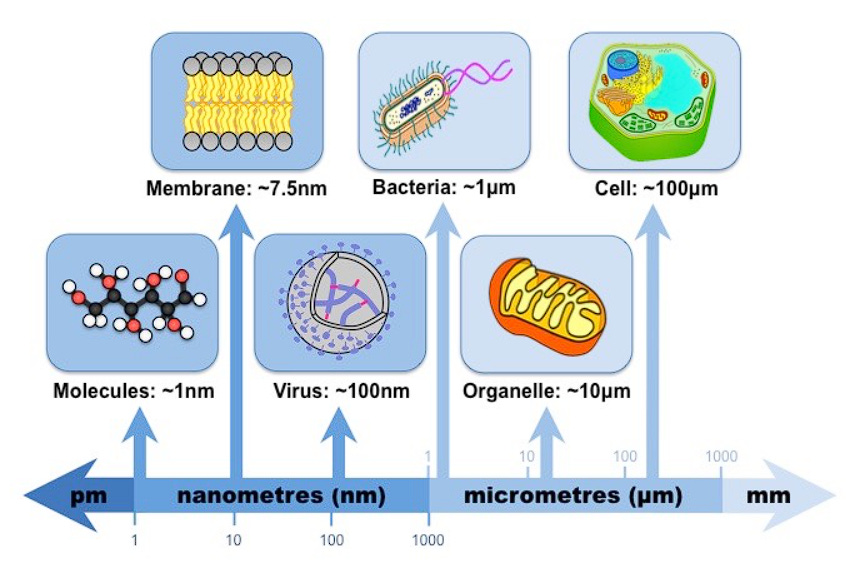
Astrophage is a life form that exists in the extreme environment of stellar surfaces, making it hyperthermophilic, capable of thriving at temperatures that would destroy most life on Earth. Astrophage cells are on the order of 10 micrometers (microns), which places them in the same range as Earth-bound eukaryotic cells, and roughly the same size as human cells. As Grace finds out in Project Hail Mary, Astrophage is extremely similar to Earth-based eukaryotic cells (cells with a nucleus surrounded by a nuclear membrane and specialized organelles), strong enough that panspermia is proposed as an explanation for the origin of life on Earth.
A Life on Earth Aside: Panspermia is the idea that life didn’t start on Earth; it arrived here. Not fully formed organisms, but the raw ingredients or early microbial life, hitching rides on comets, asteroids, or interstellar dust. Space, in this view, isn’t empty. It’s a delivery system. Rocks get blasted off one world by impacts, drift for millions of years, and—if the physics lines up—land somewhere else with their biological cargo still intact. Panspermia doesn’t explain how life begins. It just punts the question elsewhere.
What it does say is that life might spread. It might be resilient enough to survive vacuum, radiation, and time—and if that’s true, then biology isn’t a local accident. It’s something that can leak from world to world.
Like life on Earth, Astrophage appears to be carbon-based, contains water, and has very similar organelles.
While alive, Astrophage cells are effectively opaque across the electromagnetic spectrum and have a super-strong outer coating capable of withstanding the vacuum of space and the stellar corona. Despite its strength, the Astrophage coating can be pierced by something very sharp, such as the nanoneedle Grace used, which unexpectedly killed the cell. When Astrophage dies, they become translucent or clear, revealing their internal structure.
For Astrophage, that line between life and death comes down to one thing: energy.
Astrophage: Diet
Astrophage derives its energy from starlight. Rather than just the visible light that Earth’s plants absorb, Astrophage absorb across the entire electromagnetic spectrum. The preferred habitat of Astrophage is a star’s corona, giving it direct access to the energy being released. It’s the “infection” of the opaque Astrophage in the outer layers of the star, which blocks energy from the sun, causing it to dim. It’s like a mold growing across a clean window - as it grows, more and more light is blocked, and less light can enter.
The “how” of Astrophage eating all the energy produced by a star is the result of a property referred to as “super cross-sectionality.” And it’s poorly understood— that is, it shouldn’t work, but it does. Thanks to this property, nothing — nothing — can pass through Astrophage, not even neutrinos (which normally pass through matter almost without interacting) or subatomic particles that should be able to quantum tunnel through it. Weirdly, Astrophage also blocks wavelengths of light longer than its own size.
Light Interaction Aside: This is the diffraction limit, the reason why light microscopes only work up to a point. If an object is smaller than the wavelength of light, the light diffracts around it, instead of reflecting off of it, making it functionally invisible to that light. At 10 microns, Astrophage are larger than visible wavelengths (Grace can see them with a standard light microscope). Longer-wavelength radiation, such as infrared and radio waves, is also stopped by Astrophage, which is impossible according to physics as we know it. How? Super cross-sectionality. In short, nothing gets through, which is why Astrophage makes excellent heat and radiation shielding, and kind of a problem when they’re dimming your star.
And to make one thing clear: if Astrophage follows biological rules, we can ratchet back some of the hyperbole about what it does. Astrophage isn’t a “star-killer.” It doesn’t extinguish a star; it just turns it down. The Astrophage population in a system will stabilize at whatever level the star can support, given incoming energy, reproduction rate, and losses to predation and other unknowns.
So, like so many biological systems, Astrophage won’t destroy the system. It finds a balance point and holds.
Astrophage: Diet, part 2
What does Astrophage do with the energy it absorbs? Here’s where things get really cool.
Astrophage converts energy into mass. No other form of life we know does this. Not plants, not us, not chemotrophs living near deep-sea vents. This makes them unique. The core idea is simple. Start with the equation that everyone knows from Einstein: E = mc2. That’s what underlies atomic energy, nuclear weapons, and a lot of subatomic physics. But that’s not what Astrophage does. They reverse it.
Just solve that equation for mass. That is, m = E/c2. That’s it.
In theory.
Prior to their discovery in Project Hail Mary, the idea of energy-to-mass conversion was full-on bonkers, both that it could happen at all and that it could happen in something alive.
The “how” of it all going on inside Astrophage goes pretty deep into particle physics. We’ll try to stay shallow…
Astrophage are basically tiny biological batteries—but they don’t store energy the way anything on Earth does. They have a “sweet spot” temperature: about 96.4°C. That’s their critical temperature. At that exact temperature, something wild happens—when two protons (just hydrogen nuclei) slam into each other, their motion can turn into neutrinos, in a way that shouldn’t be possible under known physics. Neutrinos are tiny, almost massless particles that barely interact with anything.
Now here’s the trick: if the Astrophage gets hotter than that, instead of heating up more like normal matter would, it just keeps converting that extra heat into more neutrinos. So the temperature stays locked right around that same point. It’s like a built-in thermostat—but instead of turning off a heater, it converts heat directly into mass.
So even sitting near a star, where temperatures should keep rising, Astrophage just… doesn’t get hotter. It absorbs the energy and packs it away. And it packs a lot.
A single Astrophage cell can store about 1.5 megajoules of energy—an enormous amount of energy for something microscopic. Then, when it needs that energy back, two of those neutrinos collide and turn into light—specifically a very precise kind of infrared light called the Petrova wavelength.
That light does three jobs: it can power the Astrophage’s internal processes, warm it back up if it cools down, and, most importantly, be fired out the back of the cell like exhaust, propelling it forward.
Astrophage’s diet is directly connected to its motion. There are no flagella, cilia, or pseudopods to move them — they’d be useless in space anyway — there’s nothing to push back against. They use rockets. “Toot to scoot,” as Grace put it. Astrophage converts stored energy into light and blasts it out, which pushes them forward. And because the energy density is so high, they can accelerate to ridiculous speeds—up to about 92% the speed of light (2.76 x 10⁸ m/s, or about 617,000,000 miles per hour).
Light Propulsion Aside: Astrophage is essentially a biological version of laser propulsion. Photons don’t have mass, but they carry energy—and that energy carries momentum. Laser propulsion leans on that. Shine a powerful laser at a spacecraft, and the light hitting it delivers a tiny push. It’s small, but continuous, so over time it adds up and accelerates the craft. The problem is that the energy required is enormous and expensive. Astrophage is doing the same thing, with no external fuel cost, just converting its own stored mass into energy. Instead of an external laser, it generates its own light and fires it out in a tight beam. That beam carries momentum away, and the Astrophage gets pushed in the opposite direction. It’s basically a self-contained laser drive: no traditional propellant mass. Just light doing the pushing.
Astrophage is wild because it’s not running on the kind of chemistry life on Earth depends on. No sugars, no ATP, no familiar metabolic pathways. Instead, it’s tapping directly into mass–energy conversion—the kind of physics we usually only see in stars and nuclear reactions.
Life on Earth lives in the shallow end of the energy pool, moving electrons around. Astrophage is down in the deep end, where energy and mass are interchangeable.
Astrophage: Migration
Astrophage has effectively unlimited food coming from a star, a mechanism that allows it to convert all of that energy into mass, as well as a mechanism for keeping its body temperature at a comfortable (for it) 96.415oC. Why would it ever want to go anywhere else?
Two reasons: reproduction and colonization.
The first — that’s the easiest one to understand. Once Astrophage is full of energy (there is an upper limit - about 1.5 megajoules of energy, about 17 nanograms of neutrinos), it’s stuffed, and time to reproduce.
Energy Aside: “mega” = millions, so a single Astrophage cell can hold 1.5 million joules. “Joules” is the unit of energy (it underlies all energy measurements, even the kilowatt hours of electricity that electric companies bill us for), and 1.5 million joules is considerable. For instance, at 1.5 megajoules, a single Astrophage cell is carrying about 360 food calories of energy. That’s a full meal. Not a snack—an actual, sit-down, plate-of-food meal. Or, if you want to talk water, a single Astrophage cell can store enough energy to raise roughly a gallon of water from room temperature to boiling.
That is an absolutely stupid amount of energy for something microscopic to be carrying around.
Okay - so it’s full of energy, and it’s time to reproduce. There’s a catch: while an Astrophage converts energy into mass, it still requires specific elements to replicate through mitosis. Over millions of years, Astrophage has evolved to seek out planets with abundant carbon. Again, an Astrophage may be a space-bound organism, but it’s similar to us and, like us, it’s carbon-based.
Using our solar system as an example, Astrophage migrates to Venus, which has an atmosphere made of 96.5% carbon dioxide and 3.5% nitrogen. Getting there, no problem. But “seeing” Venus? That’s a trick.
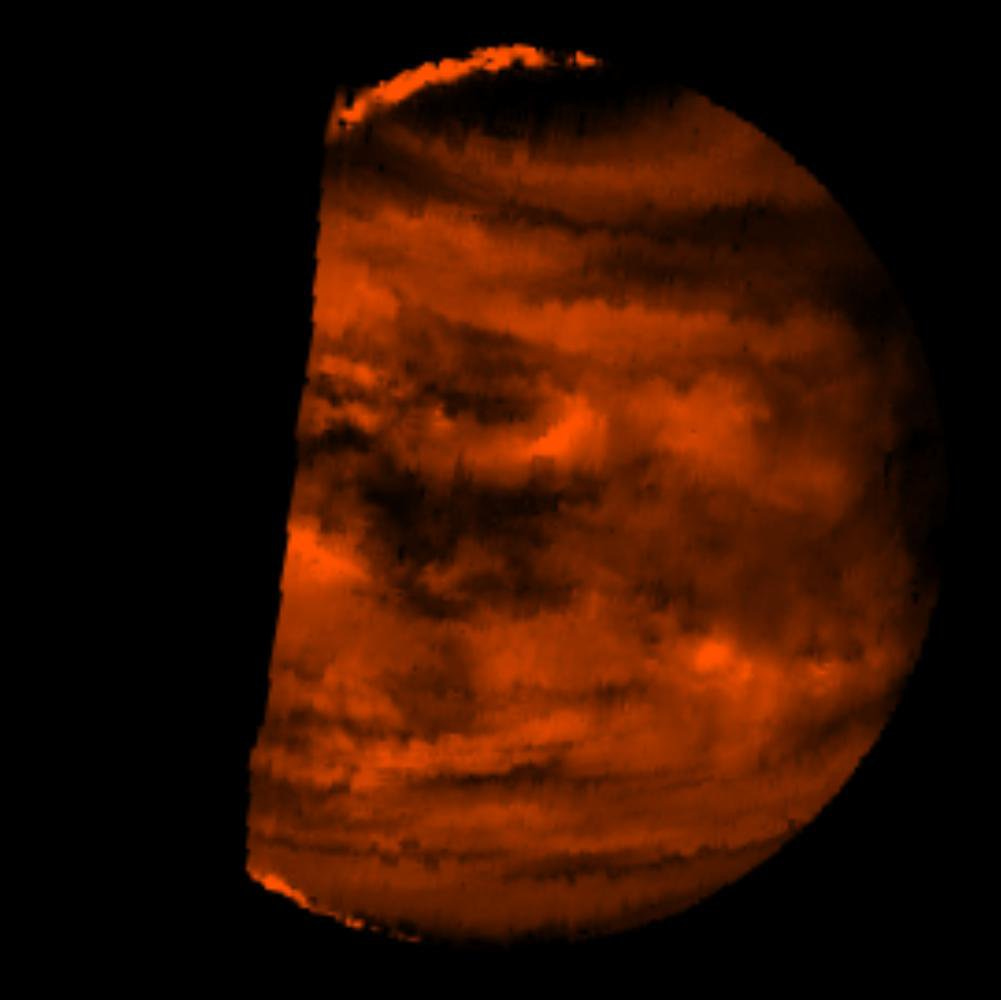
Astrophage doesn’t “see” as we do. No eyes, no images. What they can detect is the spectrum of light, which wavelengths are present and which are missing. When light passes through a planet’s atmosphere, certain gases absorb very specific wavelengths. Carbon dioxide, for example, absorbs particular parts of the infrared spectrum. So what’s left in the light carries a fingerprint.
A CO₂-rich world leaves behind a very distinct pattern—a set of “missing” wavelengths in the light coming off that planet or its star. Astrophage can detect that pattern. It’s like they’re reading the barcode of the atmosphere.
Once spotted, it’s time to go, and boy, do they go. Millions, billions follow the same path to get to the planet, all jetting along at near-light speed, so it’s a short trip. At full burn, Astrophage could cross the distance from the Sun to Venus in about six to seven minutes.
As they propel themselves through space, the Astrophage’s “jets” (toot to scoot) release infrared radiation at a wavelength of exactly 25.984 microns. That’s what was discovered by Dr. Irina Petrova, the Russian scientist who first spotted the infrared “line” connecting the sun and Venus. The Petrova line is the signal of Astrophage infection in a star system.
The quick travel time between the Sun and Venus assumes Astrophage is at top speed the whole way. Realistically, you’d have a short acceleration phase—but given how absurd their acceleration is, it barely changes the answer. And they don’t slow down when they get to their target. They air-brake. Astrophage rely on the planet’s atmosphere to slow them down— they hit the atmosphere. Hard.
Traveling at such high speed and hitting the atmosphere would destroy any human-sized ship, but for the microscopic Astrophage, it’s no big thing. Compressing air in front of them heats it to ridiculous levels, and they just gobble that energy, turning it into mass, replacing the mass converted to energy for their flight to the planet. With atmospheric deceleration, Astrophage stops when the air pressure is 0.02 atmospheres. Once there, it takes in carbon dioxide to produce biomass for the daughter cells and undergoes mitosis, splitting into two cells.
Astrophage: Migration, 2
Astrophage’s other large-scale movement comes from cells presumably forming spores and traveling to other, uninfected stars. The limit of this travel seems to be about eight light-years, the distance between nearby stars. The reason for this behavior is unknown, but, like Astrophage itself, most likely just biology doing biology.
When conditions are good, life grows. When things get crowded or uncertain, it spreads. On Earth, that looks like spores, seeds, bacteria drifting on air currents—millions launched, most failing, a few landing somewhere that works. That’s bet-hedging. You don’t need all of them to survive. You just need enough.
Astrophage follows the same strategy, just scaled up. A star is a finite resource. Upon finding a star, the population of Astrophage grows exponentially and reaches some carrying capacity. This would— if biology is universal— trigger some fraction of the population to break off, launch itself into space, looking for the next star. Not randomly—they follow light signatures, the spectral “fingerprints” that tell them where conditions might work. It’s not an invasion or even action undertaken with an intention. It’s reproduction, dispersal, and gradient-following, the same playbook life uses here, just written across stars instead of soil.
Astrophage: Ecology
That spread we just talked about? Astrophage isn’t evil. It just is biology doing biology. Life being all life-y. Its home system, the place where it evolved, is Tau Ceti, where Grace and Rocky discover each other. In that system, Astrophage feeds off of energy from Tau Ceti and reproduces on Tau Ceti E (“Adrian”). But what Grace and Rocky discover is that Adrian is home to a rich biosphere, including Astrophage’s natural predator — the Taumoeba.
Star Course Aside: If Astrophage is the problem, then Tau Ceti looked like the place where Astrophage was either behaving differently or being actively reduced. The Petrova line is the fingerprint of Astrophage metabolism, and Tau Ceti’s strong signal meant that its metabolism is being pushed hard or disrupted. That’s exactly where you look for a solution. The Hail Mary wasn’t sent to Tau Ceti because it was close, interesting, or habitable. It was sent there because, in a sky full of stars being drained, Tau Ceti looked like it might be fighting back.
On Adrian, the Taumoeba keeps the Astrophage population in check by eating it. The presence of a predator is the strongest signal that the system is Astrophage’s home - predators don’t show up before prey. Taumoeba don’t show up unless there’s a long-standing, stable food source to evolve with. Predators are a response to the presence of prey.
Find a creature that specifically hunts Astrophage? Two things are almost certainly true:
First, Astrophage have been present there for a long time—long enough for natural selection to shape something that can find them, catch them, and survive off them. Second, the environment consistently supports that interaction. Not a one-off arrival. A system.
Mirror it to Earth.
Specialized predators don’t show up for something that washed up on the island last week. They show up where the prey has been long enough and abundant enough to matter. That kind of specialization takes time. Taumoeba tells you Astrophage weren’t just passing through the Tau Ceti system. They were native, persistent, and abundant enough for evolution to build around them.
And that’s the real point: Taumoeba isn’t the headline, Astrophage is. From an evolutionary perspective, Astrophage isn’t just an organism. It’s a massive, reliable energy source. And life does not ignore energy like that.
So in the Tau Ceti system, Astrophage is pretty benign. The system, including Astrophage on the star, is stable. Astrophage doesn’t grow unchecked, dimming the star and upsetting the energy balance on Adrian and other planets of the system where life probably exists.
Seen through this lens, Astrophage is an invasive species. A really good one at that. And in Earth’s system as well as Erid’s, Astrophage found an environment with no natural predator, and its population increased at a predictable exponential rate.
Earth version? Think wolves and deer. When deer have plenty of food and no predators, their population explodes. They overgraze, strip the environment, and start to crash under their own success. Introduce wolves, and everything changes.

The wolves don’t wipe out the deer. They keep them in check. The deer population drops to a sustainable level, vegetation recovers, and the whole system stabilizes. Predator and prey rise and fall together, but neither takes over completely. That’s the Astrophage–Taumoeba relationship.
Without the predator, the system gets overwhelmed. With it, the system finds a steady state.
Same biology. Just scaled from forests… to stars.
Informative and entertaining, and exactly the way to draw students into the subject matter! I took a class in environmental science that riveted my attention, along with journalism, and I ended up with a B.S. in Journalism and minors in English and Political Science. Kind of unusual, but the newspaper in eastern Oregon needed a science reporter to cover nuclear power, farming, rivers, port districts, and small towns. Eventually when I pivoted to teaching with an M.S. in Education C&I. So of course I became a high school journalism and photography teacher. (My dad was a teacher.) And eventually English, the way you describe teaching. It makes all the difference.