
The Flash Isn’t Fast—He’s Surviving Physics
What the Artemis II reentry reveals about super speed, plasma, and why the Flash needs the Speed Force
We just watched the atmosphere catch fire.
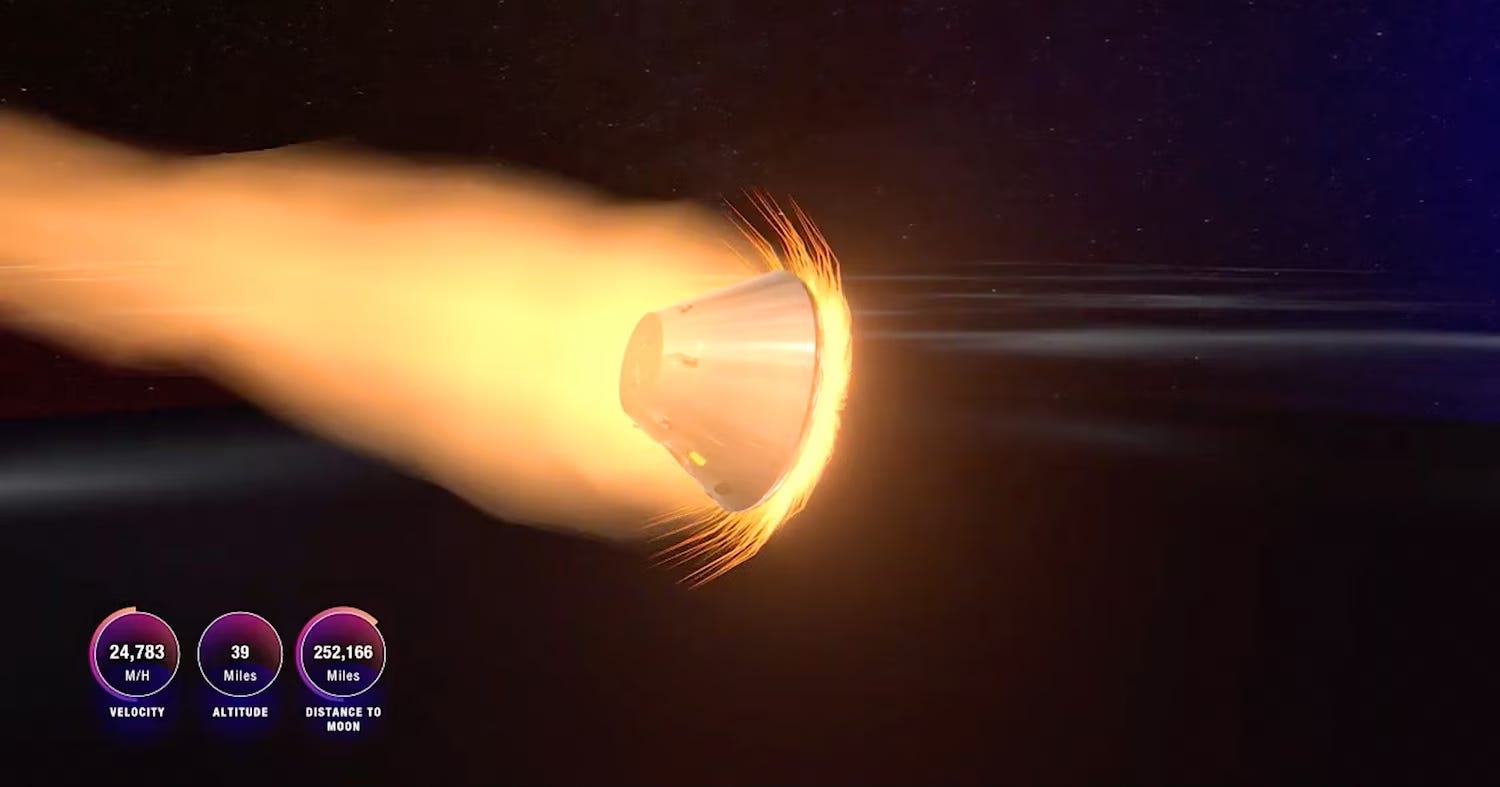
When the Artemis II came home, it didn’t look like engineering— it looked like the sky was trying to burn the spacecraft right out of existence.
The Orion capsule hit the upper atmosphere and was quickly wrapped in a glowing sheath — the video from inside, looking out, was terrifying. It was orange and white, and flickering like it was alive. When my physics students see that kind of thing, they go right to friction. Friction opposes forward motion and produces heat. What we saw must have been due to friction.
That’s a good “gut” answer, but it’s not a good “head” answer. It feels right, but it doesn’t quite feel right when physics enters the chat.
The capsule wasn’t burning — the air was breaking.
The Orion was moving through the upper atmosphere at about 11 km per second (close to 25,000 mph). That’s so fast that air can’t act like a fluid and flow around it. The capsule was smashing through the air, colliding hard with air molecules (nitrogen, oxygen, a few trace gases). They don’t have time to get out of the way.
The air couldn’t flow, so it compressed. It got squeezed so that the same amount of air occupied less volume.
Air molecules typically move at a few hundred meters per second (around 340 m/s at room temperature). Take them, and push them into a smaller space; they’ll move faster and hit each other more often. At the atomic level, the speed of a particle is directly related to how much heat energy it has, so squeeze a gas, you get a hot gas. That’s partly why a hand pump heats up when you’re pumping up a bike tire — you’re compressing gas over and over again.
But the air in front of the Orion capsule was way hotter than a bike pump. It was heading toward 5000 degrees C, about half the surface temperature of the sun. At that temperature, particles stop being nice and start getting real. The temperature is so high that oxygen and nitrogen, normally in the air as molecules (O₂ and N₂), break apart into individual atoms.
And things keep heating up. Particles keep hitting each other. The hits get so powerful that they knock electrons off their atoms. Now, instead of a mix of atomic gases, you’ve got electrons along with positive ions (charged particles that have lost electrons). Get enough ions into the mix, and you no longer have gas — you’ve got plasma. That’s a cool name for a soup of electrons and charged particles. And it’s really, really hot.
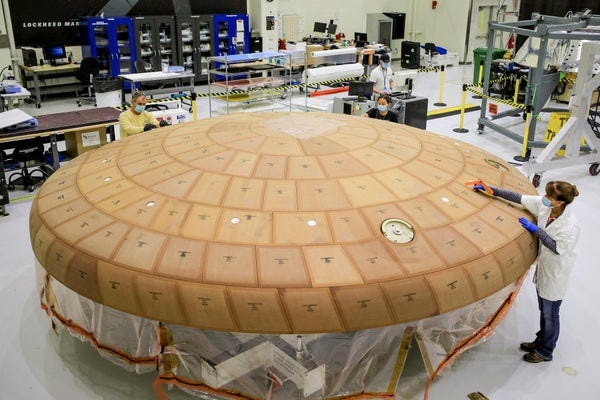
It’s also what was glowing. Electrons will grab onto positive ions, get excited, then fall back down to their normal energy levels, and everyone will be smacking into each other. All of that creates visible light. The light of atoms being torn apart and partially rebuilding themselves, and getting torn apart again.
Quick sidebar: The communication blackout during reentry? Thank the plasma. Radio waves are blocked because the free electrons in the plasma can move fast enough to absorb and re-radiate them, preventing them from traveling through. The plasma around Orion doesn’t block all radiation—it blocks the kind we use to communicate. The capsule doesn’t disappear. It just becomes unreachable.
Everything you just read is real — we just watched it happen. The atmosphere turned into plasma because something moved fast enough that the air couldn’t behave like air anymore.
Now imagine realizing that applies to you.
The Fastest Man Alive
That’s exactly what Ryan North does in his take on The Flash.
He lets the Flash (Wally West) reflect on his own powers—not like a superhero, but like a smart guy who’s studied up and gleefully points out where things don’t add up. And how that requires a hall pass from the laws of physics.
Let’s see how Wally explains it. The following sequence is from The Flash #31, written by North, with art by Gavin Guidry and Adriano Lucas.
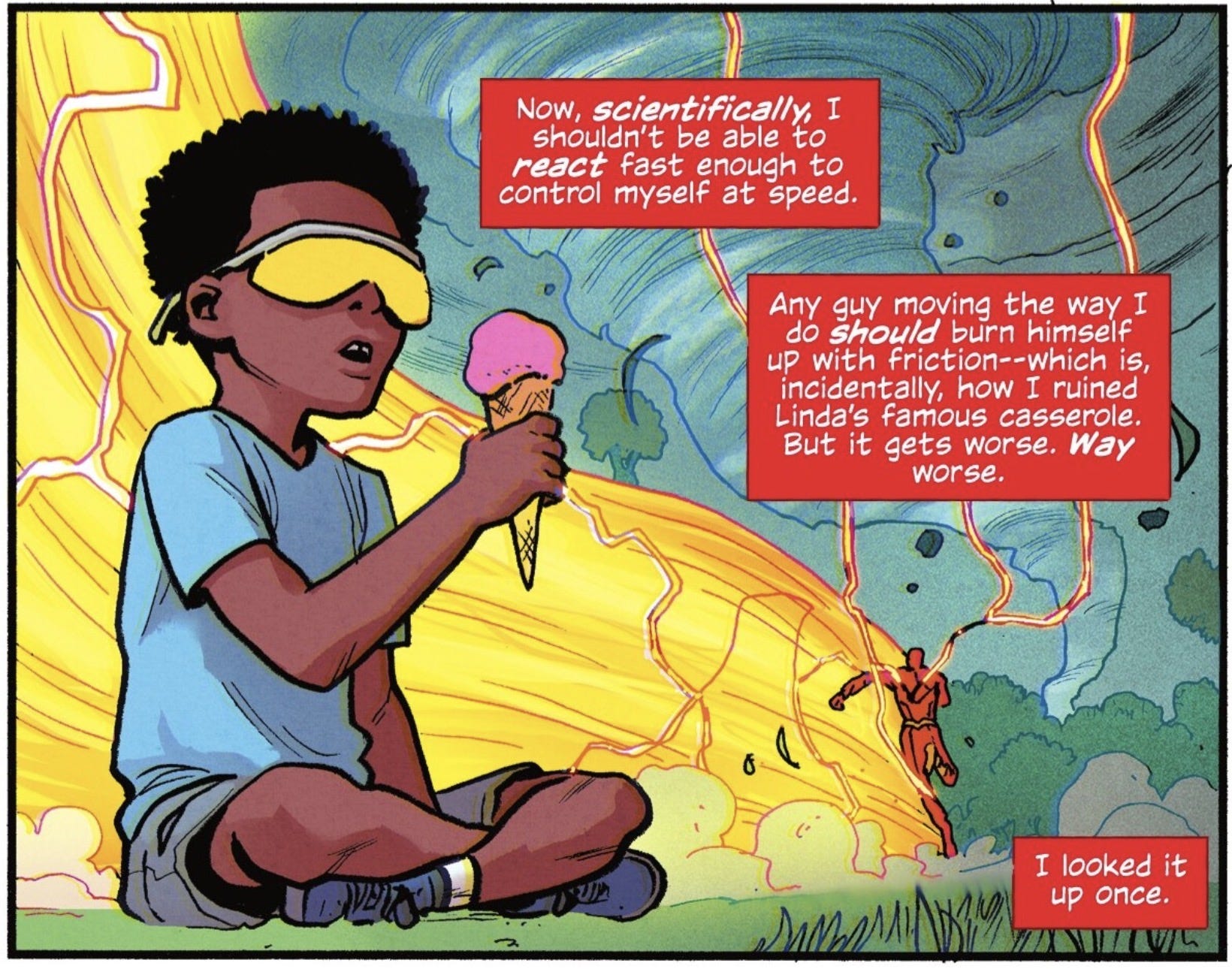
Reaction time? He’s 100% right. Human reaction time is about 0.2-0.25 seconds. That’s the time it takes the brain to register sensory input (sight, hearing, touch, and taste) and trigger a motor response. Hearing and touch are a little quicker, but at the speed Wally’s running at, it doesn’t matter. By the time his brain registered that something was in his way, he would already have crashed into it. So there’s that.
Wally’s call on friction? Perfectly understandable. My students would’ve said that—but think back to the Orion capsule. Wally’s moving faster. Maybe not light speed, but a percentage of it, which is still stupid fast. Like the capsule, Wally’s not rubbing his way through the air (which is what would cause friction), rather he’s slamming into the air—the individual molecules and atoms. The air in front of Wally? Just like the air in front of the Orion, gets compressed and the temperature spikes, molecules fall apart, electrons are knocked free from atoms, and you get plasma.
Friction occurs at normal speeds and under normal conditions. The Orion capsule? The Flash? Not normal. But I love what Wally is thinking — he’s like a student who’s just realized something is wrong… but hasn’t yet followed the physics all the way down.
Short sidebar: There might be some friction as Wally initially accelerates from a standstill, but given the final speed he reaches, the time when friction is the major issue is vanishingly small.
Let’s continue on:
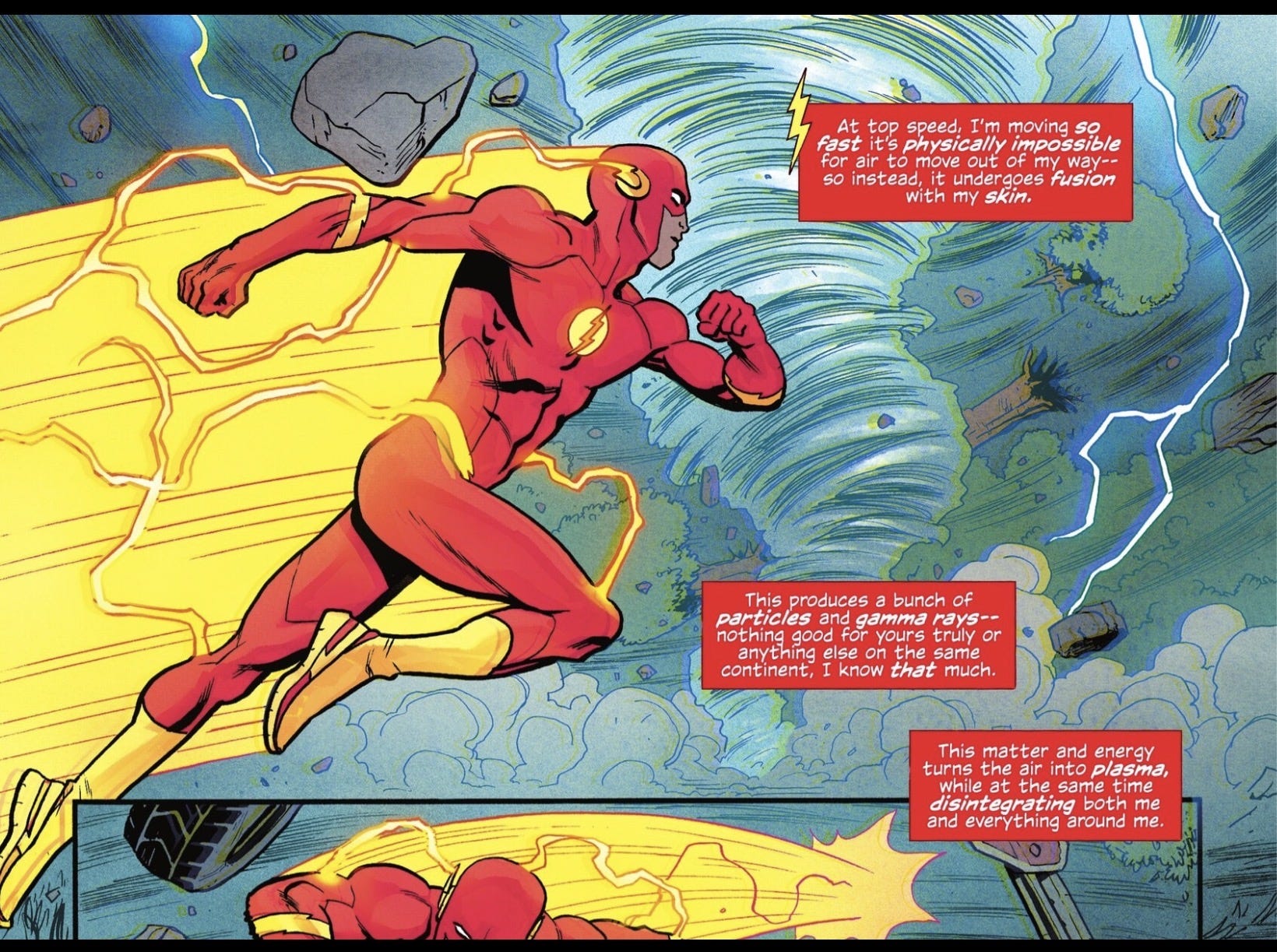
Alright — here we go. Now Wally brings the physics in and separates himself from the Orion. We (normies) can move fast enough that air acts like a fluid and flows around us. The Orion on reentry was moving so fast that it was compressing the air in front of it, causing it to heat up. The Flash? He’s moving so fast that the air can’t get out of the way, and before it can compress, he’s hitting it. Physically smacking into the molecules. That’s not good, as Wally explains above.
The plasma from Orion? That’s at lower speeds, not Flash speeds.
Now, the air particles cannot get out of the way, and compression occurs even more violently. We’re now in conditions where collisions become extreme enough to even consider fusion. In the Flash’s case, it’s atomic nuclei—positively charged because of the protons in the nucleus—getting close enough to stick together. And they really don’t want to do that. You need absurd energy for that to happen. It happens in the Sun. That level of absurd.
At Flash speeds? Maybe. In the most extreme collisions, some tiny fraction of nuclei might actually fuse. And if they do, you’d get exactly what he describes—high-energy particles, gamma rays, radiation you definitely don’t want to be anywhere near.
But again, let’s back away from the scary fusion for a moment. In our world, at Flash speeds, there would already be radiation present.
Radiation isn’t some special nuclear thing. It’s just energy moving as waves. Light is radiation. X-rays are radiation. Gamma rays are radiation. Same family, different energy levels.
So the real question isn’t “is there fusion?” It’s: are there charged particles getting thrown around? The moment the answer is yes, you’re going to get radiation. And the second the air turns into plasma—which we already walked through—you’ve got exactly that situation.
You’ve got free electrons, positive ions, and everything colliding, changing direction, speeding up, and slowing down. It’s chaos at the particle level. And charged particles that accelerate give off radiation.
Not “sometimes.” Not “if conditions are right” — always.
Electrons get knocked loose → radiation.
Electrons slam into ions → radiation.
Electrons get captured again and drop to a lower energy state → radiation.
And to answer your radiation question, yes—in our world, this is dangerous. Not in a vague way, but in a very specific, physics-has-names-for-this way. You’d be producing X-rays from electrons slamming to a stop (bremsstrahlung), visible and ultraviolet light from electrons dropping back into atoms, and at higher energies, even gamma rays. In other words: not just heat, but radiation that can ionize, damage, and destroy matter—including you. Bad bad bad.
So by the time the Flash is even thinking about fusion—nuclei sticking together, which is actually very hard to do—the situation is already out of control. The air is plasma, the particles are colliding, and radiation is already pouring out of the system.
Fusion isn’t step one.
Fusion is what you get if you somehow make an already catastrophic situation even worse, which is kind of the running theme here. You don’t need nuclear reactions to make this deadly.
You just need to take ordinary matter, hit it hard enough, and let physics take over. Things get bad very quickly.
Mr. Fusion
So let’s go with Flash’s claim that fusion is—or should be—starting to happen. Thankfully, it’s not in the DC Universe (because the DC Universe has magic. More on that in a second). That’s very cool from the physics side of things, but very, very bad from the “continuing to live” side of things.
Fusion is what happens when atomic nuclei—the dense, positively charged centers of atoms—are forced close enough together that they stick and form a new nucleus. The problem is that those nuclei repel each other. Strongly. So getting fusion requires collisions energetic enough to overcome that repulsion and push them into contact long enough for the strong nuclear force to take over. That’s why fusion is hard in stars and even harder in labs. You don’t get it just because things are hot—you get it because things are absurdly energetic.
If we’re willing to say the Flash is moving fast enough to reach that regime, then what’s happening at the leading edge of his motion isn’t just plasma anymore. It’s a region where bare nuclei—nitrogen and oxygen nuclei from the air—are colliding at energies high enough that, occasionally, a pair doesn’t bounce apart. They fuse.
And when they do, something important happens.
The new nucleus that forms has slightly less mass than the two nuclei you started with. That “missing” mass hasn’t vanished—it’s been converted into energy. This is the part you’ve heard before, but it matters here in a very literal way:
E=mc2
Yep = the energy contained in matter is equal to the matter’s mass multiplied by the speed of light (3.0 x 10⁸ meters per second), squared.
Because the speed of light (“c”) squared is such a huge number, even a tiny loss of mass turns into a large release of energy. Not in a vague, hand-wavy sense—very specifically, and very violently. Collision by collision. And there can be many collisions.
That energy doesn’t come out as a gentle warming of the air. It comes out as high-energy radiation and fast-moving particles. Gamma rays. Subatomic fragments. Nuclei and protons kicked away at high speed. In other words, every fusion event is a tiny burst of energy that doesn’t stay put—it punches outward into whatever is nearby.
And that’s where this stops being a single reaction and becomes a problem.
Because those particles and that radiation don’t just leave the system. They interact with it. They slam into the surrounding plasma, dumping more energy into it, driving more collisions, raising temperatures, and increasing the likelihood that more nuclei will collide with enough energy to fuse. You don’t get one neat fusion event at the front of the Flash. You get a cascade—small, sporadic nuclear reactions feeding energy back into an already violent environment.
So if you take the comic seriously on this point, what the Flash should be carrying with him isn’t just heat, or even just plasma. It’s a moving region where nuclear reactions occasionally occur, where energy is released as radiation and particle showers, and where that energy continuously feeds back into the system.
At that point, the situation isn’t about “running fast” anymore. It’s about driving the atmosphere into a regime where the nuclei themselves start to stick, and every time they do, they release energy in the worst possible way—outward, into everything around them, including him.
Fusion doesn’t replace the plasma problem.
It sits on top of it—and makes it violently worse.
And the Flash actually explains that pretty well, too.
The End of the Flash?
The Flash finishes his reflection on his powers in the worst possible way.
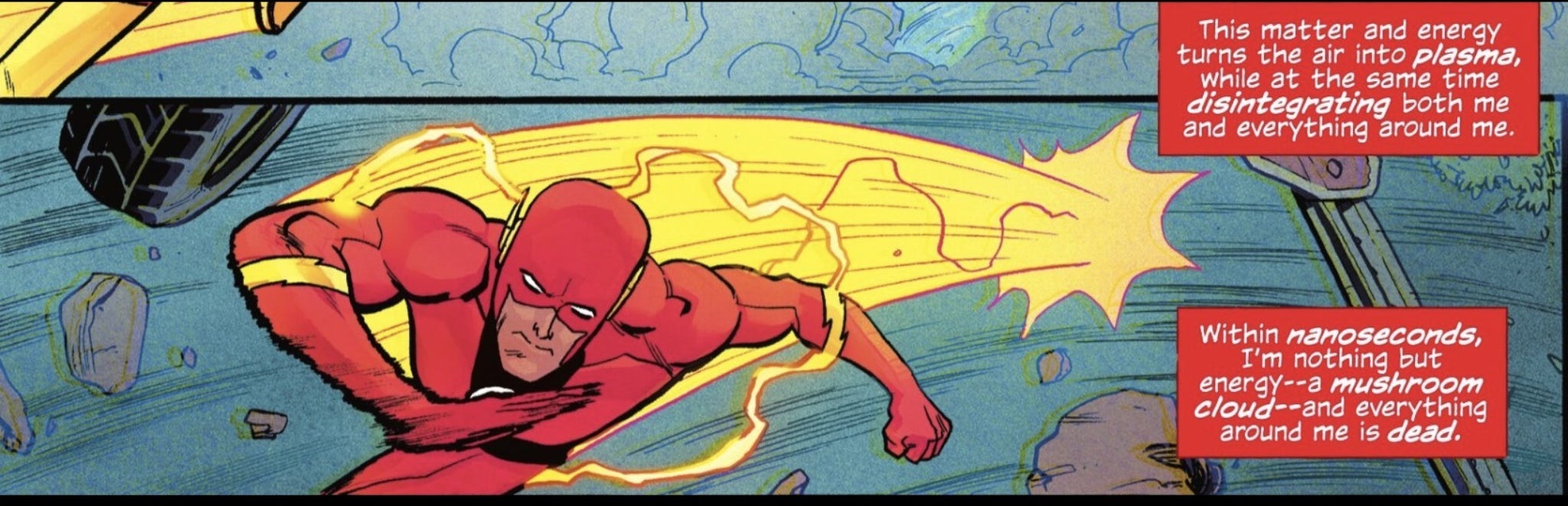
If all of that is happening—if the air has gone from gas to plasma, if collisions are dumping energy into the system faster than it can dissipate, and if even a fraction of those collisions are crossing into fusion—then there isn’t really a “runner” anymore.
There’s just energy being released along a path.
Wally’s line about nanoseconds matters. At these speeds, everything we’ve been talking about—compression, ionization, radiation, even the possibility of fusion—is happening incredibly fast. Not over seconds. Not even over milliseconds. Over billionths of a second. There’s no time for the system to stabilize. No time for heat to spread out. No time for anything to behave gently.
Energy gets dumped into the air all at once. When you release a large amount of energy into a small region in a very short time, physics has a name for that.
Explosion.
Not metaphorically. Not “like an explosion.”
An explosion.
The “mushroom cloud” line isn’t comic book exaggeration—it’s a rough description of what happens when hot, energized material expands outward rapidly and drives a shockwave through the air. That’s exactly what you’d expect if you took everything we’ve just walked through and let it run to completion.
So the panel lands the conclusion, even if it takes a slightly messy path to get there:
At those speeds, you don’t stay a person moving through the atmosphere. You become a moving release of energy.
That’s the point where the character stops being about speed and starts being about survival. Because if this is the physics—and it is, just pushed to an extreme—then there are only two options: either the Flash doesn’t exist,
or the rules do not apply to him.
In the comics, that answer has a name: the Speed Force. It’s not a boost or an upgrade. It’s a workaround.
Created by Mark Waid in The Flash (vol 2) #91 in 1994, the Speed Force is just that—a little wink, a nod, and an awe-inspiring sense of the DC Universe’s unknown, and possibly unknowable cosmos. Waid — no physics slouch—knew what he was doing when he created it. It’s not just a “magic” get-out-of-jail-free card—it was created as something more, and became even more than that.
The Speed Force is a way to run without turning the air into plasma, without dumping his kinetic energy into the world, without becoming the explosion that physics insists he should be. Without it, the Flash doesn’t outrun anything.
Given the quasi-spiritual nature of the Speed Force, a member of the “Flash Family” in the DC Universe that somehow rejects the protection it grants and can still run at “Flash” speeds has just signed their death warrant—and that for thousands of people around them when they take their final run.
Thankfully, Wally isn’t down with that.
Of Spacecraft and Superheroes
We just watched a spacecraft survive this.
That’s the part that’s easy to miss.
When Artemis II’s Orion capsule came back to Earth, it didn’t glide through the atmosphere. It didn’t slip past the air. It slammed into it, turned it into plasma, and then survived by managing the energy involved as carefully as humanly possible. Heat shields. Ablation. Angles of entry are calculated to within a degree or less. Everything about that moment was engineered around one idea:
Don’t let the physics win all at once.
And even then, it’s not comfortable. It’s not gentle. It’s a controlled argument with the atmosphere that the spacecraft only barely wins. Now take that same process and scale it up.
Faster speeds. More energy. Less time for anything to spread out or dissipate. Strip away the heat shield. Strip away the careful entry profile. Replace it with a person taking a step.
That’s the Flash.
Not the lightning. Not the blur. Not the cool pose mid-stride.
The physics. The part where the air stops behaving like air, where matter starts coming apart, where energy stops being something you carry and starts being something you release. The realization—quietly sitting inside those panels—is that this isn’t a problem you solve by trying harder.
You don’t train your way past it. You don’t build better muscles or faster reflexes.
You don’t win.
Unless you change the rules.
So the story does exactly that. It gives him something the Orion capsule doesn’t have and never could: not better engineering, but an escape hatch. A way to run without triggering everything we just walked through.
A way to move without turning the atmosphere into plasma, without dumping his kinetic energy into the world, without becoming the explosion physics insists he should be.
It gives him the Speed Force.
Not a cheat, a requirement. Because the universe already lets things move that fast. We see it in particle accelerators, in cosmic rays, in the jets of distant black holes.
It just never lets anything survive it.
Orion survives by respecting that boundary.
The Flash survives by stepping outside it.
And if you watch that reentry footage again—the glow, the plasma, the silence—you can almost see the moment where the real world stops…
…and the Speed Force would have to take over.
Final sidenote: for another version of this, that both The Flash and this article give a relativistic hat tip to, check out the GOAT, Randal Munro’s explanation of what would happen if a baseball were pitched at near light speed. Spoilers - same as here. Nothing good.