
Hulk Smash Science #1: The Day Before the Dinosaurs Died
Dinosaurs, deep time, and the worst possible moment in Earth’s history to send the Hulk.
TSO (The Science Of) explores the real science behind the stories we love—from comics and movies to science fiction.
In Hulk Smash Everything #1, the Leader comes up with a simple solution to his Hulk problem: remove him from the present entirely. Instead of fighting Hulk directly, he throws him backward through time—far enough that the Hulk simply can’t get back.
Where does he land?
About 66 million years ago, at the very end of the Cretaceous Period.
The Hulk has always had strong ties to science—and because of that, he’s long had an outsized pull on scientists and (ahem) science teachers. This series, Hulk Smash Science, takes a closer look at the real science behind those stories.
Let’s go!
The Worst Place the Leader Could Send the Hulk(*)
In Hulk Smash Everything #1, the Leader comes up with a simple solution to his Hulk problem: remove him from the present entirely. Instead of fighting Hulk directly, he throws him backward through time—far enough that the Hulk simply can’t get back.
Where does he land?
About 66 million years ago, at the very end of the Cretaceous Period.
Geologists call this moment the Maastrichtian, the final stage of a world dominated by dinosaurs for more than 160 million years.
It’s a good choice on the surface. The Leader didn’t just send Hulk somewhere vaguely in the distant past, like a villain with access to a time machine but no clear grasp of history. Nope—the Leader dropped Hulk into one of the most dangerous moments in Earth’s history: the last quiet minutes before the asteroid arrives.
Before we get to that asteroid, though, we need to understand just how much history has already happened before Hulk arrives.
To do that, we need to talk about deep time.
The History Beneath Hulk’s Feet
Scientists use the phrase deep time to describe the enormous span of Earth’s history. Human history covers thousands of years. Recorded civilization spans perhaps ten thousand.
Earth’s story unfolds across billions. The planet formed about 4.54 billion years ago, when dust and rock in the early solar system collided and merged to form the young Earth.
Not long after the planet cooled enough for oceans to exist, life appeared. The earliest evidence dates to roughly 4.28 billion years ago, when microscopic organisms were already thriving in ancient seas. It took about 628 million years for life to appear on the newly formed Earth. Through the lens of deep time, that’s practically an eyeblink.
For most of Earth’s history, life was microscopic. Tiny organisms dominated the planet for billions of years, gradually reshaping the chemistry of the oceans and atmosphere.
One of the most important transformations happened around 2.4 billion years ago, when photosynthetic microbes began releasing large amounts of oxygen into the atmosphere. This event—known as the Great Oxidation Event—fundamentally changed Earth’s environment and helped make more complex life possible.
Much later, around 540 million years ago, animals with shells, skeletons, and complex body plans began appearing in the fossil record during the Cambrian Explosion. From that point forward, ecosystems became increasingly complex.
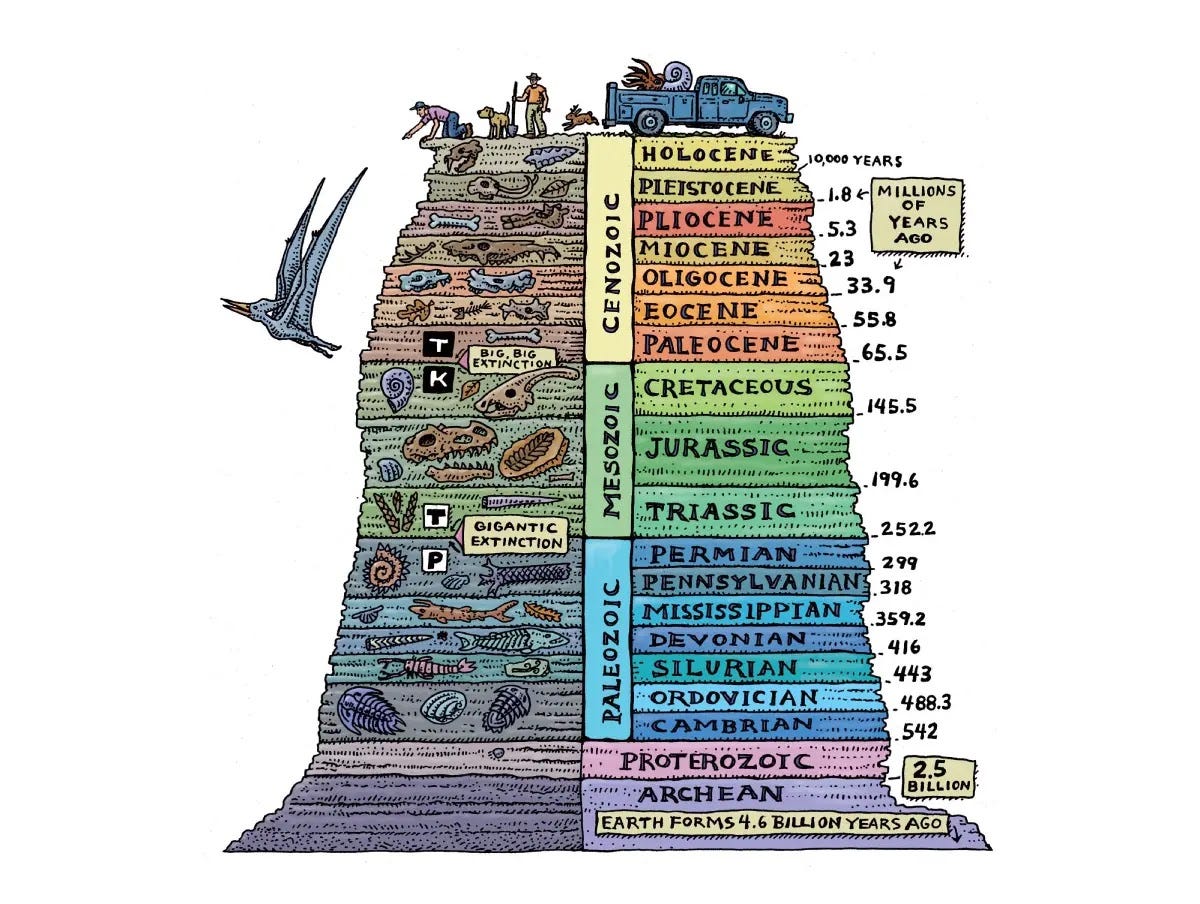
Over the hundreds of millions of years that followed, continents drifted, oceans opened and closed, and ecosystems rose and vanished again and again.
By the time the Hulk arrives 66 million years ago, Earth has already hosted life for more than 4 billion years.
The ground beneath his feet contains the remains of countless earlier worlds. Layer upon layer of ancient rock preserves organisms that lived hundreds of millions of years ago. Fossils from long-vanished oceans, forests, and coastlines lie buried deep beneath the surface.
Even the oil and natural gas deposits we rely on today began forming long before Hulk arrived. Petroleum originates when enormous quantities of microscopic marine organisms sink to the seafloor and become buried under sediments. Over tens of millions of years, heat and pressure transform that buried organic material into hydrocarbons (which will return for a cameo next time).
Beneath Hulk’s feet lies a stack of ancient worlds—oceans, forests, and reefs that lived and died hundreds of millions of years before dinosaurs ever appeared. So when Hulk lands in the Late Cretaceous, he isn’t stepping into the beginning of Earth’s story.
He’s arriving very late in it.
And the world he sees is only one more chapter in a very long history.
North America, 66 Million Years Ago
The next surprise Hulk would notice is that the continent doesn’t look the way it does today.
The asteroid that will soon strike Earth will hit near the modern Yucatán Peninsula, at the location now known as the Chicxulub crater. Today, that region is covered by dry tropical forest.
But 66 million years ago, it looked more like coastal Florida or the Bahamas.
Sea levels were much higher than today, and the Yucatán region sat on a warm, shallow marine platform filled with lagoons, reefs, and low limestone islands.
Most evidence suggests the asteroid struck shallow ocean water, roughly 100–300 meters deep. So Hulk probably wouldn’t be standing in dense inland jungle near the impact site. Instead, he’d likely be somewhere along a tropical shoreline, surrounded by coastal wetlands and warm, shallow seas.
In fact, issue #1 seems to place Hulk in almost exactly the right environment. The panels show him fighting small raptor-like dinosaurs along a tropical coastline dotted with palm-like trees and low rocky outcrops. That setting lines up well with what scientists think the Yucatán region looked like at the end of the Cretaceous—a warm coastal landscape along the edge of a shallow sea.
Zoom out further, and we see Hulk fighting on a peninsula-like stretch of land jutting into the ocean—something that closely resembles reconstructions of the ancient carbonate platforms that once formed much of the Yucatán region.
If that interpretation is right, Hulk wasn’t placed randomly in the dinosaur world.
He’s standing very close to one of the worst possible places on Earth to be 66 million years ago.
But the continent’s most important geographic feature at this time lay farther north. Instead of a single continent, Hulk would be looking at a North America split nearly in half by a warm inland ocean.
For tens of millions of years, a vast inland sea called the Western Interior Seaway stretched from the Gulf of Mexico to the Arctic Ocean, covering areas that are now Kansas, Nebraska, South Dakota, and eastern Colorado.
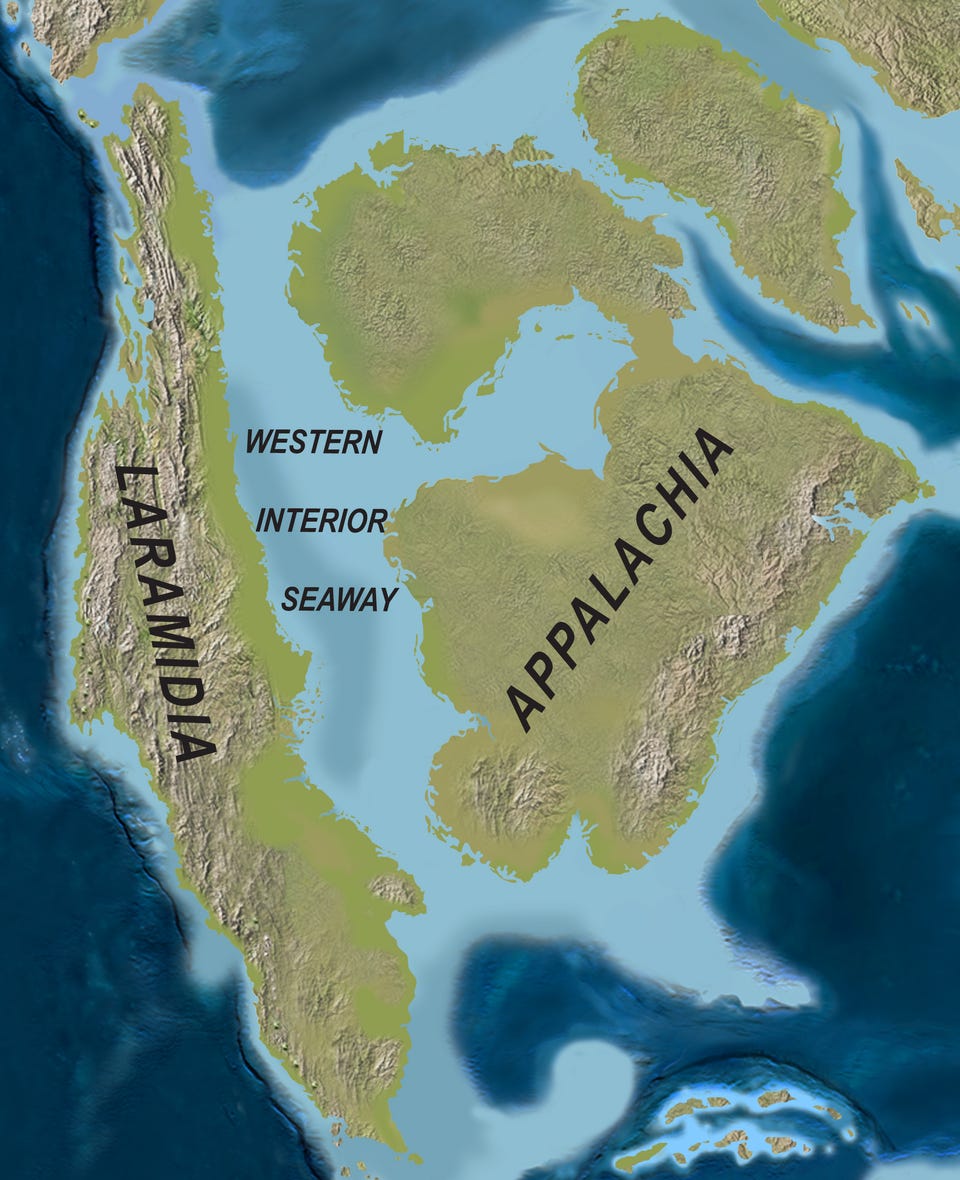
By the time Hulk arrives, the sea is retreating—but its influence (and its salt, which we still mine today) is everywhere. The continent remains divided into two regions:
To the west lies Laramidia, a narrow strip of land squeezed between the rising Rocky Mountains and the inland sea.
To the east lies Appalachia, a much older landscape built around the worn-down Appalachian Mountains.
Laramidia is where most of the famous dinosaur fossils are found today.
The environment there would feel surprisingly familiar to modern Americans. Imagine a prehistoric version of the Mississippi River basin or the Gulf Coast wetlands—broad river valleys, seasonal flooding, dense vegetation, and enormous floodplains stretching for hundreds of miles.
These landscapes supported vast herds of plant-eating animals.
And where there are herds of herbivores, there are predators.
The Dinosaurs of This Ecosystem
By the end of the Cretaceous, dinosaur ecosystems were highly developed and diverse.
Large herbivores dominated the floodplains. Among the most common were duck-billed dinosaurs like Edmontosaurus, animals up to 12 meters long that grazed on vegetation using hundreds of tightly packed grinding teeth known as dental batteries.
Nearby moved horned dinosaurs like Triceratops, massive animals roughly the size of elephants but equipped with three horns and enormous bony frills protecting their necks.
At the top of this ecosystem stood Tyrannosaurus rex.
At roughly 12 meters long and weighing several tons, T. rex was one of the largest land predators that ever lived. Biomechanical studies suggest its bite force exceeded 30,000 newtons (about 3-4 times the weight of a typical car), powerful enough not only to slice flesh but also to crush bone.
Sharing the environment were smaller, feathered predators such as Dakotaraptor, agile hunters armed with curved sickle claws on their feet. Overhead flew birds—small feathered descendants of earlier dinosaur groups, because birds didn’t replace dinosaurs.
Birds are dinosaurs.
By the time Hulk arrives, these ecosystems have been stable for millions of years.
Nothing about the world suggests it’s about to change.
The Hulk’s Sparring Partners
One of the fun surprises in Hulk Smash Everything #1 is that the dinosaurs Hulk encounters are actually pretty grounded in real Late Cretaceous biology. Ryan North and artist Vincenzo Carratu clearly did their homework.
Let’s play who’s who.
For help, we brought in a specialist: paleontologist Jimmy Waldron from Dinosaurs Will Always Be Awesome.
So let’s ID some dinos.
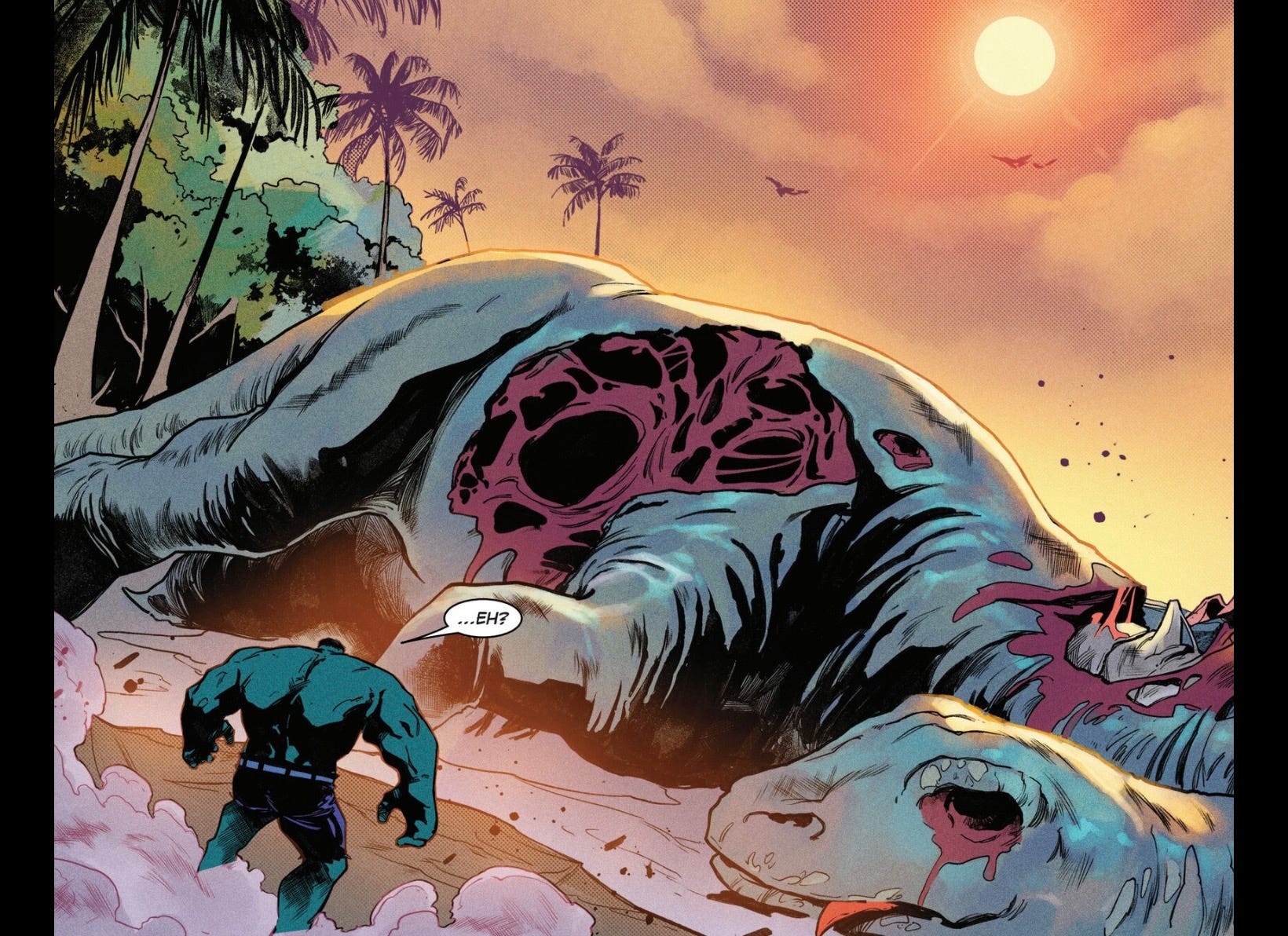
Hulk completes his time jump next to the carcass of a much larger dinosaur that’s already had its tastier bits eaten by smaller predators. From the image, it looks like a classic long-necked sauropod—the kind of enormous plant-eating dinosaur made famous by Apatosaurus and Brontosaurus. But there’s a catch.
“There was a period of time in the early days of the Late Cretaceous that we call the Sauropod Hiatus,” Waldron explains. “It was a time when we simply don’t find very many sauropod bones in North American rocks. We don’t really know why yet, and it’s very strange.”
Brontosaurus and Apatosaurus lived earlier in the Jurassic, but sauropods as a group persisted into the Late Cretaceous as titanosaurs. The panel leans into the visual shorthand of a gigantic long-necked herbivore to show just how immense the animals of this world could be.
“The only real sauropod known from Late Cretaceous North America is Alamosaurus,” Waldron says. “An absolute unit of a titanosaur, living between Utah, New Mexico, Texas, and northern Mexico.”
Given that the range of Alamosaurus may have been larger than what we’ve discovered so far—and considering its size—the half-eaten dinosaur Hulk encounters could plausibly be an Alamosaurus.
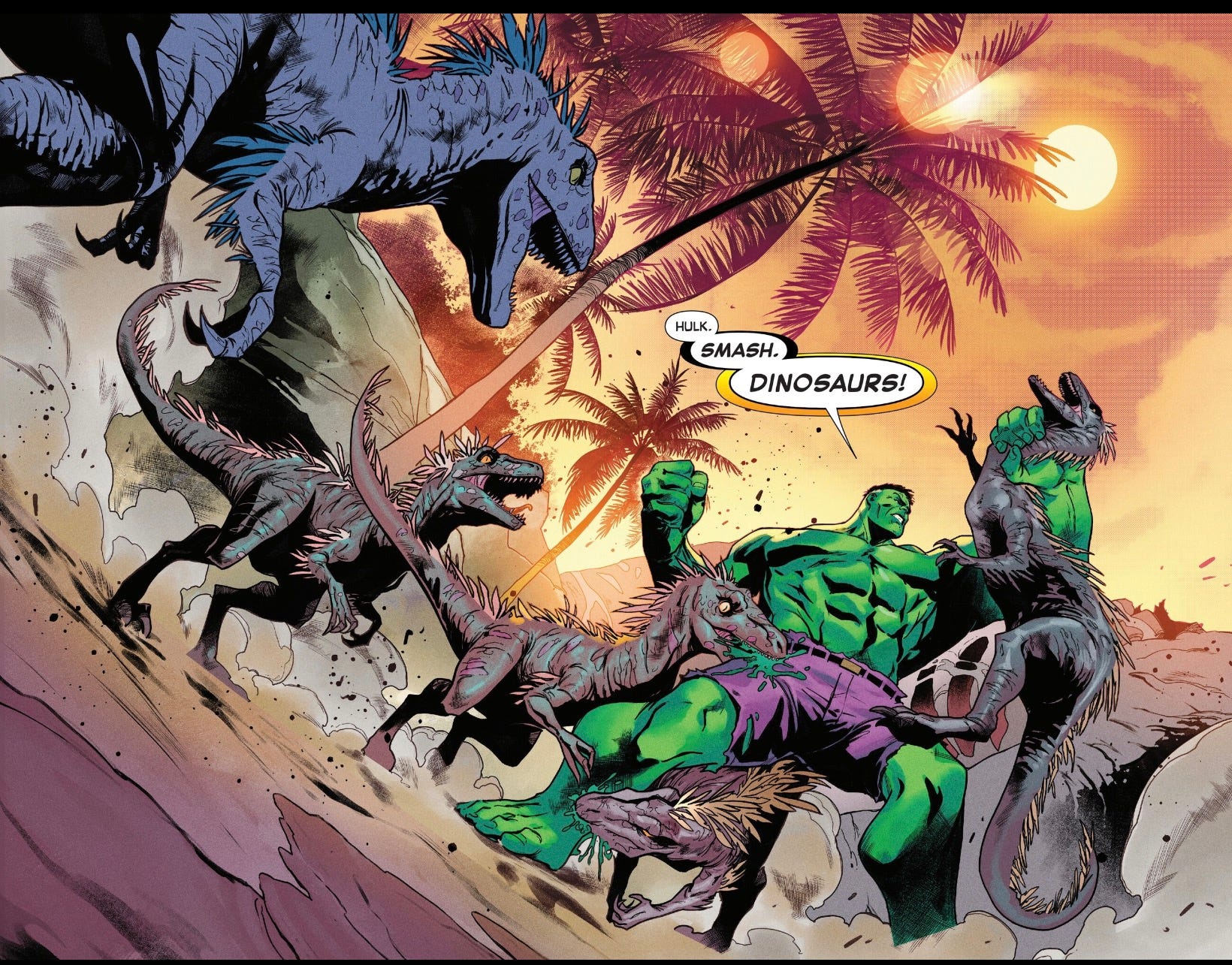
But before Hulk can get his bearings—or get us a positive ID—he’s surrounded by a group of small, fast-moving predators.
These are the raptors we were all expecting: versions of the creatures that have been haunting people’s nightmares ever since Jurassic Park arrived in 1993.
They look very much like dromaeosaurs, the same general family as Velociraptor. The long tails, narrow snouts, and raised sickle claws on their feet match what paleontologists recognize as classic raptor anatomy.
And then there are the feathers—a detail that reflects what paleontology has learned since Jurassic Park. For decades, dinosaurs were depicted as scaly reptiles, but fossil discoveries now show that many theropods—including raptor-like predators—were feathered.
In other words, the “giant murder turkey” aesthetic scientists sometimes joke about is actually pretty close to reality.
“Our raptor friends here are very Jurassified,” Waldron says, “based largely on the Velociraptors of Jurassic Park in their design and determination to rattle Hulk like a spoonful of green Jell-O.”
However, the real Velociraptor lived in Mongolia and was long extinct by this time.
“With their size and habitat range, these are likely Utahraptor,” Waldron continues. “And yes, spielbergensis was almost the species name—it ended up being Utahraptor ostrommaysi, named after two prominent raptor researchers.”
Fun fact #1: spielbergensis literally means “of Spielberg,” a nod to the director of Jurassic Park—and a shorthand scientists sometimes use for slightly fictionalized movie raptors.
Fun Fact #2: The sauropod skeleton in the Jurassic Park visitor’s center in the first film? That’s our buddy, Alamosaurus!
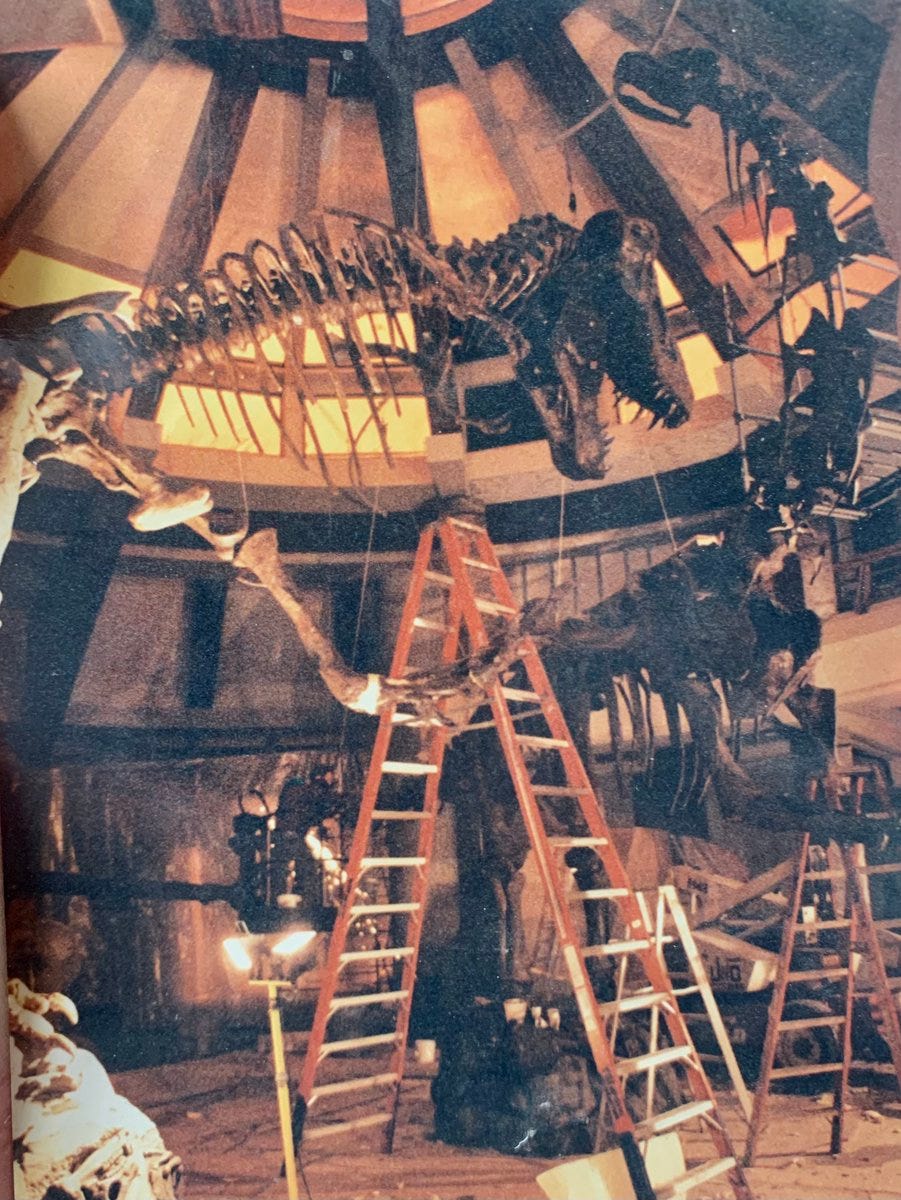
Fun fact #2: Dromaeosaurs and their close relatives, the troodontids, were a Late Cretaceous success story. These dinosaurs filled ecological niches across the planet, and many paleontologists think they may already have been developing flocking or pack-like behavior.
Some evolutionary biologists, including Jonathan Losos, have even speculated that if the asteroid had missed Earth—or struck harmlessly in the Pacific—raptor-like dinosaurs might have continued evolving into the planet’s dominant intelligent life.
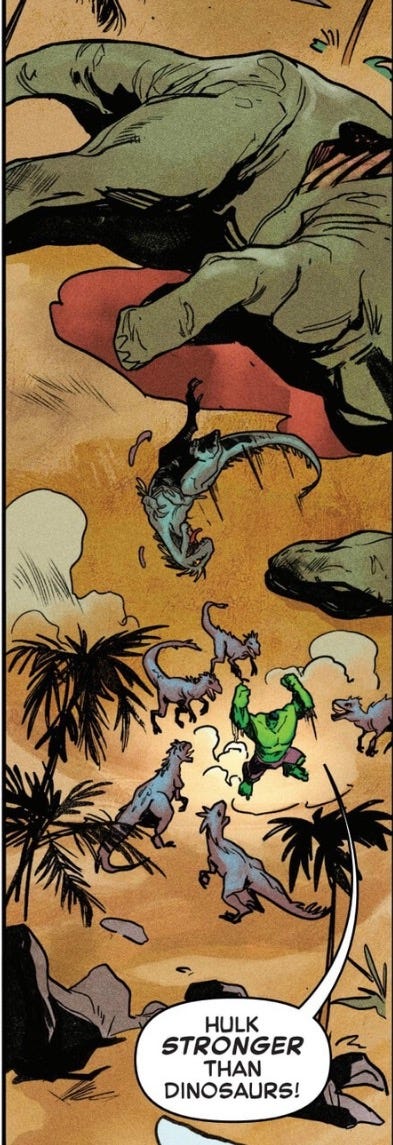
Also notice the body plan: long balancing tails and grasping arms, exactly what you’d expect for agile predators in Late Cretaceous ecosystems.
None of the animals are drawn perfectly to scale or with museum-level anatomical precision—this is still a Hulk comic, after all. But the overall choices are impressively close to what paleontologists think actually lived in North America at the end of the Cretaceous.
So if you dropped a very large green superhero onto Earth 66 million years ago and waited for the Chicxulub asteroid to finish the job…
“Well,” Waldron concludes, “considering the geography near the impact, the giant sauropod, and the large North American dromaeosaurs, my estimation is that Dr. Banner is somewhere in central Texas—66 million years ago—smashing Utahraptors and avenging Alamosaurus.”
The Light in the Sky
And as that final panel shows, far out in space, a mountain-sized rock is already on its way.
The asteroid that will strike Earth is roughly 10 kilometers wide—about the size of Mount Everest laid on its side. It’s traveling at roughly 20 kilometers per second, or about 45,000 miles per hour.
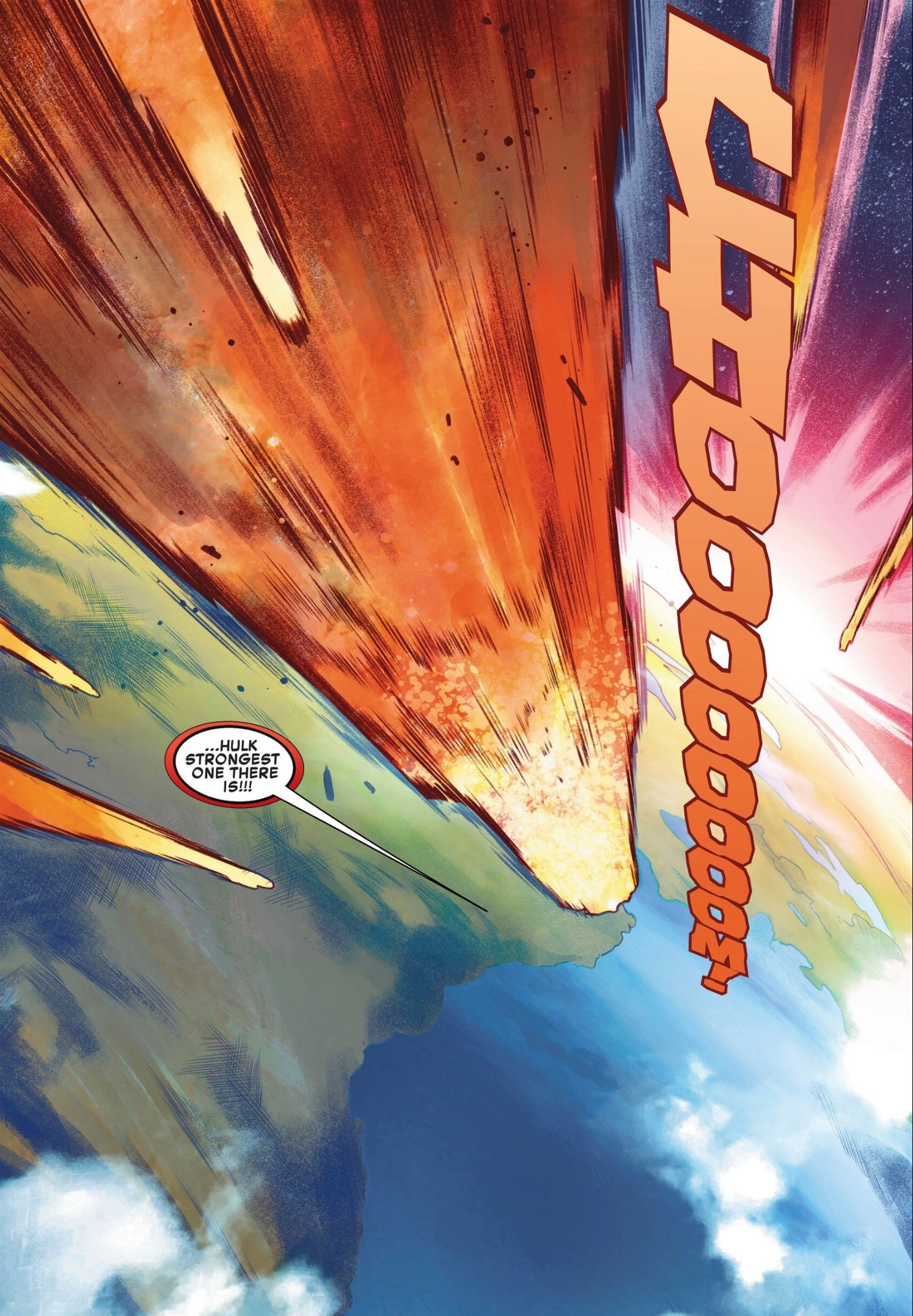
When it strikes near the Yucatán coast, the energy released will equal billions of nuclear bombs detonating at once.
The impact will blast out a crater nearly 200 kilometers wide, launch molten rock high into the atmosphere, and trigger massive earthquakes and tsunamis.
Debris blasted into space will rain back through the atmosphere, turning the sky itself into an oven and igniting wildfires across entire continents.
Dust and aerosols will block sunlight for months to years, collapsing ecosystems worldwide.
And the world Hulk has just stepped into—this stable, thriving planet—will begin to unravel.
Not instantly.
But permanently.
Next time: the impact itself—and what happened after—in Hulk Smash Science #2.
Hulk Smash Science is a four-part series exploring the real science behind Marvel’s Hulk Smash Everything.
(*) - or so we thought! Just wait until issue #2!
All comic images © Marvel Comics, used for commentary and review.