
The First Science Experiment in Project Hail Mary
Before he remembers his name, Ryland Grace drops a test tube and discovers that something is fundamentally wrong.
There will be some spoilers.
First — I teach physics.
Ask me what I love most about Andy Weir’s Project Hail Mary? The moment I realized I was never going to be without a copy of it?
It happens in the first chapter, and most readers probably glide right past it, because…math.
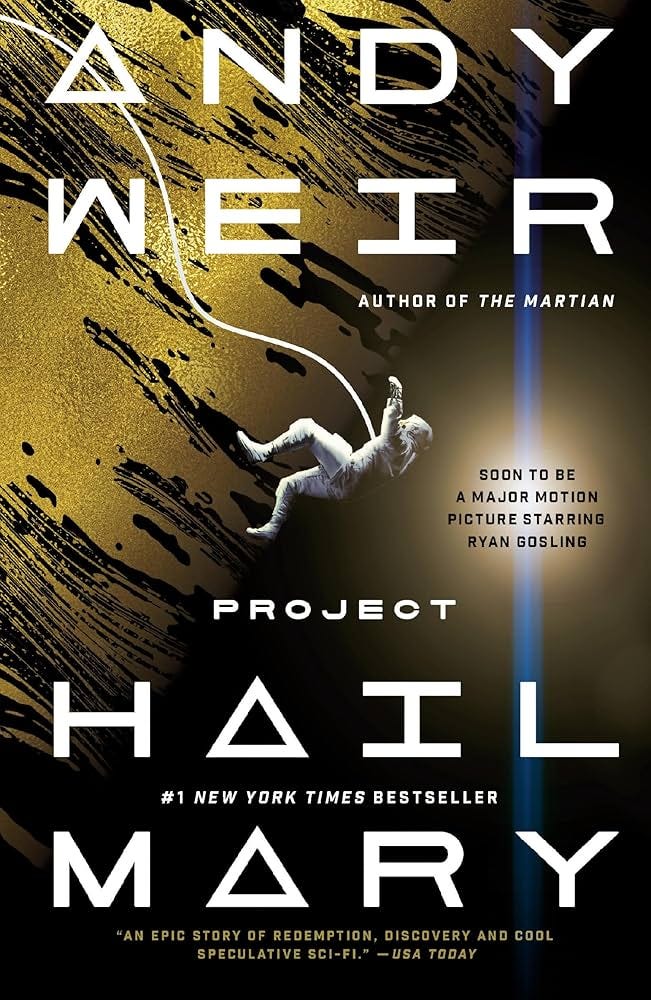
It starts with a problem I’ve used on physics tests for years — one that always makes my students look at me and ask, “When would this ever happen?” I feel so very validated. Thanks, Andy. Because suddenly that ridiculous physics-test question had a real-world use.
In the opening pages of the novel, Ryland Grace wakes up unsure of where he is — or even who he is — but aware enough to notice that something feels off. Following up on those instincts, he does a physics experiment.
In chapter freakin’ 1.
AMAZE!
Let me just grab a quick (non-copyright violation) taste of that sweet, nerdy angle, Ryland Grace:
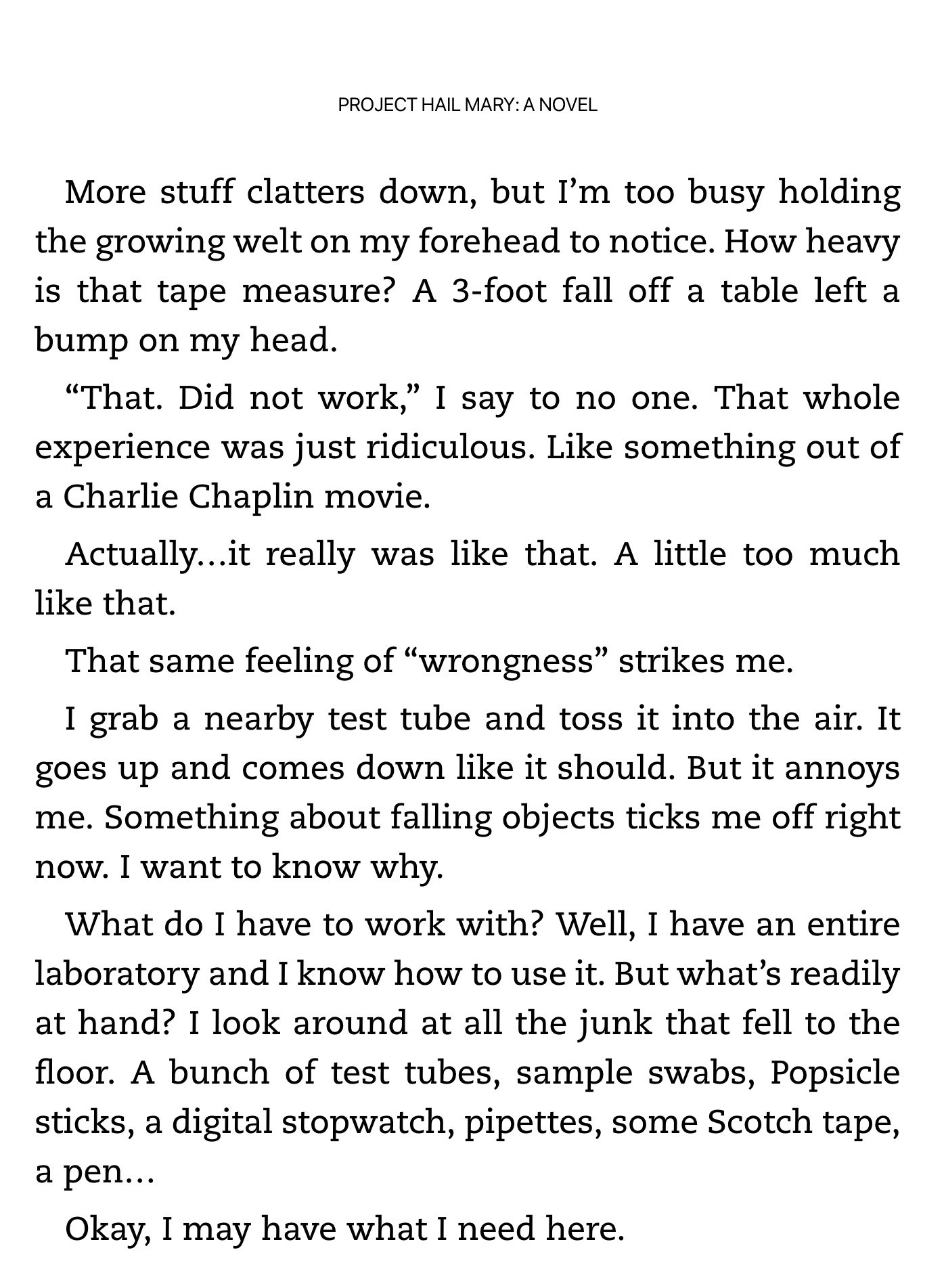
In quick order, Grace drops a test tube off a table that’s 91 centimeters off the floor.
But he doesn’t trust a single measurement. Grace repeats the drop twenty times and averages the results. That’s not just good science fiction — it’s good science. When your stopwatch reaction time might be two-tenths of a second, and the fall only lasts three-tenths of a second, repeating the experiment is the only way to get a reliable number.
Grace writes all the times on his arm (he hasn’t found paper yet), and finds that, when the measurements are averaged, it takes 0.348 seconds for the test tube to hit the floor. He’s got data, and the data supports the “off” feeling he has.
Now he can get to work.
But before that, just a quick shout-out for this entire scene. Grace’s memory is gone, but his scientific habits survived. And that’s actually one of the smartest character signals in the entire opening scene, and one that many of us with decades of science training and teaching know too well. It tells us something important before the plot even starts moving: the man may not remember who he is, but he’s still a scientist.
How Grace’s Body “Knew”
Before the math shows up, Grace’s body already knew something was wrong. To understand that, we have to sidestep physics for just a second.
Humans evolved inside a very particular environment: one planet, one atmosphere, and one gravitational field pulling downward at about 9.8 meters per second squared (32.15 feet/second2). Every movement you make—standing up, catching a ball, dropping a set of keys—happens inside that invisible constant. Everything speeds up downward at that rate — about 9.8 meters per second faster every second.
Over a lifetime of countless observations, your nervous system builds a model of it.
Your inner ear, deep inside the skull, is constantly measuring acceleration. Tiny fluid-filled canals shift when your head moves, letting your brain know when you start, stop, or change direction. Your muscles and tendons are doing their own measurements at the same time, sensing force and balance. And your brain is always predicting what should happen next—how fast something should fall, how hard you should land, how much force it takes to lift something.
Most of the time, you never notice this system running — it’s automatic.
But it means that when gravity changes—even a little—your body notices immediately.
Drop something, and it hangs in the air a fraction longer than it should.
Jump, and you rise just a little too easily.
Your sense of weight shifts.
You don’t reach for a calculator. You just feel that something is off.
The universe is no longer behaving the way it always has.
It’s why the footage of astronauts on the moon looks weird (not faked, it just looks weird). The moon’s gravity is 1.6 m/s2. Literally, things fall more slowly on the moon. There’s less “pull” downward on them than there is on Earth. Watching astronauts move across the lunar surface can feel eerie — something in our brains tells us that’s not how things should be.
That’s the moment Ryland Grace hits in the opening pages of Project Hail Mary. Before he remembers who he is, before he understands where he is, his brain notices the mismatch. The falling object takes too long, and that tiny delay is enough to trigger the most basic scientific response there is: that’s weird.
In a minute, we’re going to run the exact same experiment Grace does, but to get back to the story — Grace hasn’t recovered his memory yet, but the part of him that understands gravity is already awake.
Back to the Math
Once Grace notices the fall feels wrong, the next step is the same one scientists have been doing for centuries: estimate first, calculate second. The physics of falling objects is about as simple as it gets. If something drops under gravity alone, the distance it falls is given by the formula:
d = ½gt²
Every intro physics class on Earth eventually meets this equation.
That is, the distance (d) something falls is equal to one-half multiplied by the gravitational acceleration ( g = 9.8 m/s2 on Earth) multiplied by the time it takes the object to fall, squared. In other words, the distance an object falls depends on how strong gravity is, and how long the object has been falling.
In most physics classes, we solve this equation for the distance, not for g. But Grace isn’t in a physics class. If you want to solve for gravity instead, you just rearrange the equation:
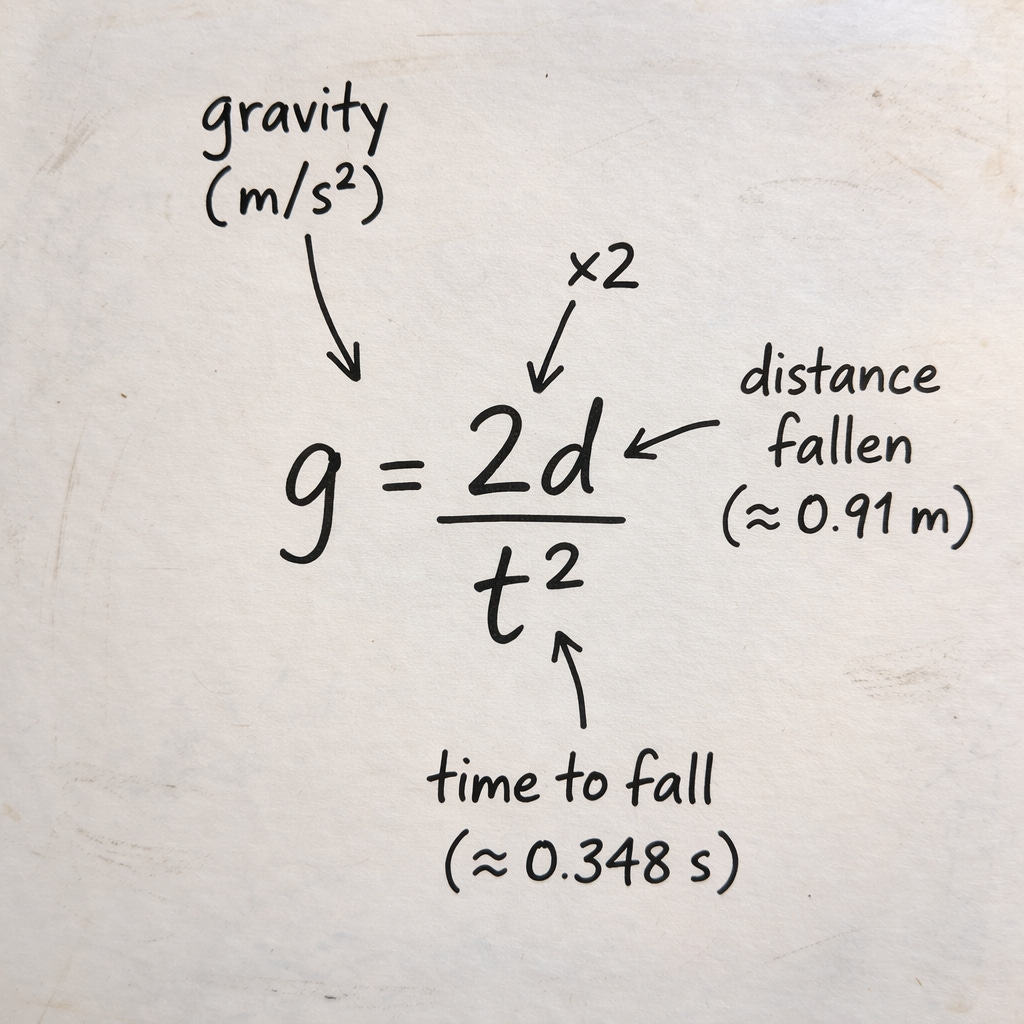
That’s the version Grace is working with.
Now plug in what he observes. The object falls about 3 feet, which is roughly 0.91 meters. And the fall takes about 0.348 seconds.
Put those numbers into the equation and you get a gravitational acceleration of about 15 m/s².
Again, on Earth, gravity is about 9.8 meters per second squared.
So wherever Grace has woken up, the gravity is only about one and a half times that of Earth.
That’s a huge difference. In a place like that, everything would feel heavier. Grace couldn’t jump as high, and objects would fall faster (and hit harder, as Grace learned). Movements would feel heavier and more deliberate. Anything that depends on gravity would happen faster.
Grace takes this result and reaches one of two possibilities: he’s either somewhere with stronger gravity than Earth, or — thanks to Einstein’s equivalence principle — he’s inside a sealed chamber accelerating at 15 m/s².
Don’t worry — I didn’t ruin either the book or the upcoming movie for you. There’s a lot more for Grace to figure out before he fully realizes where he is. This happens in the first few pages.
Try It Yourself
You can do the same experiment Grace did here on Earth — just duplicate his method. Drop something a bunch of times. Aim for at least a meter of drop height, because your reaction time (how quickly you can start and stop a stopwatch) is locked in at about 0.250 seconds. Grace’s 91 centimeters? Right at the edge of the sweet spot.
Take lots of measurements — 20 repetitions wasn’t overkill, it was a best practice, given that human reaction time was involved. Drop something that’s streamlined — a test tube was perfect. You can use a pen or something similar. Do the same math as above, and see what you get.
And Just In Case…
If you’re feeling like my old students and thinking this is all very contrived…shhh. Just read the book (you have a little bit before the movie comes out). It all makes perfect sense.
Drop something and see what gravity says.
One Final Note
Just in case you’re a STEM Teacher, I did run this question by my physics class, and they loved the heck out of it, particularly the question of “logically, what can Ryland Grace conclude from his finding?”
They all answered it pretty quickly, and pretty well. I’ve got a room full of would-be saviors of the earth in first period.