
Rick and Morty's Tiny Earth Is a Tiny Death Trap
When your planet is smaller than a football field, physics gets weird.
Artifact Recovered: original publication date: 8/24/17
This piece was originally published on a previous version of The Science Of and has been recovered from the digital strata. Its lightly edited version is represented here because it’s useful, weird, fascinating, updated, or some combination of the four.
all images © Adult Swim
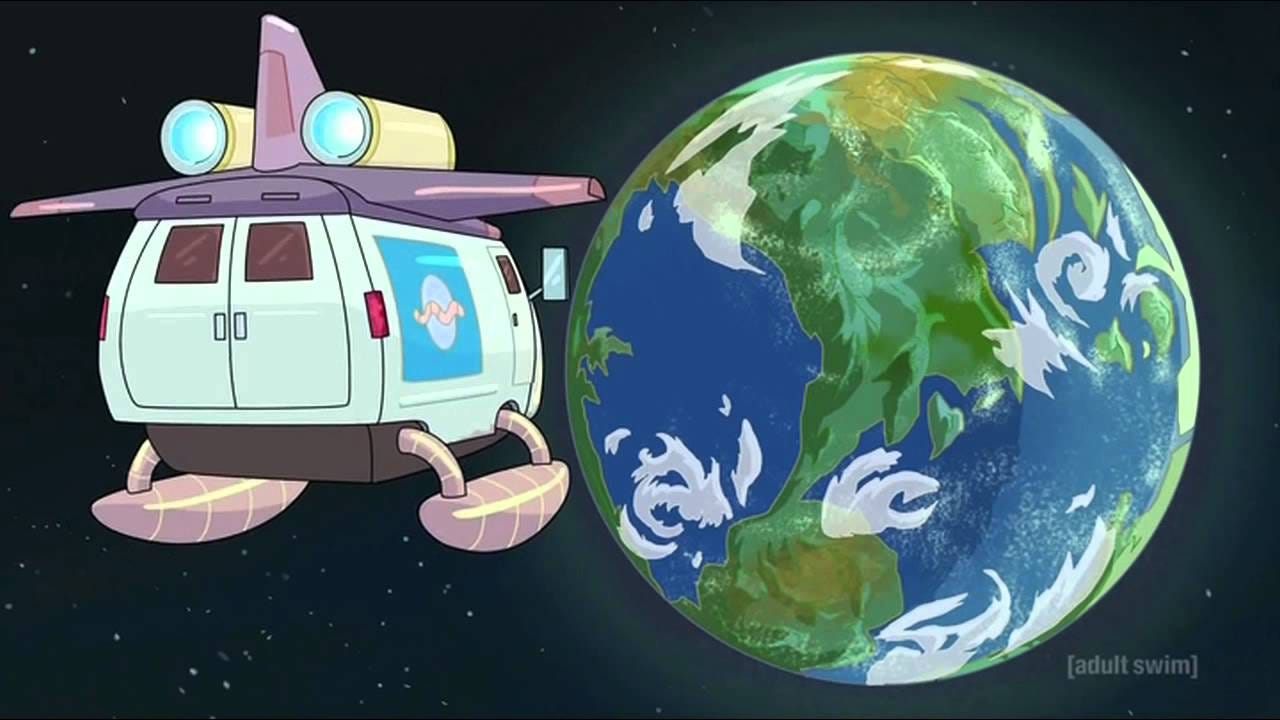
In its run of over 85 episodes (to date), Rick and Morty have shown us a huge variety of planets – weird, obscene, funny, normal, big and…small.
Looking back on the Season 2 finale, “Wedding Squanchers,” Rick, Morty, and the family find themselves on the run after a wedding turns into an ambush for Rick and his friends. After telling his family that they can never go back to Earth, Rick starts hunting for replacement homeworlds, and…long story short…they settle on Dwarf Terrace-9, a tiny version of Earth.
According to Rick, the planet is one of three that is at least 90% like Earth and is outside federal jurisdiction.
The family lands, and they are basically giants on Tiny Earth. As they’re there, they are walking normally, like they’re on Earth – with normal Earth gravity.
You can see where this is going, can’t you?
Yes, this is a nod to Antoine de Saint-Exupéry’s The Little Prince, whose asteroid (Asteroid B-612) is “scarcely bigger than a house. And we could do the science of that, but let’s focus on Rick and Morty instead.
Let’s get into the science of Rick and Morty’s Tiny Earth and see if we can figure out its gravity and if you’d be walking around like it was no big deal.
Physics ahead…
…but it’s easy. Trust me. I teach this stuff.
So – the morning after landing, when Rick comes in and asks if he’s smelling bacon, the family tells him that they had discovered (and subsequently made extinct) a species of tiny pig off the coast of “New Australia,” which, according to Beth, is “about 30 yards east,” to which Morty adds, “or 300 yards west.”
Boom. We’ve got a meaningful number.
If Morty and Beth are describing the same point, and we know its distance from their point, both east and west, we know the distance around the full sphere, or the circumference. We’re going to assume Morty and Beth were talking about 30 and 300 yards due east and due west, respectively. The full circumference around Tiny Earth? 330 yards.
Now we can crack this nut.
What we’re trying to do is figure out Tiny Earth’s gravitational pull. Here’s how we’re going to do it.
The formula we need is the gravitational field formula:
g = Gm/r2
Where:
g = the gravitational field strength in m/s2
G = the Cavendish/gravitational constant: 6.67259 x 10⁻¹¹ N m2/kg2
m = the mass of the planet in kilograms
r = the distance from the center of the planet, equal to the radius of the planet, in meters
Put the values of m and r in for Earth (5.98 x 1024 kg and 6.38 x 10⁶ m, respectively), and you’ll get right around 9.81 m/s2, the accepted value for the Earth’s gravitational field strength. That means things fall at a rate of 9.8 meters per second, every second they are falling. Everything on earth falls this fast, and yes, air resistance screws it up.
So how do we get things going for Tiny Earth? Problem solving. What do we have, and what do we need?
We’ve got the circumference of Tiny Earth in yards, and that’s it. We’ll need to calculate everything for the formula above. Let’s start with the radius of Tiny Earth.
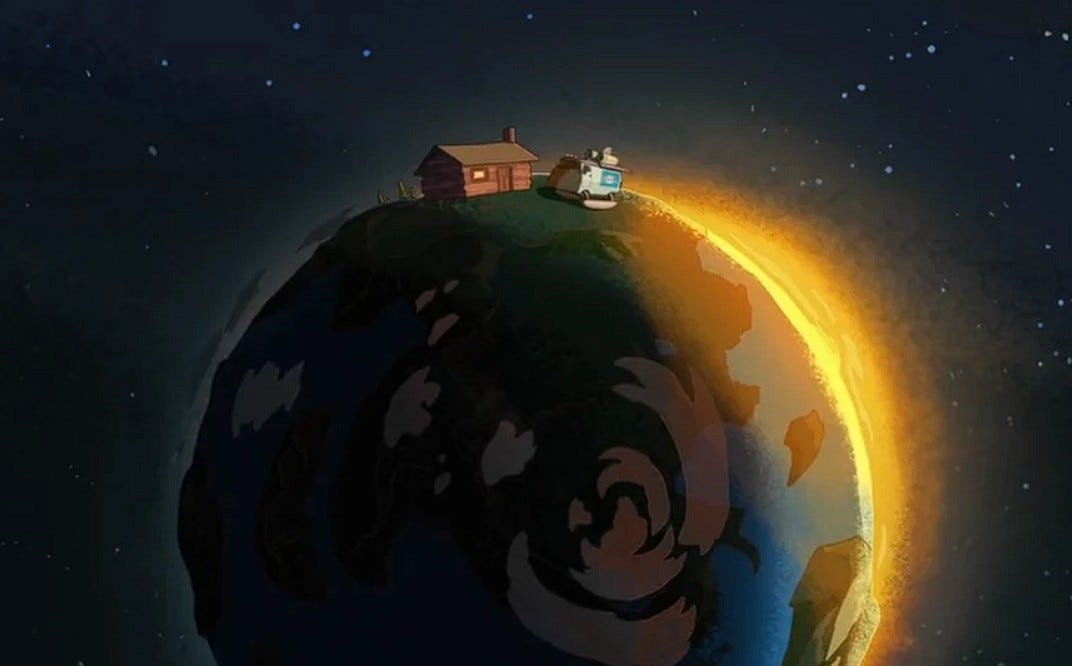
Tiny Earth’s Tiny Radius
We have the circumference of Tiny Earth, so we can work backward using the circumference formula to calculate the radius. Before we do that, we need to get our yards into meters. A quick conversion shows that 330 yards is about 302 meters.
The circumference of a sphere is the same as the circumference of a circle, so we’ll use that formula:
circumference = 2πr
Rearrange to solve for r:
r = circumference/2π
r = 302/ 2π
radius = 48.0 meters
Easy. The next part has a couple of steps, and we’ll need this value for the radius.
Tiny Earth’s Tiny Mass
This is a stop sign for a lot of my students when I assign something like this in my physics class. I think the big problem is that the answer to the question is so simple, they completely miss it. We need the mass of Tiny Earth, right? We know the radius of Tiny Earth, and from that we can calculate its volume. Remember – Rick said that these three planets were all at least 90% like Earth. To keep things simple, let’s assume that Tiny Earth is 100% like Earth (we can tweak those numbers later if we want to, but for now, let’s just get the problem working…)
The Earth is a rocky planet with a known density, and Tiny Earth would have the same density. And as we all learned early on in science, density = mass/volume, and Earth’s density is 5520 kg/m3. Aha.
So – what’s the volume of Tiny Earth? We need the formula for the volume of a sphere:
v = 4/3 πr3
Plug in 48.0 for r, cube it, and complete the calculation.
Volume of Tiny Earth = 463,240 m3
Now for mass:
Density = mass/volume
mass = (density)(volume)
mass = 2.6 x 10⁹ kg
And like that, we’re good to go.
Tiny Earth’s Timny Gravity
This part is simple – just plug the values into the gravitational field strength formula up above, and you’re good to go.
I’ll trust you to do the calculation and the appropriate unit cancellation. Be careful – 9 times out of 10, my students will have everything correct in the set-up and then mess something up in the calculation.
g = 7.5 x 10⁻⁵ m/s2
Wow – that’s like…nothing. Seriously — it’s 0.000075 m/s2. You’d barely notice a thing is falling.
I mean…the gravitational field strength on the moon is a relatively robust 1.62 m/s2.
This would affect everything in our reality – for example, we could easily calculate the escape velocity (how fast you need to move upward in order to escape the gravitational field of Tiny Earth), using the formula:
ve = √2Gm/r
ve = √2(6.673 x 10⁻¹¹)(2.6×10⁹)/48.0
ve = 0.084 m/s, or about 8.4 cm per second.
Jumping up would be overkill. That’s waaaay slower than an easy jog (about 3 m/s). If you didn’t stay still, just walking would get you off Tiny Earth.
Just for comparison, the Earth’s escape velocity is 11,184 m/s.
And the weak gravitational field would also affect how quickly things fall. Applying the free-fall formula under these circumstances, we can show just how wonky that tiny bit of gravity would be if you dropped something from 2 meters (a little less than Rick’s height) on Tiny Earth:
The free fall formula:
x = 1/2 g t2
Where:
x = the distance fallen in meters
t = time in seconds
rearranging to solve for time:
t = √2x/g
t = 231 seconds, or about 3.9 minutes
Just for comparison (and using the same formula), on real earth, an object dropped from 2 meters lands about .64 seconds after you drop it.
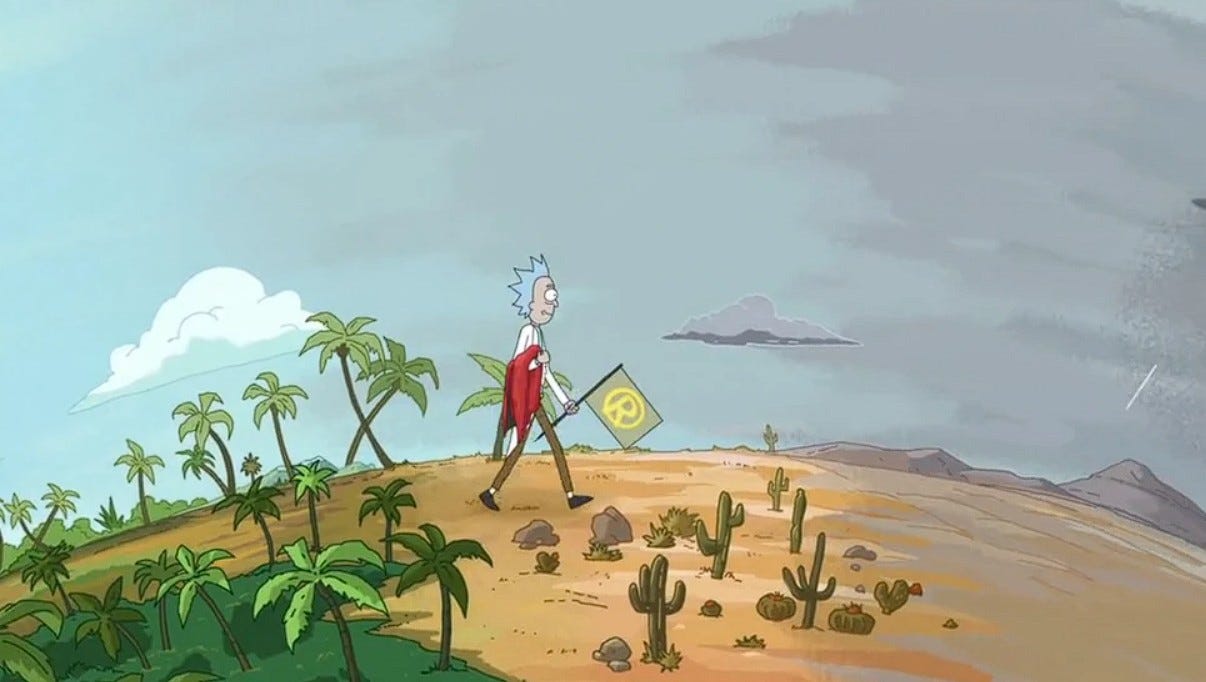
But…But,…But…They Seemed Okay…
Sure — the only strange thing was the size of the planet. Rick and the family seemed fine otherwise, or, as we’re concerned, as if gravity were just fine on Tiny Earth. How would that work?
Tiny Earth was Tiny Earth, so the size is set. What’s the only way that the gravitational field strength can change? The mass of Tiny Earth has to change. Normal Earth gravity is 9.8 m/s2, so what do we have to do to get Tiny Earth’s g value up to that same value? Crank that mass. By how much? Let’s talk math and the formula we used earlier, but this time, we’re solving for mass, so…
g = Gm/r2
9.8 = (6.673 x 10⁻¹¹)(m)/(48)2
Rearrange and solve for mass – we find that for the gravity of Tiny Earth to be the same as real Earth’s, the mass will be:
m = 3.39 x 10¹⁴ kg
Okay – so what? What can we do with that?
We can figure out what Tiny Earth was made from. Remember density? If Tiny Earth has the same gravity as Earth, we know what its mass has to be, and its volume hasn’t changed, so we can calculate the density:
D = m/v
D = 3.39 x 10¹⁴/463,247
Density of Tiny Earth (for normal Earth gravity) = 7.3 x 10⁸ kg/m3
That’s basically the same density as a white dwarf star – a star near the end of its life, with roughly the mass of the Sun and the volume of the Earth.
Tiny Earth isn’t very earth-like at all, when it comes down to it.
If you want to tweak this out and play with values that are, say, 92.3% Earth-like, then you’re talking about changing the density, which would affect the mass. If you’re trying to make Tiny Earth work that way, you’re going the wrong direction – a smaller mass will only decrease the gravitational field strength, but give it a shot.
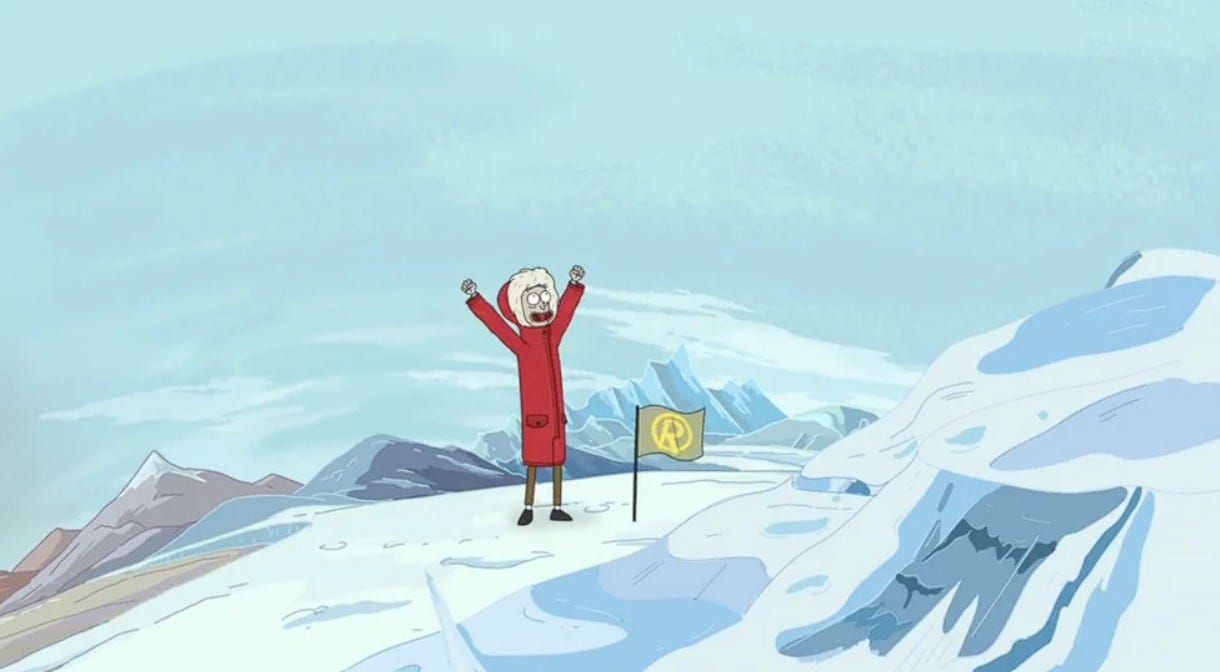
But that’s not quite all – living on Tiny Earth would be its own horror show. Over at xkcd, Kevin Munroe went into depth about what “living” on a tiny earth/rock/asteroid would be like, using The Little Prince as a launching point.
Gravity obeys the inverse-square law, so the farther away you get from the center of the planet, the more the gravitational field shrinks, so as a result, the gravitational field would have one value at your head and another near your feet. And given the pull of gravity on Tiny Earth, this would be significant.
How significant?
Let’s say you’re 5 feet, 9 inches tall (1.75 meters).
So…
Feet: 48.00 m from the center
Head: 49.75 m from the center
A mathematical representation of the inverse -square law looks like:
g ∝ 1/r2
Or, the force of gravity decreases by the square of the radius, twice as far from the center as your pal, you feel ¼ as much (twice as far = 2x, 22 = 4). So…
ghead=9.81(49.7548)2
ghead=9.13 m/s2
Or roughly, 0.93g, while your feet are living in 1.00 g.
Sure, it’s only 7% weaker at your head, but that 7% difference is 140,000 times larger than the difference you feel on earth.
What would it feel like?
It wound’t be like you were being torn apart, but it would feel weird. Your circulatory system evolved to work against Earth’s very gentle gravity gradient. On Tiny Earth:
Blood would tend to pool differently.
Standing upright might feel strange.
Jumping could feel unstable.
Tossing a ball upward would produce visibly different motion than you’re used to.
On Tiny Earth, gravity would be weird however you want to slice it. Your head and feet would experience measurably different gravitational pulls if it has the same gravity as Earth, or, if it had gravity that follows the rules we’re used to, dropped objects would take minutes to hit the ground, and an enthusiastic leap could send you drifting off into space.
In other words, looking at it through the lens of our world’s science, Rick’s replacement Earth isn’t really an Earth at all. It’s a tiny, adorable death trap.
Is looking at Rick and Morty’s science your idea of a good time? I gotchu! I wrote a whole book all about it a few years back — you can get your copy here, or wherever books are sold.