
Could a Spider Bite Rewrite Your DNA?
Spider-Man: Brand New Day pushes Peter Parker’s arachnid biology to the breaking point. Here’s what spider venom actually puts into you.
In Spider-Man: Brand New Day, the entire world may have forgotten Peter Parker, but in Spider-Man fandom, everyone remembers the spider that gave him his powers.
Spider-Man’s origin story is so well-known in pop culture that Spider-Man: Homecoming skipped it altogether. Peter goes on a science field trip. A spider encounters radiation, genetic engineering, experimental chemicals, or whatever origin-flavored substance that particular universe uses. The spider bites Peter, dies shortly(ish) afterward, and transfers something into him, giving him spider-like powers.
Spider side-note: There are caveats and variations that give the spider more than one bite, a spiritual nuance to the spider, the spider had a mission, etc. We’re going to keep it as simple as we can without doing a full Spider-Verse census. Knowing Spider-Man’s origin used to be so much simpler.

In 1962’s Amazing Fantasy #15, the spider’s special sauce was a straight-up dose of radiation along with something “spidery” from the spider. Later versions leaned heavily into genetic engineering and altered DNA. Through it all, the central idea has remained the same: the spider didn’t just inject venom into Peter. It passed along information.
Which gets to an interesting biological question. Mosquitoes, ticks, and fleas can deliver diseases and even parasites when they bite us. Spiders…nope.
Why not?
Spider-science time.
What Does a Spider Actually Inject?
Okay - starting with the basics, spiders can and do bite. They have venom that’s delivered via fangs that may puncture skin. Some spider bites can be very serious.
There are more than 54,000 species of spiders on the planet. And while they can bite, there’s only a small fraction of spiders whose bites cause problems for humans. In the continental United States, there are two well-known groups: widows (including the black widow) and recluses (including the brown recluse). Elsewhere in the world, funnel-web spiders, wandering spiders, and others can cause problems with their bites.
But spiders that can (and do) bite humans are the exception, not the rule. For virtually all spiders, we’re terrain to be covered, not prey. Spiders don’t bite humans for food; they bite us for self-defense. It’s been grabbed, caught against skin and clothing, caught between a sleeping person and a mattress, startled, or feeling that it’s otherwise in danger. When that’s the case, it uses the only serious weapon it has: fangs.
Let’s Get Anatomical
At the front of a spider’s body are two appendages called chelicerae, and each ends in a fang. In most spiders, the fangs have small ducts that connect to venom glands. When the spider bites, the fangs puncture the target, and the venom is pumped through the ducts, through the fangs, and into the prey. The delivery of the venom is called envenomation, and the amount of venom delivered in a bite can vary from a lot to none.
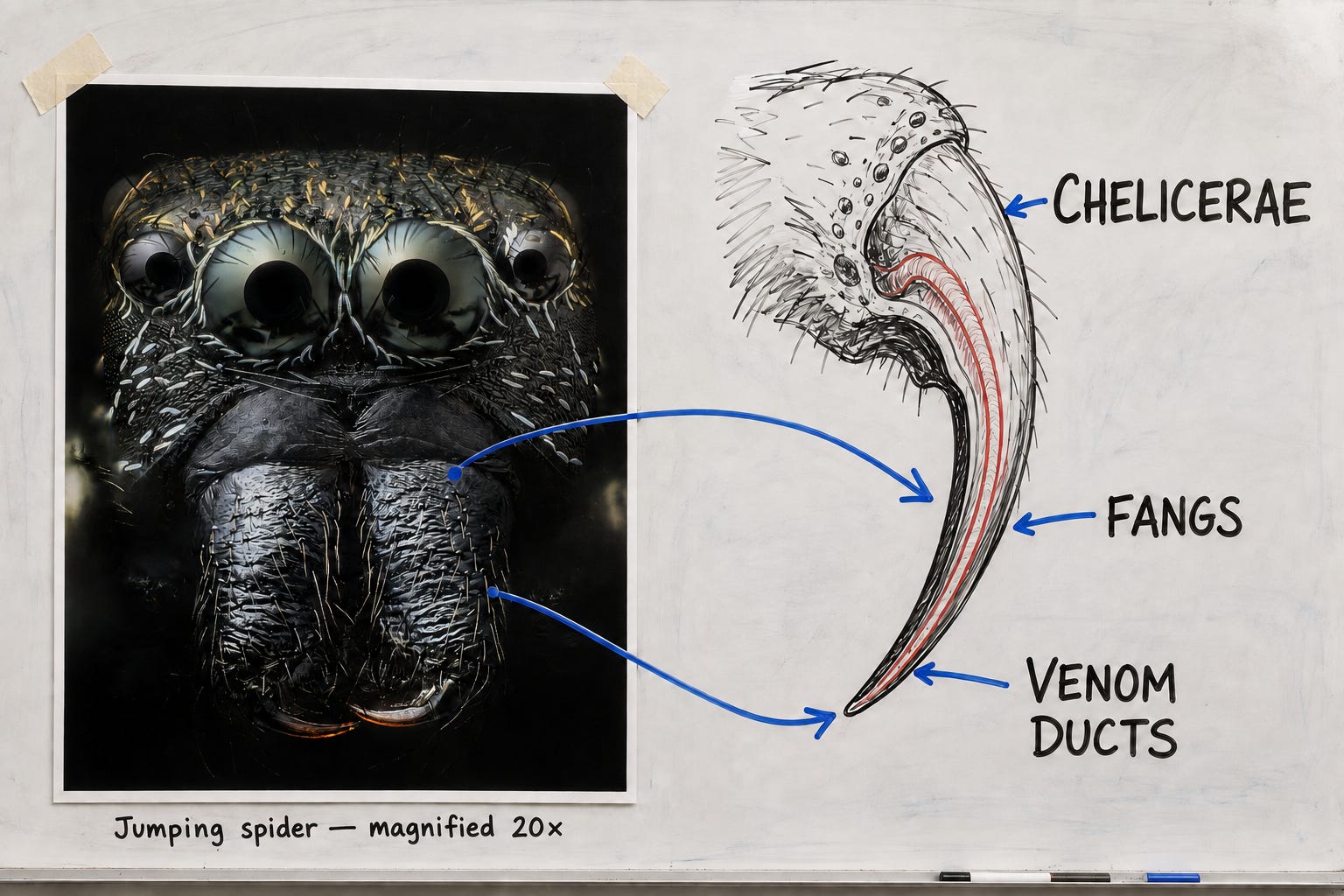
The venom isn’t just one substance that can be labeled as “spider toxin” in a bottle. It’s a cocktail of peptides, proteins, enzymes, and other molecules that can interfere with nerves, muscle cell membranes, and other biological machinery. The cocktail’s recipe varies wildly depending on the spider’s taxonomic classification, but virtually all share one thing in common — they do their best work on insects and other small arthropods.
That said, when people get bitten by a spider and have adverse effects, the problems are a crossover problem, not human-specific venom effects. For example, widow venom disrupts nerve signaling, causing pain, muscle cramping, and other body-wide symptoms in human bite victims. Recluse venom contains compounds that damage cells and can sometimes produce a worsening skin lesion. Most verified bites from other spiders cause temporary pain, redness, swelling, or not much of anything.
But let’s make one thing very clear: venom is venom, and the spider’s digestive system is something else altogether. It’s an important distinction.
In normal spider-life, the spider bites its prey, and the venom immobilizes it (again, it’s most effective against insects and arthropods). Then, the spider releases digestive fluids into or onto its prey. Those fluids break down non-spider tissues (prey), allowing the spider to pull in the liquefied remains of its prey.
That’s extra-oral digestion, which is the scientific way of saying the spider turns its food into a smoothie before drinking it.
So where are we on our spider journey? A spider’s bite injects venom, which is a mixture of chemicals built to immobilize smaller prey. What a spider’s bite doesn’t normally deliver is a virus, bacterium, or parasite that has evolved to use a spider as part of its life cycle.
Or not much (if any) of its own genetic material, enhanced, engineered, irradiated, or otherwise.
Venom Manufacture and Delivery
The venom that comes out of the spider’s fangs serves a purpose in the spider’s food acquisition and defending itself, but venom is not a part of the spider’s digestive system.
Spider venom is produced by specialized cells inside the spider’s venom glands. The cells pull amino acids from the spider’s hemolymph (think “blood”) and ribosomes assemble them into venom peptides and proteins. The venom components are processed and released into the gland’s central reservoir; in some species, the secretory cells rupture as part of that process. Once there, the venom waits, isolated from the spider’s other tissues.
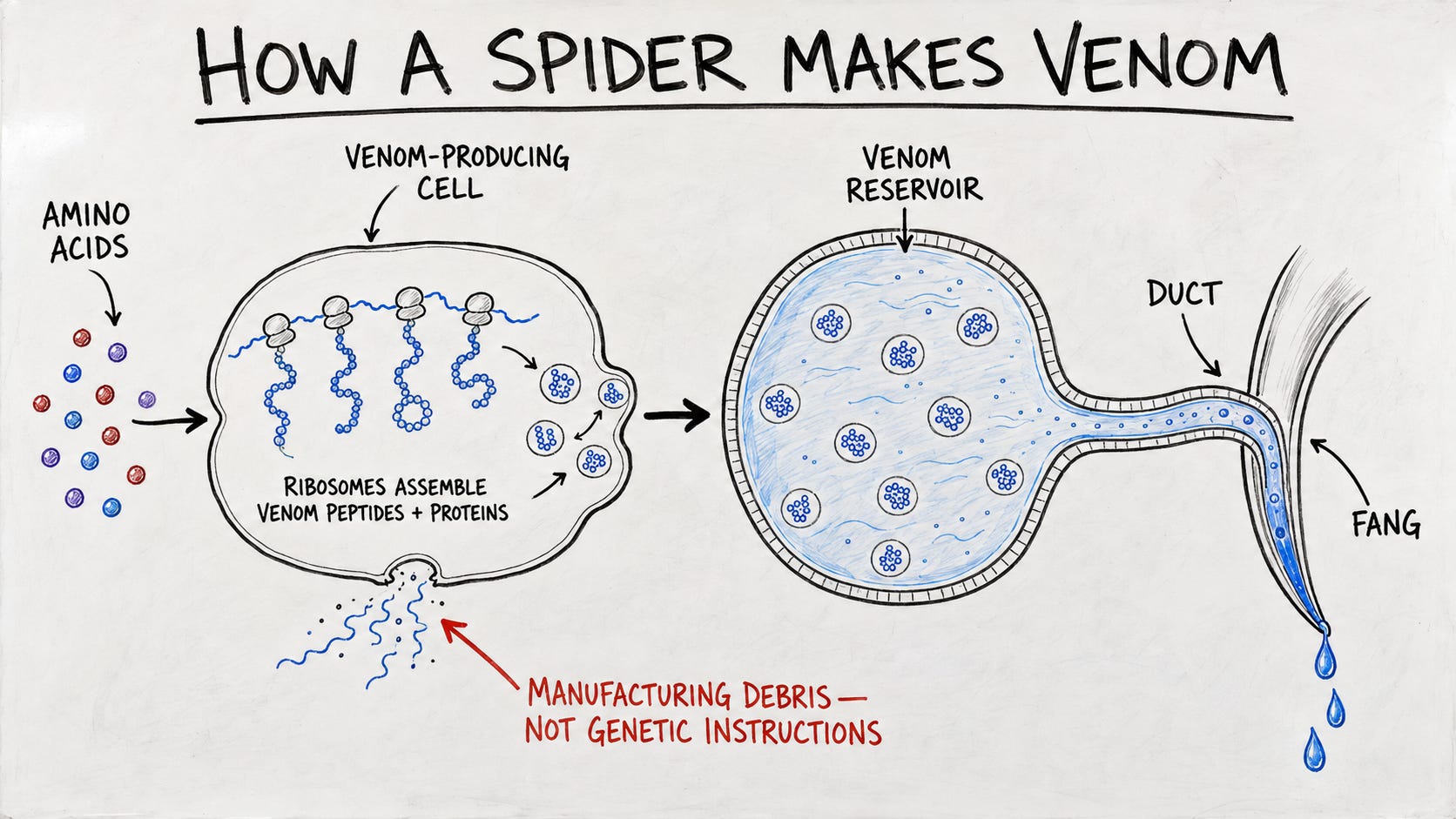
When the spider bites its prey, muscles surrounding the glands contract, pushing venom through the ducts and out through the fangs.
Because making anything in cells can be messy, small amounts of cellular material, including fragments of DNA or RNA, can sometimes make it into the venom. This can happen when venom-producing cells rupture, and fragments of genetic material enter the gland along with their toxic contents.
Genetic material may be there, but its presence is a byproduct of venom manufacture, not the goal. That said, brown recluse venom also contains sulfated derivatives of guanosine, one of the nucleosides used to build RNA. These modified nucleosides may act as neurotoxins that help immobilize prey.
A Venom-Induced DNA Change?
Slight spoilers for Brand New Day, but the movie mentions repeatedly that Peter Parker’s DNA contains arachnid elements threatening to overtake his human DNA. That makes for a great metaphor about finding balance in your life, but in our reality (which is not Marvel’s reality), there’s no chance of that happening.
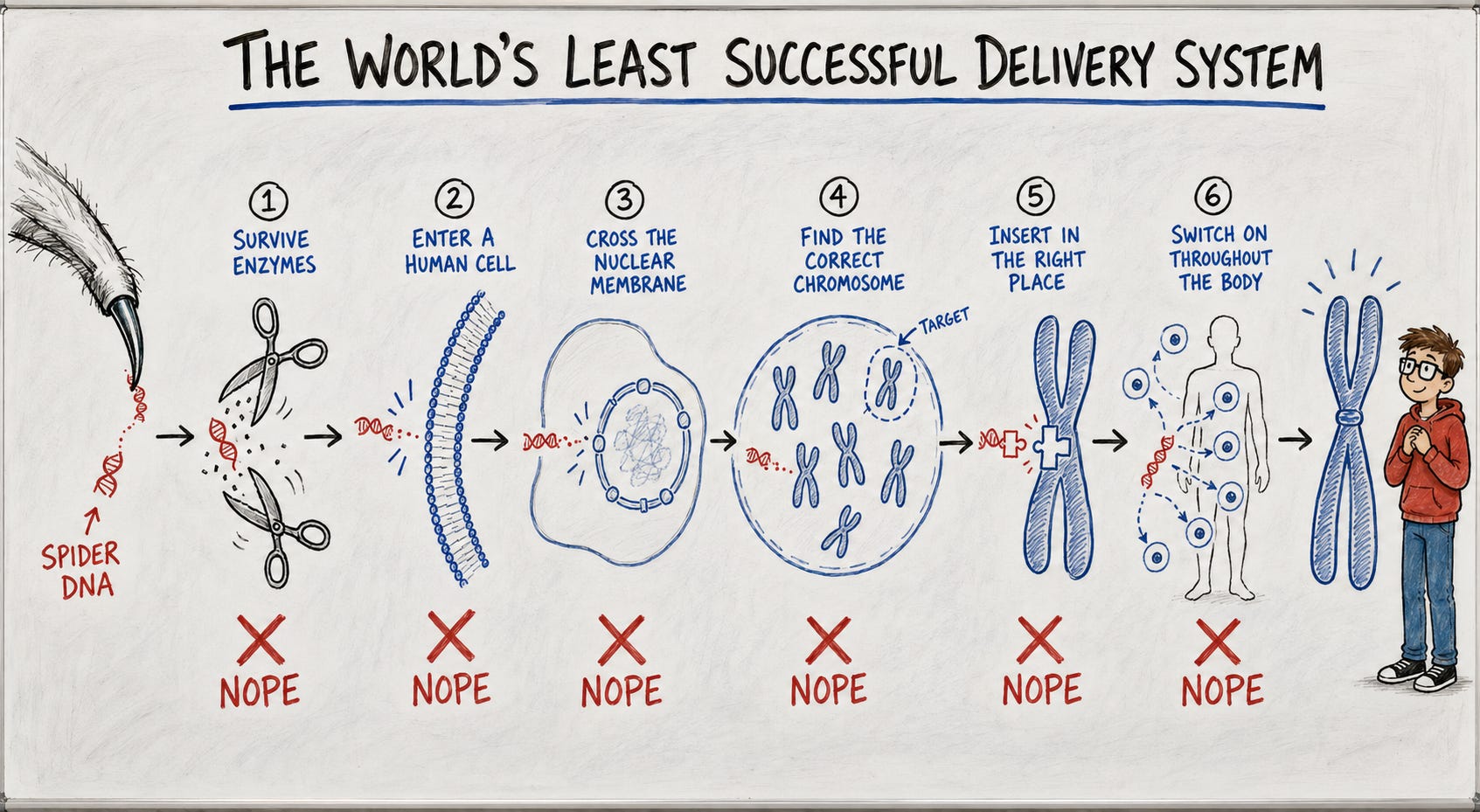
Yes, spider venom can contain fragments of spider DNA or RNA, but those fragments cannot simply rewrite the victim’s genome. Loose genetic material is rapidly broken down by enzymes and cleared by the body. To change Peter’s genome, spider DNA would have to survive, enter his cells, reach their nuclei, insert itself into the right places, and become active. That’s all super-cool, but not what is possible in our world.
The spider bite may hurt (and in some cases a lot), but that’s due to the venom, not your DNA starting to change.
What’s the Friendly Neighborhood Takeaway Here?
There are lots of spiders on the planet.
None of them sees you as prey.
Sometimes they will bite people, usually when trapped, pressed against the skin, or otherwise facing what feels like a life-or-death situation.
Of those that do bite humans, most are too small, or have fangs poorly positioned in order to readily puncture human skin.
Of those that can puncture human skin, only a small number have venom capable of causing serious harm.
When venom is injected, the dose is usually small, and the effects are generally mild and temporary.
Occasionally, a spider bite causes a more serious injury requiring medical attention and, in some cases, antivenom
If a spider does bite you, a 2015 review found only one credible case in the medical literature it examined in which a verified spider bite appeared to introduce a bacterial infection. That doesn’t mean a bite wound cannot become infected later. It means there is almost no evidence that spiders deliver those infections themselves.
(Also, unfortunately, no one who was bitten by a spider gained spider-powers).
This is one of those things where someone says, “You’re more likely to get hurt from _____________ than from a spider bite,” and they’re right. On the list of things you should worry about (sensationalist local news stories notwithstanding), spider bites rank very, very, very low.
The irony in all of this? If spiders are so cool and harmless, why do they make so many people lose their…cool?
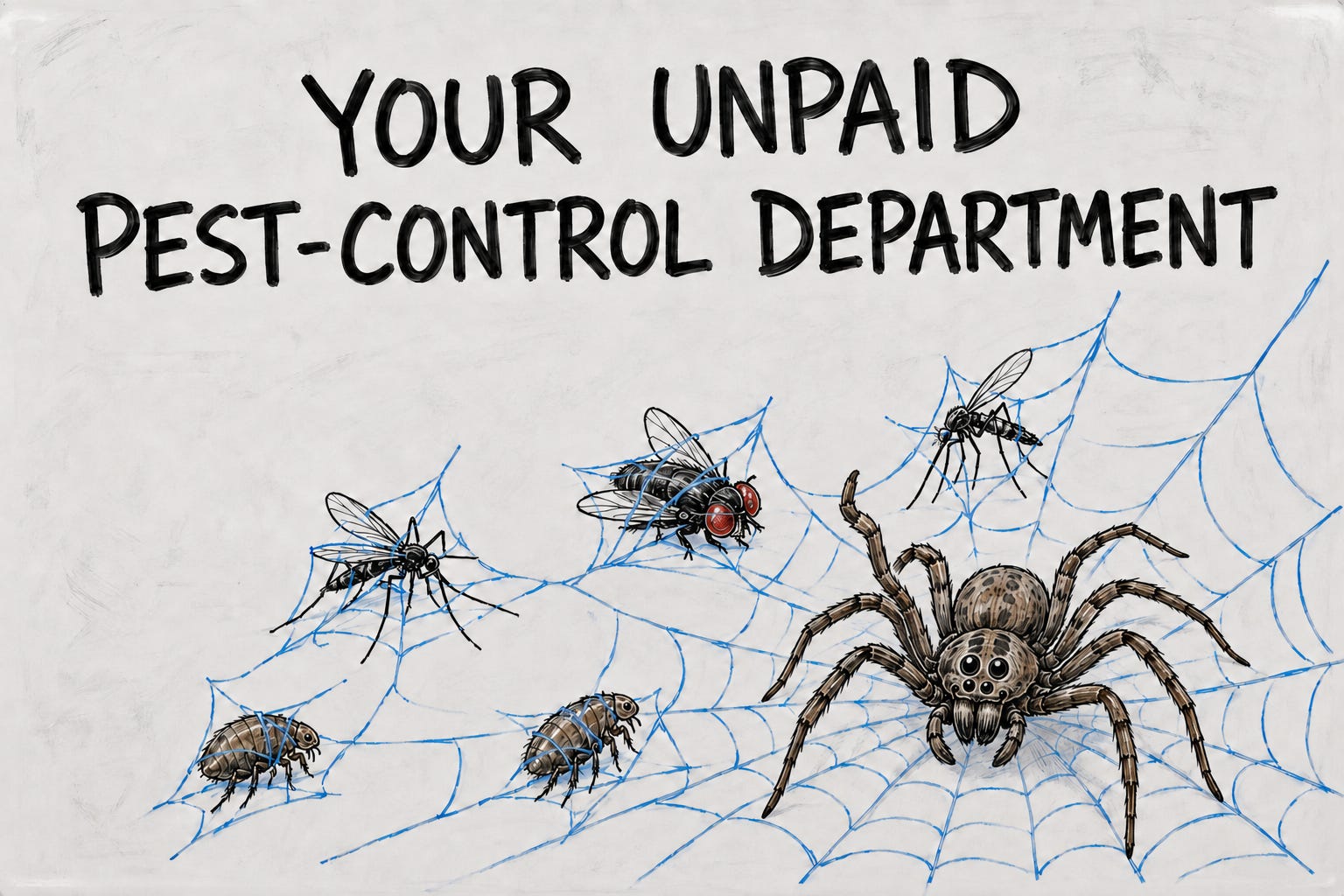
Something about spiders speaks to a primitive part of our brains. They’re so alien and creepy and foreign and…other. There’s even a specific term for an intense fear of spiders: arachnophobia. We kill spiders because we fear them. Yet spiders catch and eat mosquitoes, fleas, ticks, and other pest arthropods, some of which carry disease.
The next time you see a spider hanging out around your house or walking by, let it be. Okay, or escort them outside if you must. They’re our pals.
So How Did Peter Parker Get His Powers, Then?
No clue. It’s comic books.
You can look at all the pieces and work through them, but there’s no way in our world, using our science, to explain how a bite from an ‘energized’ spider could give someone à la carte spider powers. The original Stan Lee/Steve Ditko story featured a radioactive spider, a product of the place radiation was taking up in the zeitgeist at the time. The frontier of science (and associated science anxieties) has changed over the years. Later versions of Spider-Man’s origin have moved close to genetic engineering and gene splicing, with the Ultimate Marvel universe’s spider a product of genetic alteration via Norman Osborn’s OZ formula.
Okay, to get a Spider-Man, if we take the genetic explanation literally, something from the spider had to enter Peter when he was bitten. It had to carry some genetic information, but not all of it, strictly speaking (spiders don’t shoot webbing from their wrists, for example) and somehow make it work inside Peter’s vertebrate, mammalian cells. That’s a huge jump, genetically speaking.
Some viruses can move genetic material into host cells and even insert it into their genomes. But turning selected spider genes into an infectious agent, then having that agent produce perfectly adapted spider characteristics throughout Peter’s body…that’s not science anymore; that’s magic. The Ultimate universe’s addition of the OZ formula gives that version of Marvel a way to ‘explain away’ any science that doesn’t match our world. It’s a shrewd move, and assures that they won’t paint themselves into a corner when it comes to science absolutists shouting “nuh-uh!”
And we’re cool with that. As we say over and over, we’re not here to say the science of superheroes is stupid. Impossible superhero science gives us a way to talk about real science. And that always makes for a good time.
Spiders are your friends.
Curiosity is what brought me here.
Teaching is what I do with it.
If you’d like to read more about education, classrooms, students, and the craft of teaching, you’ll find those stories in Teacher, Teacher.