
Why Backrooms Break Your Brain
What happens when your brain can no longer trust space, memory, or itself.
So — The Backrooms.
The phenomenon that would become the film Backrooms was seeded on a paranormal-themed 4chan message board in 2019, when users were asked to “post disquieting images that just feel ‘off.’” The initial post was followed by the now iconic image:
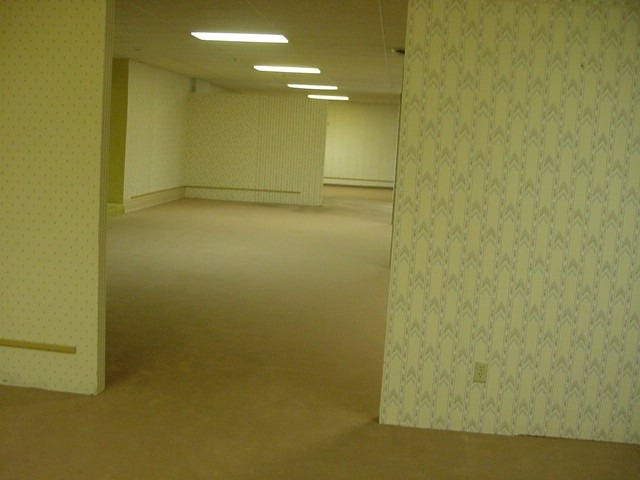

As a follow-up to the image, an anonymous 4chan poster wrote:
If you’re not careful and you noclip out of reality in the wrong areas, you’ll end up in the Backrooms, where it’s nothing but the stink of old moist carpet, the madness of mono-yellow, the endless background noise of fluorescent lights at maximum hum-buzz, and approximately six hundred million square miles of randomly segmented empty rooms to be trapped in
God save you if you hear something wandering around nearby…because it sure as hell has heard you.
The thread went viral and led to Kane Parsons (then 16 and posting as ‘Kane Pixels’) creating the web series, which, over multiple episodes, built an entire mythology atop the original idea.
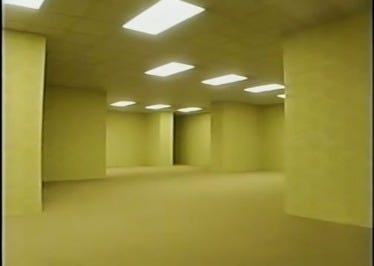
Parsons’ version is by far the most popular, with secret organizations, characters, and monsters inhabiting a world just out of reach.
But let’s get something straight - Backrooms works not because it’s another monster movie. Even before Parsons added monsters, secret projects, and an entire mythology, the original image was already unsettling.
And now there’s a movie. Sure, it’s called a horror movie, but is it? Traditional horror movies give us slashers, maniacs, monsters, and ghosts. But The Backrooms gives us…endless office space as the main “character?”
Why is an endless set of rooms scarier than a monster?
Yes, it’s a liminal space — somewhere that’s a transition between one area and the next, and yes, in our experience, it should be occupied by…something. It’s also uncanny. Useful explanations, but they don’t really explain why these places feel so weird and unsettling.
To get into the core creepiness of Backrooms, we need to dig into your brain (not literally) and look at our own operating systems we rely on every day:
Navigation
Threat Detection
Memory
Break one, and things get confusing. Break all three, and things get scary. The Backrooms does exactly that.
Let’s get into the neuroscience of the Backrooms.
There’s a Hidden GPS in Your Head
Constantly, whether you think about it or not, your brain is building maps of your physical surroundings. Normally, it doesn’t even reach conscious awareness, but if you try to feel it, it’s there. Go for a walk — without “knowing,” you have a basic idea of the area around you, if there’s a path coming up, the rough location of large objects, and a million other small details that you’re not looking for. And it’s not just an “in nature” thing. Your brain will build representations of the area around you in buildings, whether they’re large open spaces like a Costco warehouse or more constricted areas, like hotel hallways or office spaces.
It’s the “wait, this isn’t right…” you feel when you get off on the wrong floor in a building. You didn’t bother to memorize all the landmarks and specific bits of stuff, but your brain did, quietly labeling them ‘my floor.’
It’s just another service offered by our brains, a jelly-like organ that are always trying to make sense of the world around us.
One of the major hubs involved in this process is the entorhinal cortex (in your temporal lobe). Broadly speaking, different parts of the entorhinal cortex help process information about objects, locations, distances, and spatial relationships. That information is fed to the hippocampus, which smashes it all together and combines it with existing memories to make mental maps of your surroundings.
Oh, and it’s far cooler than it sounds.
The entorhinal-hippocampal region also has specialized neurons called grid cells, border cells, and place cells. Grid cells are like biological graph paper in your brain upon which your surroundings are overlaid; border cells inform the brain when it’s near the border of a specific location or environment, and place cells are the “you are here” marker inside your brain. Combine these three types with head direction cells that keep track of which direction your head is pointed, and you’ve got…
…I know. It sounds like I just described the GPS on your phone, down to the dot’s direction on the map. That’s because I did.
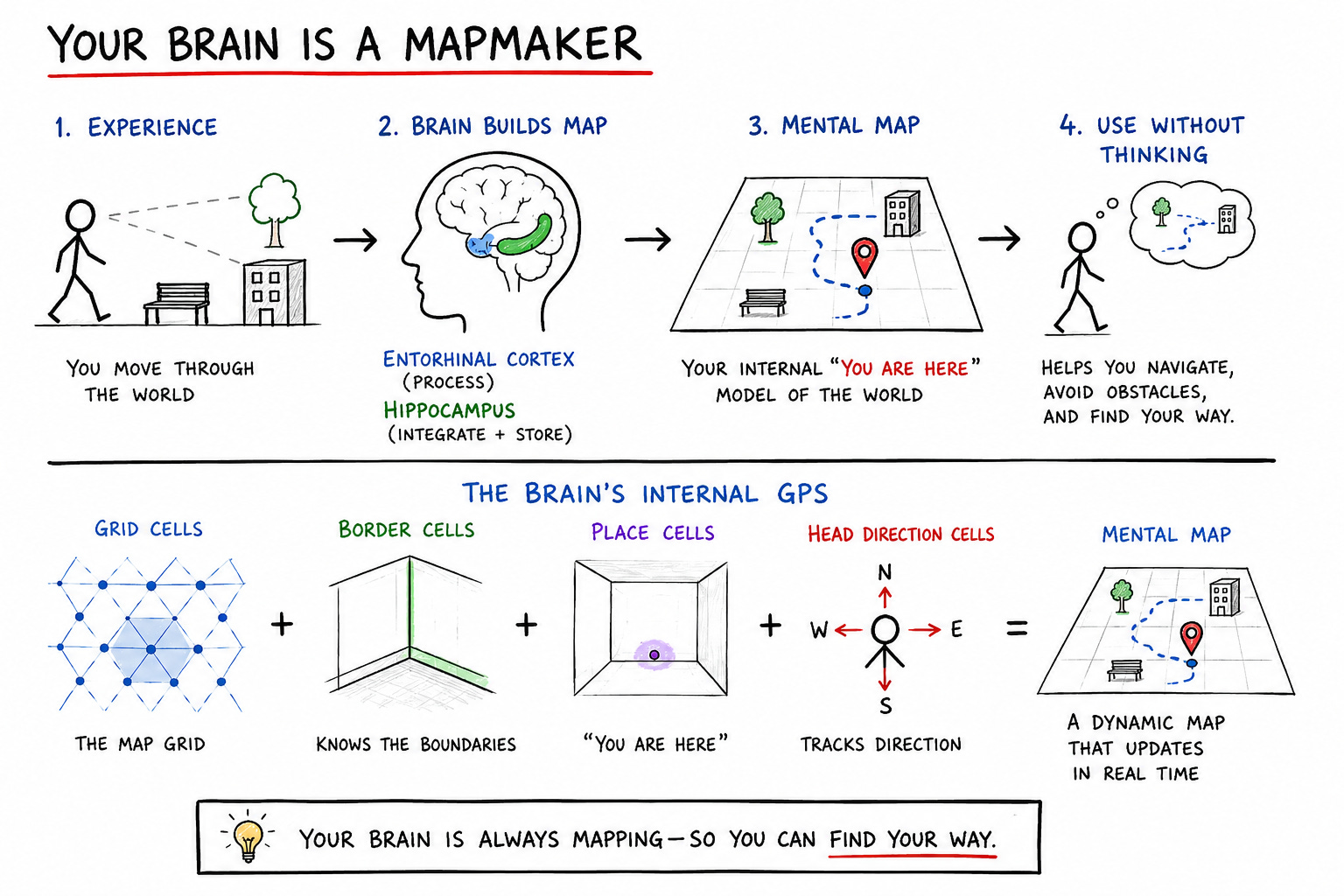
Your brain builds models of the spaces it’s in. Go into a building, and your hippocampus gives a thumbs up — it knows what to expect from a “building:” hallways, doors, water fountains and other landmarks. Meanwhile, your sensory organs are feeding your brain specific information — including landmarks — that make this “building” unique in the hippocampus’ collection of “buildings.”
Internal navigation loves landmarks.
This process is going on all the time. We don’t notice it.
Break this process down, and things get uncomfortable.
That’s what the Backrooms do — they short-circuit the brain’s mapping system. The Backrooms are nothing but repetition and sameness. Rooms feel familiar, but not unique. A hallway should help you orient yourself. A landmark should help you build a map. A room should tell you where you are. In the Backrooms, every new piece of information feels useless.
The Backrooms fight the brain’s machinery that’s trying to build a map.
Whether you’re watching it or experiencing it, you’ll experience disorientation, uncertainty, and a loss of control. This is spatial anxiety, and we’ve all felt it at one time or another. The brain’s trying, but cannot make sense of the world it’s in. It doesn’t know whether it’s making progress by moving in a certain direction or just walking in circles.
If you knew you were in a maze, you’d probably feel a little better with that knowledge, but the Backrooms don’t look like a maze. They just…continue.
A nowhere of endless sameness.
Uncertainty Is Worse Than Danger
Let’s say you’re urban exploring in an abandoned mall. Two scenarios:
Scenario A: Standing in front of an abandoned Spencer’s (no judgment), you look down the way, and in the dim light, you see a figure. Slowly, they pull a machete from behind their back.
Scenario B: Standing in front of that Spencer’s (starting to judge), you hear a noise from the mall’s second floor. Were they footsteps? A metallic tap-tap-tap? Just the structure settling, adjusting to the temperature?
It’s the secret sauce of scary movies. You can reveal or withhold (and hint). Both produce different responses, and you can certainly think of movies that did either one. But of the two, Scenario B often creates longer-lasting stress. It keeps your defensive system active because your brain hates unresolved threats. It wants to know, and it wants to know now.
Your brain was made to handle stress that could be easily identified and dealt with, not unresolved stress and anxiety.
When the brain detects a threat, it activates the sympathetic nervous system, triggering the well-known “fight, flight, or freeze” response. The response’s main hallmarks are increased vigilance, hyper-awareness, the release of stress hormones, and a heightened startle response. For a revealed threat, the brain evaluates and gets things rolling. The adrenal glands have dumped those stress hormones into your bloodstream, and you’re ready to throw hands, run, or be literally paralyzed with fear.
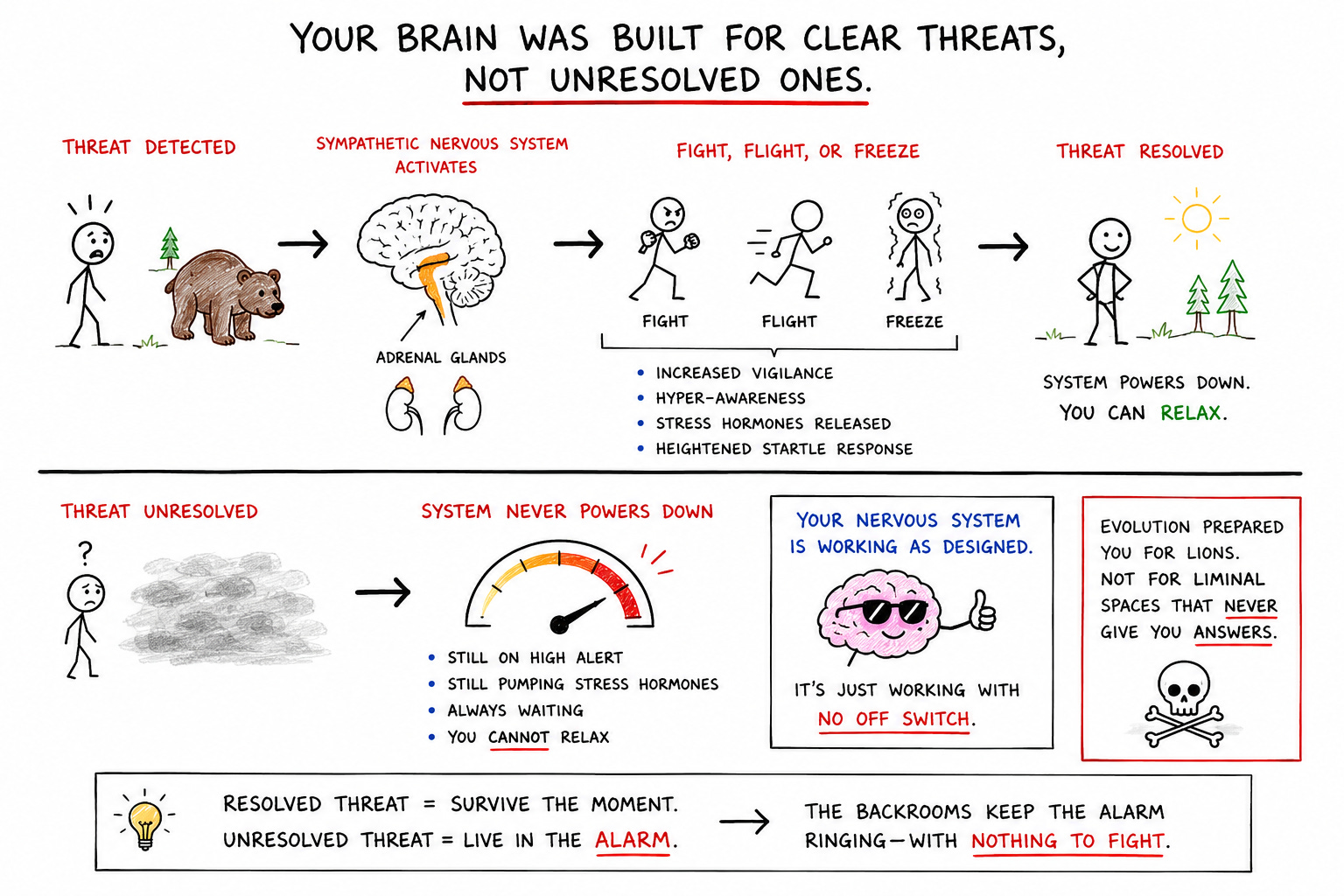
But when the threat is never resolved, the system never fully powers down. It’s still there, waiting and ready. You cannot relax. In a sense, that’s a good thing. Your nervous system is working exactly as designed.
But when that state keeps going and going and going, it’s exhausting. And uncomfortable. You scan the surroundings more. Movement is slowed, and your sensory awareness goes through the roof.
And the Backrooms rarely present a visible threat. Just strange sounds, hints of distant movement, empty corridors, and endless uncertainty. Your nervous system becomes trapped in that same endless anticipation. It’s Scenario B, stretched out indefinitely.
The scariest part from this side of the neuroscience of the Backrooms isn’t that something might be there. It’s that your brain never gets permission to stop looking.
Side Note: Early video games accidentally discovered something horror filmmakers already knew: what you don't show can be more unsettling than what you do. Fog hid technical limitations, but it also forced players to imagine what might be lurking just beyond the edge of visibility. Silent Hill was and still is creepy as hell.
This Place Feels Familiar
The third gut punch the Backrooms makes to our brains?
Nostalgia.
Again, your brain is desperate to make sense of its surroundings, and dammit, the Backrooms feel…familiar.
But they’re not.
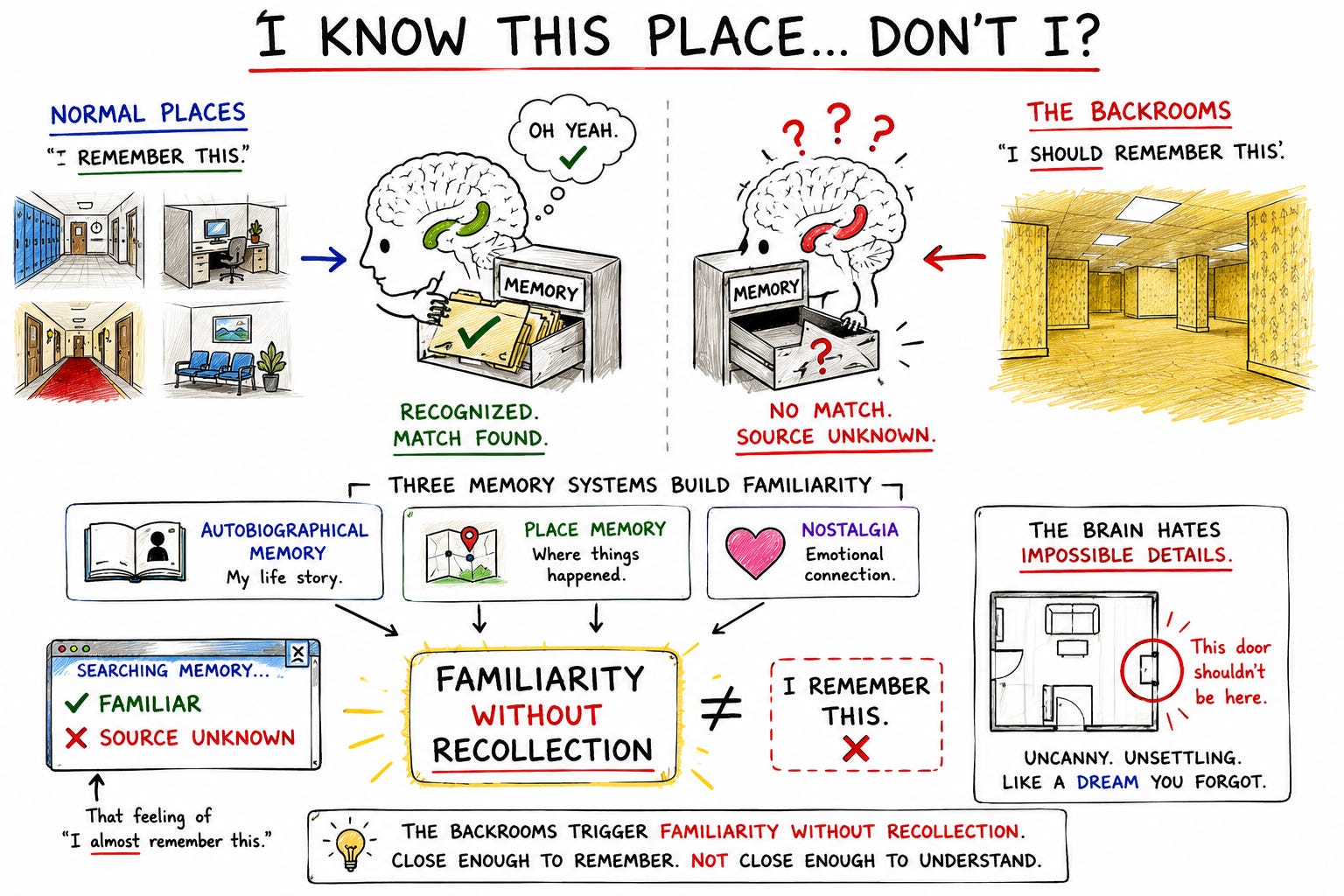
Moving through the Backrooms, they feel like schools, or office buildings, or hotels, or waiting rooms. Spaces you’ve been to many times and have memories of. But this? This place isn’t identifiable. It doesn’t match any of the patterns your brain wants to compare it against.
Usually, when your brain asks, “Wait — have I seen this before? Can I place it in my memory?” the answer is yes. You’ve been there before, or the setting is similar to other places like it. But the Backrooms break that process.
Several memory systems come into play here:
Autobiographical memory - your life’s narrative and identity
Place memory - the collection of places where things occurred
Nostalgia - an emotional response often built from the first two.
With the Backrooms, none of these are working fully. You might kinda remember having seen a place that kinda looks like this. Kinda.
And that “kinda” is the key to the unsettled nature of the Backrooms.
Neuroscientists call this familiarity without recollection. It’s not “I remember this,” it’s “I should remember this.”
And that’s uncomfortably close to “I almost remember this.”
Your brain, when seeing the various locations of the Backrooms, gets a ping of familiarity, but none of the reward that comes with recognition.
Because those memories remain fuzzy, the Backrooms take on that uncanny feeling. It’s like you’re walking through a dream you forgot you had, or a school hallway that never existed, or a location from your childhood that you realize you misremembered. It’s like when you have a dream about walking through your home, and you see a door where you know, for a fact, no door exists. Unsettling, yeah?
Or think about the early days of video games. Producers offered games with ambitions that exceeded the hardware’s capabilities. How to make something creepy (that the processor couldn’t reliably render?) Add fog. Keep the immediate surroundings somewhat familiar, but mist things out starting at the mid-distance.
The Backrooms, created from bits and pieces of real environments, feel like that — a damaged memory. Not something fake that your brain could suss out immediately, and not something real, but something in between.
All your brain wants to do is make sense of the setting and find a match somewhere in storage, and it’s trying every tool it’s got, but none of them work.
The Monster Paradox
This is more observation than science, but many Backrooms fans think that the entities that show up are the weakest part of the lore of Parsons’ Backrooms.
I know, I know — “But it’s a horror movie! There should be monsters!”
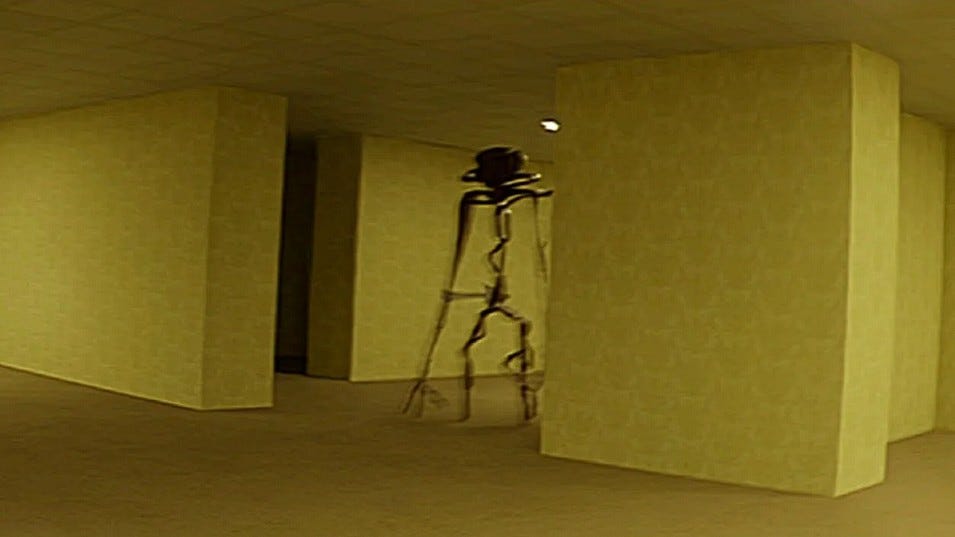
But — go with me here. The monsters in the Backrooms change the idea from environmental horror to a problem with a potential solution. The monster (or entity) gives certainty to an uncertain, unfamiliar world that is attacking the three systems of your brain that you rely on, day-in, day-out.
Now, this unsettling liminal space has a rock. An anchor. You know that:
Something is chasing you
It wants _____
It behaves like this…
Your brain, which has been desperate to make sense of the world it’s found itself in, can start making rules. As a result, the mystery shrinks. It’s fear of a thing versus fear of a place. One hits harder - consider the creepiness of:
An abandoned hospital
Empty schools at night (I’m a teacher, and they still freak me out)
Endless stairwells
Dense fog
The environment is the antagonist. It’s the threat to your understanding of the world, attacking your brain.
Monsters? Hell, monsters can be chased and killed, demons exorcised, invaders sent back to where they came from, but what do you do when the world itself is the enemy? Not in the active sense, but in the passive, like the Backrooms.
The real “monster” of the Backrooms isn’t a traditional monster that appears in the stories. It’s not an entity.
The monster is uncertainty itself. The architecture of the Backrooms is the predator. The environment has trapped your brain inside a problem it cannot solve.
Your Brain Was Not Designed for the Backrooms
Every day, your brain relies on three systems to function within its environment: navigation, threat detection, and memory. The Backrooms attacks all three.
To experience the Backrooms is to know what it’s like to be unable to build a reliable map of your surroundings in your mind, to be unable to determine whether danger actually exists, and to be unable to determine whether a place is truly familiar.
Mess with any one of them, and things get weird. Go after all three, and that’s the perfect storm — hitting the audience exactly where evolution left us vulnerable.
The result of watching the Backrooms isn’t just fear. Traveling through the yellow rooms creates a sense of cognitive disorientation.
Unlike so many horror stories, the Backrooms aren’t terrifying because something is hiding in the darkness. They’re terrifying because the darkness has moved into systems we normally trust without thinking: our sense of place, our sense of safety, and our sense of memory. The moment those systems stop working, even a fluorescent-lit office can become a nightmare.
The Backrooms aren’t a haunted house.
They’re a haunted operating system.
Curiosity is what brought me here.
Teaching is what I do with it.
If you’d like to read more about education, classrooms, students, and the craft of teaching, you’ll find those stories in Teacher, Teacher.