
Why the Cat in Flow Still Looks Like a Cat
Dogs are our employees. Cats are contractors. The surprising science of why one would outlast civilization almost unchanged.
Background: The following is a larger version of a talk given on 6/25/26 at the outdoor screening of the film, Flow. The showing was held at Kaleideum in Winston-Salem as part of a/perture Cinmea’s Science on Screen film series.
If you haven’t seen Flow, you should; it’s wonderful. Trailer at the end of the article.
Cats and dogs are different.
I know, I know. But go with me here.
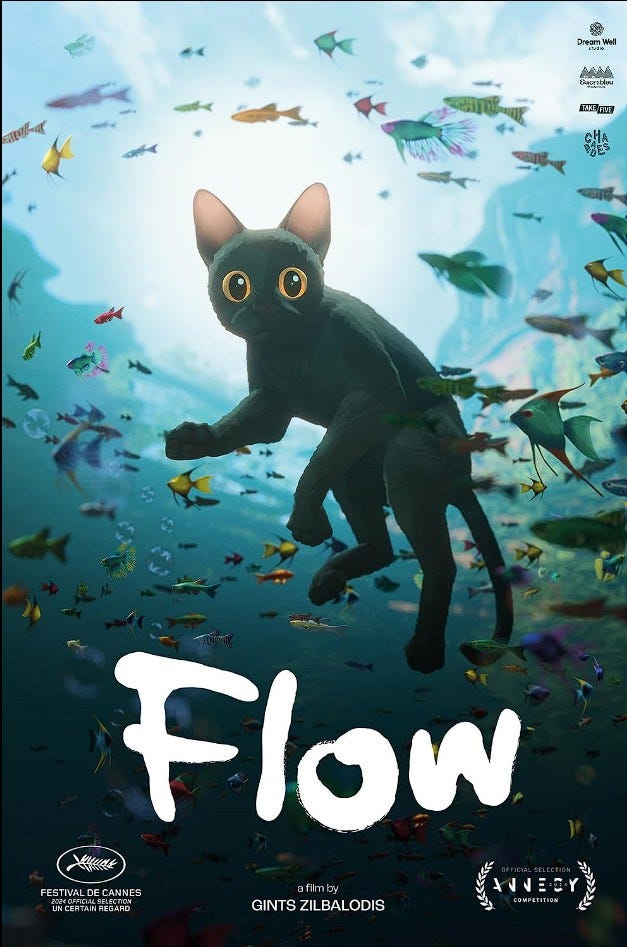
In the 2024 film Flow, we’re dropped into a post-apocalyptic world where all humans have vanished, apparently almost overnight. No bodies. No evidence of war or large-scale destruction. People are just...gone. This also isn’t Pixar or Disney. The animals don’t talk. In fact, there’s no dialogue at all.
Cities are crumbling, forests are reclaiming roads, and the water is rising.
And quietly moving through it all is...a cat. The unnamed cat doesn’t look futuristic. It isn’t mutated. It doesn’t have wings. It looks just like…your cat.
Yeah, but should it?
To answer that, we actually need to go back about 30,000 years.
The Animal That Domesticated Itself
When we think about domesticated dogs and cats, we’re actually talking about two completely different evolutionary stories.
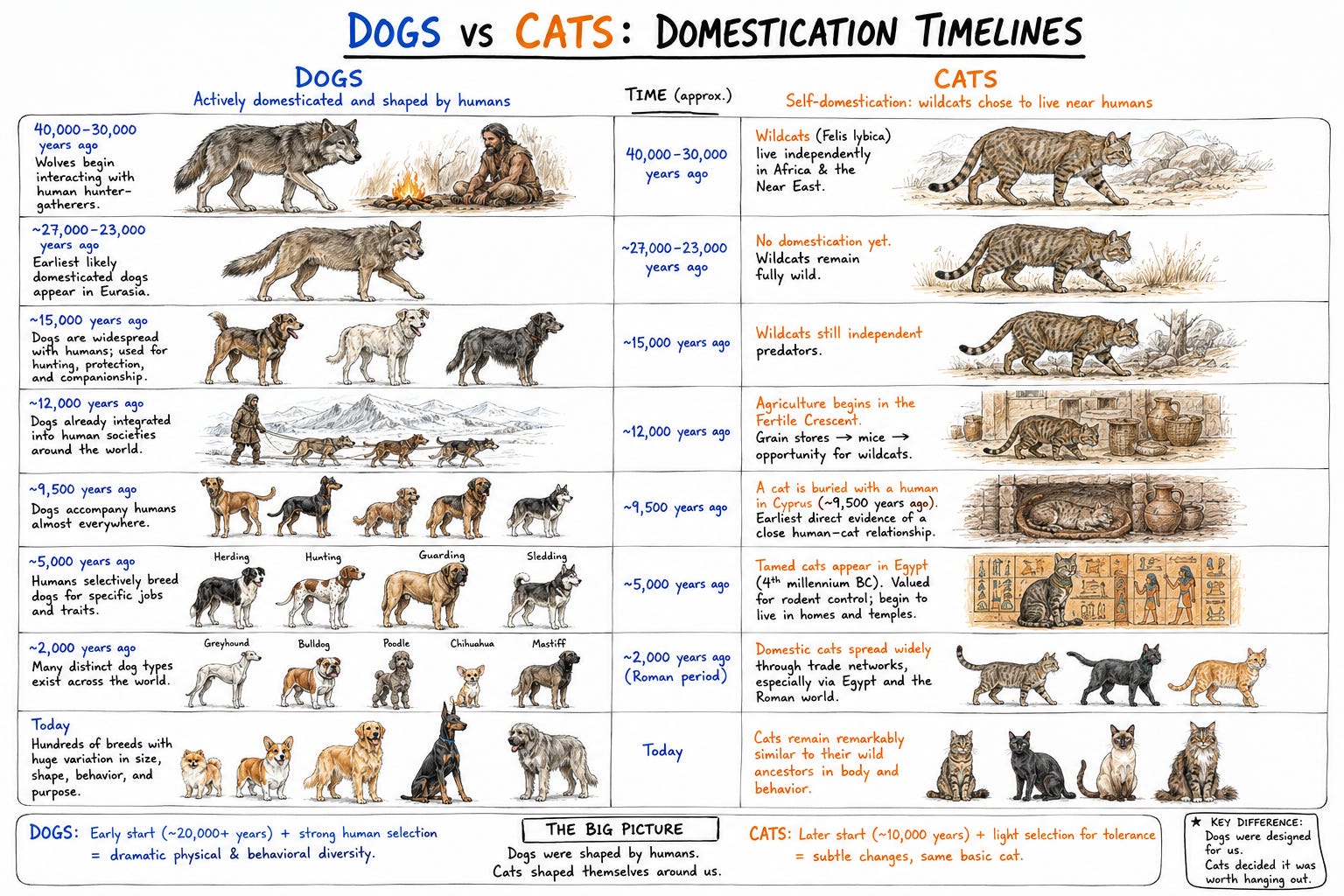
Our domestication project with dogs began somewhere between 30,000 and 40,000 years ago, when wolves started hanging around the camps of our hunter-gatherer ancestors. It worked because both species were after the same things: food and security. Over time, we began helping each other.
Over time, wolves with gentler dispositions (and eventually more puppy-like features) got more food and were allowed to stay closer to the fire. Better-fed, more secure wolves reproduced more successfully, and over generations, the traits that made them friendlier spread through the population. By roughly 15,000 years ago, dogs were established companions across much of Eurasia, and our domestication project really took off. Once dogs were part of human society, we began intentionally breeding them for specific jobs: protection, herding, hunting, sled pulling, and eventually companionship.
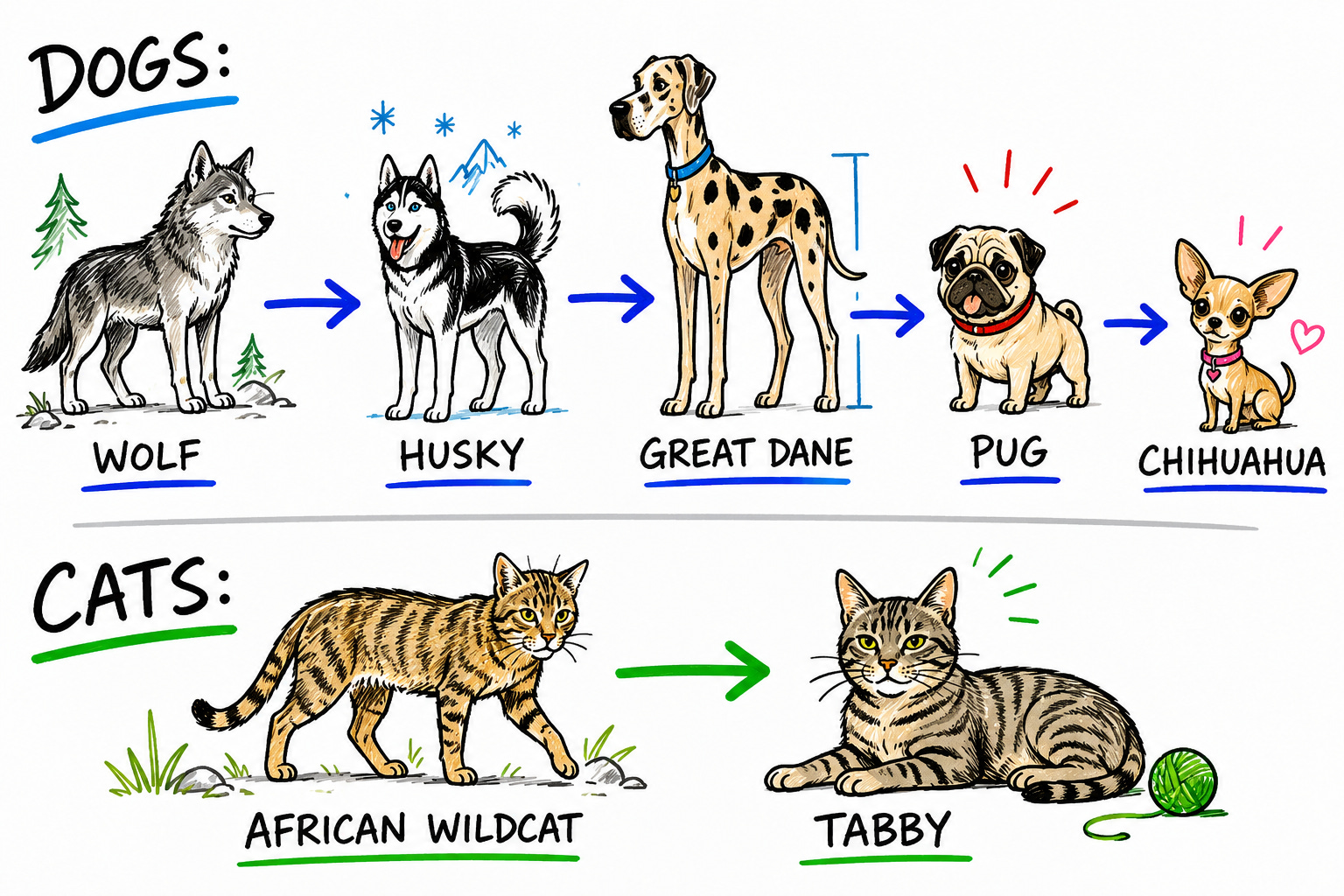
The results of that project are obvious today. Every dog, from a Chihuahua to a Great Dane, shares a common ancestor with the gray wolf. Even the one that snores and farts under the table while you’re watching a movie.
Cats? Their story is completely different.
Cats joined the human story a few thousand years after dogs. Wildcats were doing just fine on their own. They had no reason to seek us out, and they were understandably wary of humans. By the time dogs were firmly part of human society, our shift from hunting and gathering to agriculture accidentally created an opportunity that wildcats couldn’t ignore.
Part of agriculture involves storing grain; stored grain attracts rodents, and rodents attract wildcats. Circle of life.
We eventually shaped wolves into the dogs we needed. We never really set out to create cats. Biologists call this commensal domestication. Human settlements benefited the cats. Cats benefited humans.
In a very real sense, dogs became our invention. Over thousands of years, we shaped them into hunters, guardians, herders, sled pullers...and eventually, companions small enough to ride around in a designer handbag.
Cats chose to become our neighbors. We simply took care of the ones that didn’t immediately run away or try to maul us.
If you think about it, our relationship with them looks a lot like the workplace:
Dogs are employees; cats are contractors.
Both get paid, but only one of them pretends they don’t need the job.
From Wolf to Pug, From Wildcat to…Cat.
All the dog breeds that populate the world today? Yeah, that’s on us.
As mentioned earlier, our intentions for cats were practical. We needed partners to help us hunt, herd livestock, guard our camps, and eventually even follow animals into burrows (looking at you, dachshunds). Selective breeding isn’t fast, but given enough generations, it works. Breed one dog with desirable traits to another with desirable traits and, hopefully, their puppies inherit both. If not, try again.
Over and over, for thousands of years.
If you’re a cat person, you know this. You quickly get used to the idea that the feline sharing your home would probably do just fine without you. Every now and then, you catch a glance that expresses your cat’s sheer tolerance of being near you.
Cats didn’t need to change.
Meet the African wildcat, Felis lybica, the primary wild ancestor of today’s domestic cats.
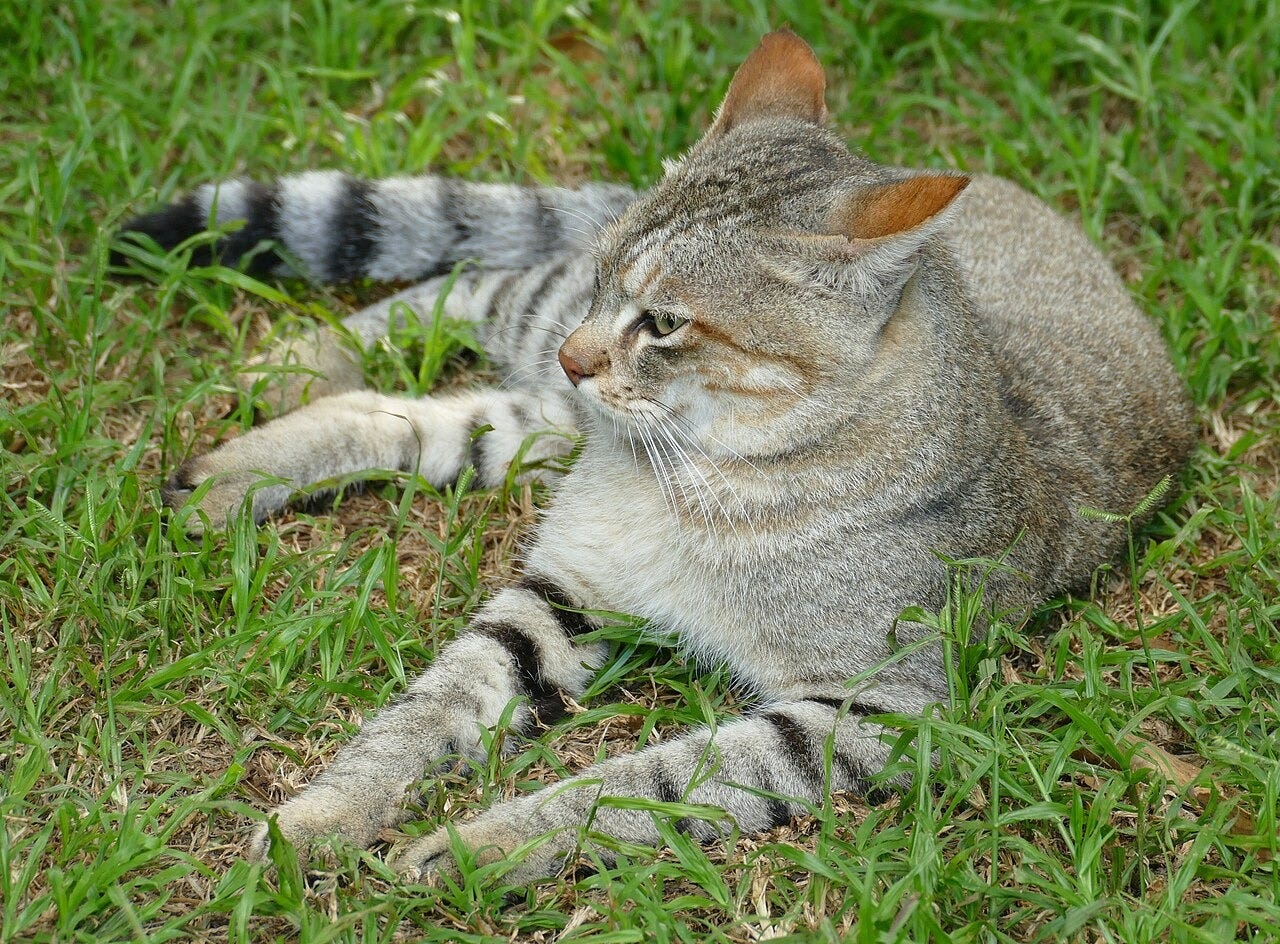
Yup. That’s basically...a cat.
There are two reasons for that. First, cats joined us roughly 20,000 years after dogs. Second, they never needed a different job. They’re still doing exactly the job they applied for: hunting rodents. Anything they do other than hunting rodents is just waiting to hunt rodents. There are even suggestions that cats are neurologically plucking at our heartstrings, endearing themselves to us with their baked-in cuteness.
Domesticated cats have undergone surprisingly few physical changes. Compared to African wildcats, they have slightly smaller brains and a handful of subtle skull differences, but that’s about it. Otherwise, the cat sleeping on your couch is basically a wildcat with better customer service.
As grain stores spread throughout the ancient world, so did cats. One of the earliest pieces of evidence for the human-cat partnership comes from a 9,500-year-old burial site on Cyprus, where a person was buried alongside a cat. Wildcats weren’t native to Cyprus, so someone intentionally introduced them there. Whether it arrived as a pest controller, a companion, or both, it was important enough to be buried beside its human.
Cats became especially important in ancient Egypt, where they protected grain stores, became household companions, and were eventually associated with the goddess Bastet.
From there, cats traveled with merchants, farmers, soldiers, and sailors. They spread along trade routes, aboard Roman ships, and later with European explorers, becoming one of humanity’s most successful traveling companions.
Because domestic cats spread so recently and so successfully, scientists still view them as a single global population with relatively little genetic differentiation.
But there was almost a different form of cat hanging around humans…
China Tried Its Own Cat Partnership
Around 5,400 years ago, leopard cats began appearing in archaeological sites associated with farming villages in China. They also show up in ancient Chinese art. This relationship appears to have lasted for centuries. Then, sometime during the first millennium CE, leopard cats gradually disappeared from the archaeological and cultural record, replaced by domestic cats descended from African wildcats.
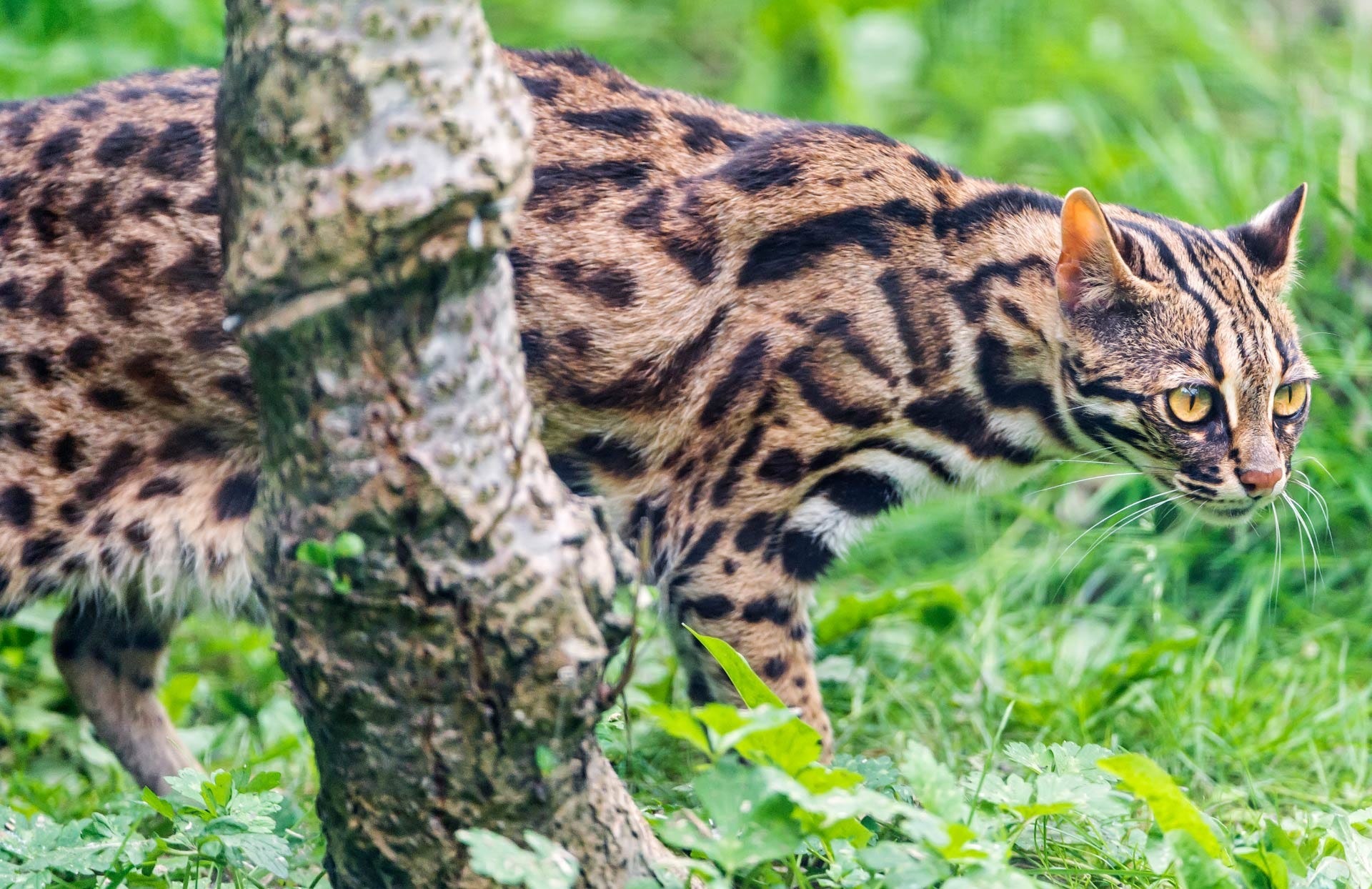
The reason leopard cats moved into ancient Chinese settlements was probably the same one that drew African wildcats into villages in the Near East. Like other human civilizations, agriculture created the same food chain:
Villages → grain stores → rodents → leopard cats.
And…
…nothing.
It took centuries, but the great leopard cat experiment eventually fizzled.
It was one of those rare cases of evolution running the same experiment twice.
Once, with African wildcats, we got the cat sleeping on your couch.
The second time, with leopard cats in ancient China, the experiment simply...didn’t take.
African wildcats and humans formed a successful commensal partnership. Leopard cats and humans, for reasons we still don’t fully understand, didn’t.
Leopard cats didn’t disappear from China; they simply disappeared from human settlements and the archaeological record.
Side note: There is absolutely no evidence that a leopard cat, after years of being antagonistic towards the Emperor, scratched him one too many times, and the Emperor decreed that there would be no more cats in houses. It’s a kind of funny story, but no evidence.
Nearly a thousand years later, domestic cats descended from African wildcats arrived via long-distance trade, probably by the Tang Dynasty. Those are the ancestors of the house cats living in China today.
Would Cats Survive Us?
So let’s go back to the world of Flow.
If humanity disappeared tomorrow, how would dogs do?
Many working breeds would probably adapt reasonably well, just as we see in Flow. Others would struggle almost immediately. Bulldogs, pugs, and many toy breeds would find themselves on evolution’s very short list of unfortunate design choices.
Over many generations, without human breeding, the boundaries between dog breeds would gradually disappear. The end result would most likely be a medium-sized, lean, athletic dog with upright ears, a narrow muzzle, and a short coat, with many populations likely hunting cooperatively when conditions favored it.
Side note: What was just described can now be observed: about 75–80% of the world’s dogs aren’t pets. They’re free-breeding village dogs. Across Africa, Asia, South America, and parts of Europe, they’ve already converged on almost exactly the same body plan: medium-sized, tan or brown, short-haired, pointed ears, narrow muzzle, athletic build. That’s kind of cool from an evolutionary perspective.
What about cats? Cat people already know the answer: cats would do just fine without us.
Cats are fully domesticated, but they’re much less changed by domestication than dogs are. They still know how to stalk, hunt, climb, and survive on their own. They tolerate partnerships with humans remarkably well, yet retain many of the skills that made their wild ancestors successful. They’re remarkably unchanged despite their millennia-long relationship with us. The millions of feral cats living around the world demonstrate just how quickly domestic cats can return to hunting and independent living.
Over generations, feral populations would likely become leaner and warier, gradually losing traits that only make sense in human homes. But overall, they probably wouldn’t look dramatically different from today’s cats.
Dogs would spend generations becoming more like their ancestors.
Cats?
They’ve never wandered very far from theirs.
Evolution Doesn’t Care About Ownership
Given our long relationship with cats and the role they play in our lives, it’s easy to think that we “created” cats the same way we created dogs.
That’s not the way the science rolls here.
We didn’t choose cats; they chose us. We built an ecosystem that rewards one particular type of wildcat — one that does the job, isn’t too scared of us, and responds to rewards. The cats stayed because it worked.
Civilization changed the world and undoubtedly created the dog, but it barely changed the cat.
Flow imagines a world after us.
Ironically, one of its most believable characters may be the one we’ve been living beside for more than 10,000 years.
Curiosity is what brought me here.
Teaching is what I do with it.
If you’d like to read more about education, classrooms, students, and the craft of teaching, you’ll find those stories in Teacher, Teacher.