
Lonely Galaxy Guide to the Project Hail Mary Neighborhood
From the Sun to Tau Ceti to Erid—and the Physics That Connects Them
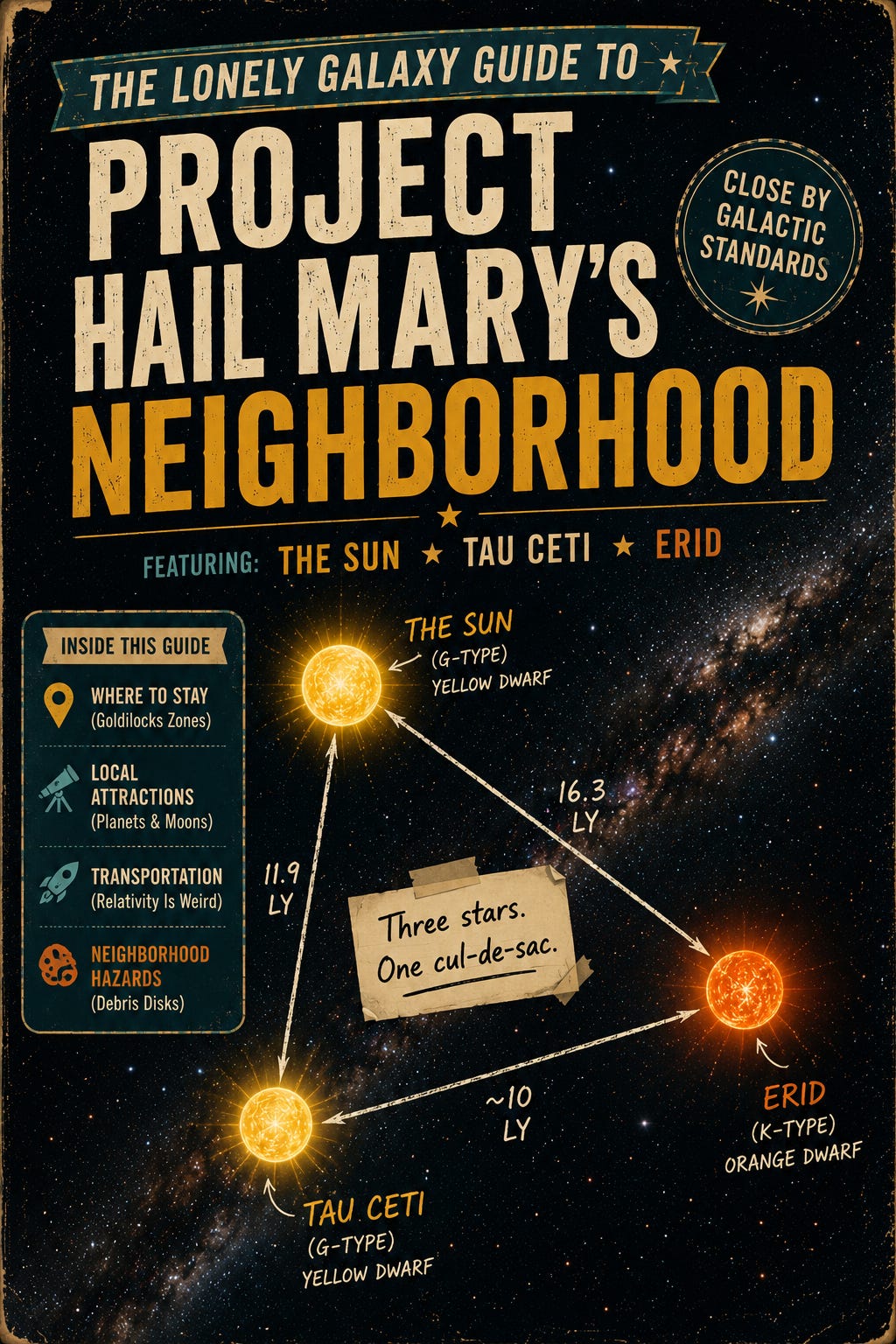
The Milky Way is enormous.
The neighborhood we’ll be visiting today? Not so much.
Well, relatively.
On the scale of the Solar System, the journey Ryland Grace undertook in Project Hail Mary was almost unimaginable. Sixteen light-years is such a ridiculous distance that our brains quietly file it under “basically infinite” and move on.
But that’s only if you’re thinking on Solar System scales.
Zoom out - way out.
Far enough that the entire Solar System disappears into a single pixel and the Sun becomes just another star among hundreds of billions.
From that perspective, Grace’s voyage wasn’t a trek across the galaxy.
It was a trip across the neighborhood.
In fact, the three systems we’ll be visiting today - the Sun, Tau Ceti, and Erid are so close together that, as far as the Milky Way is concerned, they’re on the same street. (If you zoom out to the scale of the observable universe, they really are in the same place. But that’s a different article.)
Today, we’ll travel from Earth to Tau Ceti and then onward to Erid, covering a total of about sixteen light-years without ever leaving the same galactic cul-de-sac.
Before we go, though, let’s make sure we’re all speaking the same language.
Terms and Conditions that Will Apply
Distance
On Earth, we measure distances in miles (if you’re in one of the few countries still clinging to Imperial units) or kilometers.
Just in case high school science was a long time ago, a kilometer is 1,000 meters, or about 0.62 miles.
That’s Earth-scale thinking. Astronomers gave up on that nonsense a long time ago.
The problem is that space is big. Really big. Distances that seem enormous on Earth become inconveniently small once you leave it.
For travel within a solar system, astronomers use the Astronomical Unit (AU): the average distance between Earth and the Sun.
One AU is about 93 million miles (150 million kilometers).
Using that scale:
Earth orbits at 1 AU
Jupiter orbits at 5.2 AU
Neptune orbits at about 30 AU
For most of the Solar System, the AU is a perfectly useful yardstick. But once you start traveling between stars, even the AU starts feeling a little cramped.
That’s where the light-year comes in.
Despite the name, a light-year is a measure of distance, not time. It’s simply the distance light travels in one year.
One light-year equals:
63,241 AU
5.88 trillion miles
9.46 trillion kilometers
Which sounds enormous until you realize that the entire journey of Project Hail Mary takes place across only a handful of them.
Side Note: Parsecs
At some point, someone will ask why we’re using light-years instead of parsecs. Fair question.
A parsec is another unit of distance used by astronomers. One parsec is equal to about 3.26 light-years.
Unlike a light-year, which is based on how far light travels in a year, a parsec is a unit of distance derived from geometry. Specifically, it’s the distance at which 1 AU would appear to shift by one arcsecond against the background stars as Earth moves around the Sun.
If that sentence made your eyes glaze over, don’t worry. Mine too, and I teach this stuff. The important thing to know is that parsecs are incredibly useful for astronomers because they’re tied directly to how we measure distances to nearby stars.
The important thing to know for this article is that they’re annoying. Not because they’re bad. They’re perfectly good units.
But if I tell you that Tau Ceti is about 3.65 parsecs away and Erid is about 4.9 parsecs away, most people’s brains immediately respond with, “Cool. Is that close?”
If I tell you they’re about 12 and 16 light-years away, respectively, at least the unit itself provides a hint that we’re talking about really large distances.
Astronomers may grumble. They’ll survive.
As for the whole “parsecs in Star Wars” debate, we’re not opening that airlock today.
For the rest of this trip, we’ll mostly speak in AUs when we’re inside a solar system and light-years when we’re traveling between them.
The simplest version? Think of AUs as city blocks, and light-years as the distance between towns.
One final note before we leave Distance behind: If you draw lines between Earth, Tau Ceti, and Erid, you don’t get a straight line. You get a triangle.
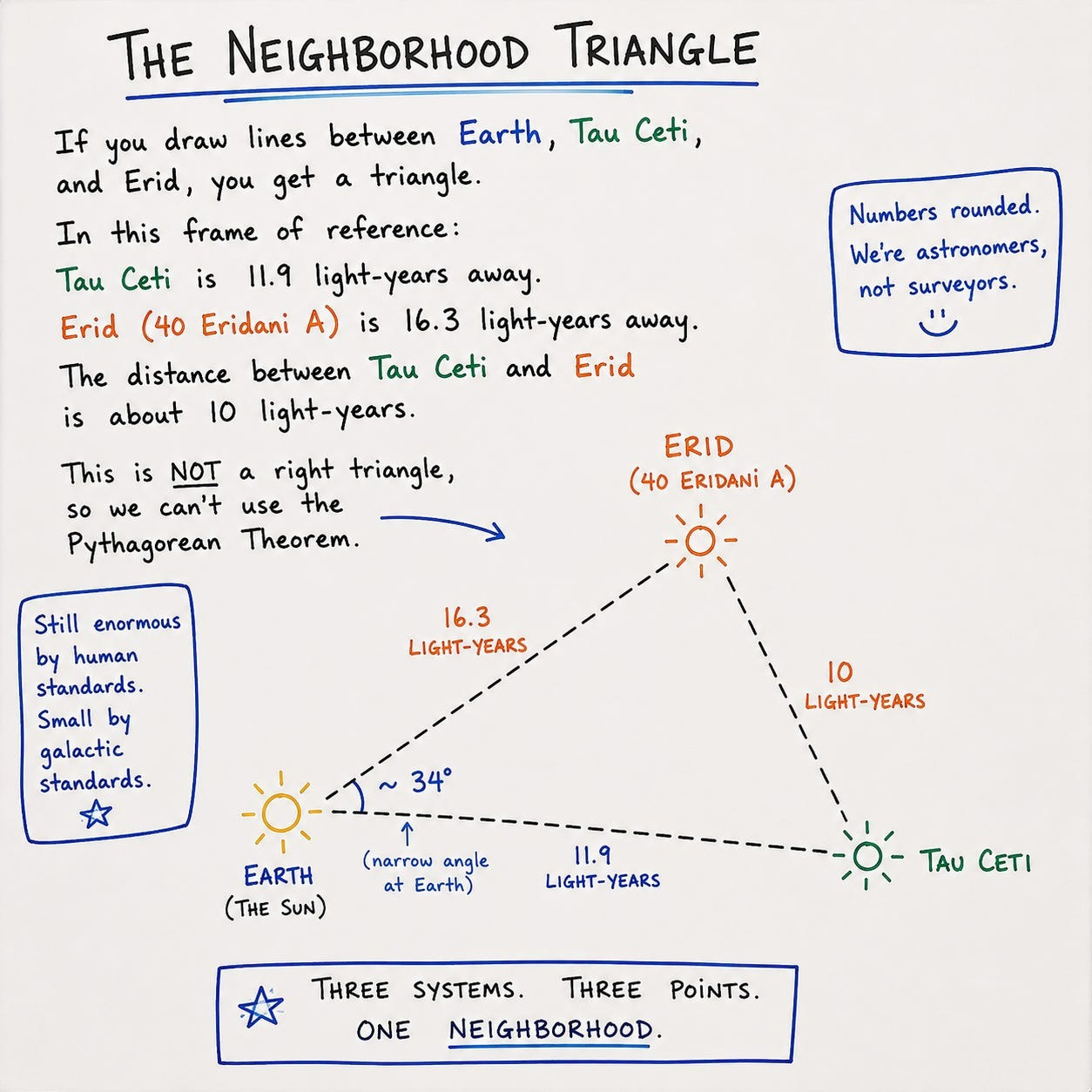
Earth sits at one corner. Tau Ceti sits about 11.9 light-years away. Erid sits about 16.3 light-years away. The surprising part is the third side.
Tau Ceti and Erid are only about 10 light-years apart.
That’s still an absurd distance by human standards. But on a galactic scale, it’s another reminder that these systems are neighbors.
Again, if the Milky Way were a city, the Sun, Tau Ceti, and Erid wouldn’t be in different states.
They’d be on the same street.
Just for one final reference, and to drive home the point that Erid and Tau Ceti are our neighbors, the center of the galaxy is 26,000 light-years away, while one of our nearby galaxies, the Andromeda Galaxy, is 2.5 million light-years away. Yeah, given that, we can look at Tau Ceti or Erid and see if someone left a light on in the window.
Types of Stars
Before we start hopping between solar systems, we need to talk about stars.
Not all stars are the same.
Some are larger, hotter, brighter, and burn through their fuel like a college freshman discovering energy drinks. Others are smaller, cooler, dimmer, and can keep shining for tens or even hundreds of billions of years. As a general rule, the cooler you burn, the longer you live.
Astronomers classify stars by their temperature and color using a system that ranges from hot blue stars to cool red stars. There are considerably more details than that, but for this trip, we only need to concern ourselves with three stars.
The Sun
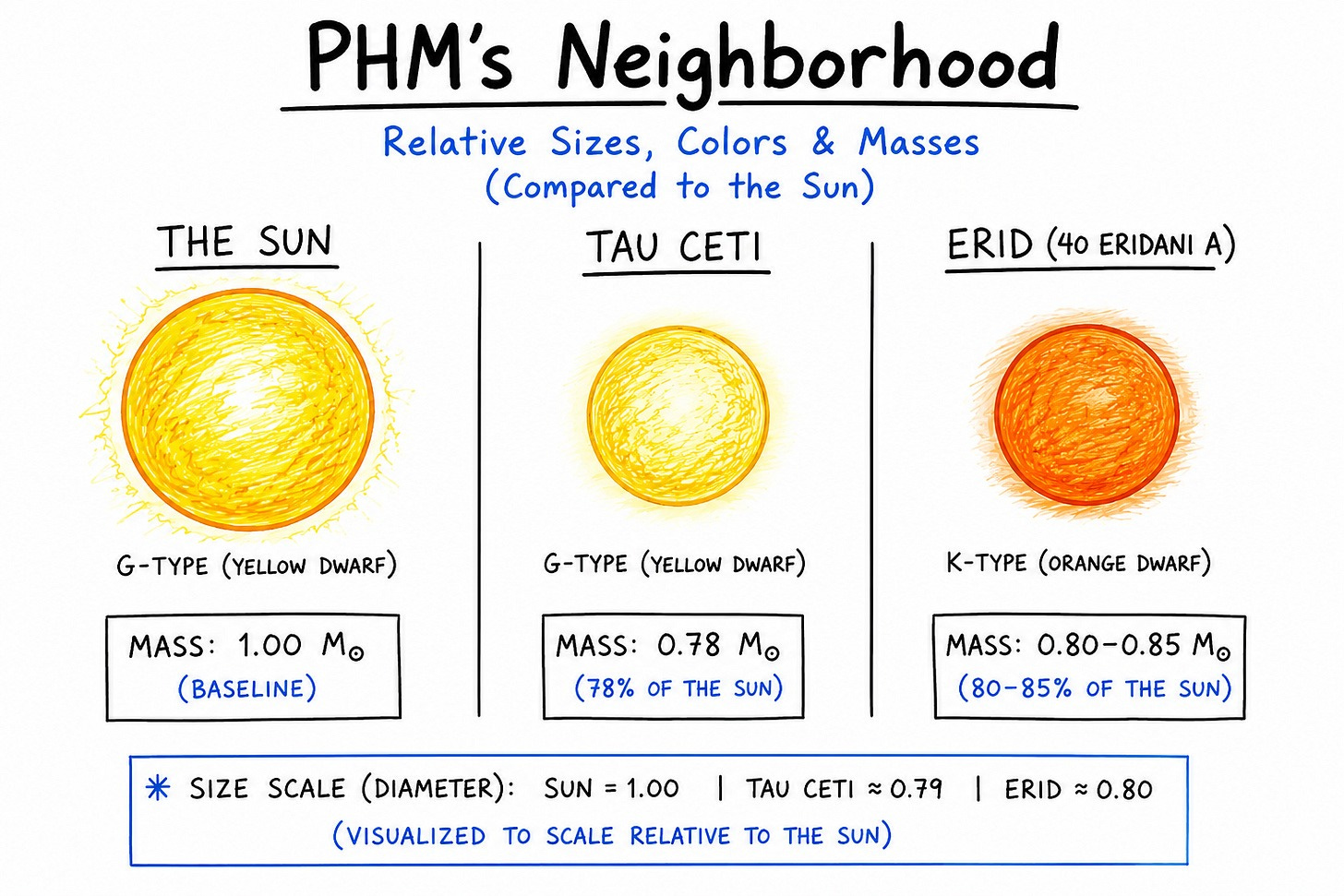
Our Sun is a G-type main-sequence star.
It’s the standard unit for this part of the trip: 1 solar mass, 1 solar radius, 1 solar luminosity.
Convenient. Almost suspiciously convenient. Like we live next to the thing or something.
The Sun has been steadily converting hydrogen into helium for about 4.6 billion years. It is bright enough to keep Earth warm, quiet enough not to sterilize it, and massive enough to provide the gravity that holds the entire Solar System together.
When astronomers talk about another star’s mass, radius, or brightness, they often compare it to the Sun.
Think of the Sun as the Holiday Inn of stars. Not the biggest. Not the fanciest. But clean, reliable, and familiar enough that we use it as the baseline for comparison.
Tau Ceti
Tau Ceti is also a G-type main-sequence star, making it one of the Sun’s closest cousins in the neighborhood.
It is smaller and dimmer than our Sun:
about 0.78 solar masses
about 0.79 solar radii
roughly 0.5 solar luminosities
In plain English: Tau Ceti has about 78% of the Sun’s mass, about 79% of its radius, and gives off about half as much energy (even before its Astrophage infection). So yes, it is Sun-like.
But “Sun-like” does not mean “basically the Sun with a different nametag.”
If you somehow swapped the Sun for Tau Ceti tomorrow, Earth would get colder. Not “instantly frozen death planet” colder, but colder enough that everyone would notice, especially the plants, the oceans, and everyone who already complains when the thermostat drops two degrees.
Tau Ceti is familiar enough to be useful and different enough to matter.
Which is exactly why astronomers care about it. It’s close enough to study, familiar enough to compare, and weird enough to keep things interesting, which we’ll talk about coming up.
Erid (40 Eridani A)
Erid is different.
The star Rocky calls home (which Grace eventually names “Erid”) is known to astronomers as 40 Eridani A. It is a K-type orange dwarf: cooler, dimmer, and longer-lived than the Sun. The “A” in its name is to keep track of it - 40 Eridani is a triple-star system, so there’s 40 Eridani A, B and C.
Side Note: No, we’re not going to lean into the 3-Body Problem here, either. This is Project Hail Mary. Focus.
Erid’s numbers are close to Tau Ceti’s in mass and size, but not in color or stellar personality:
about 0.8–0.85 solar masses
about 0.8 solar radii
roughly 0.4–0.5 solar luminosities
That means any potentially habitable planet orbiting Erid needs to orbit closer to Erid than Earth does to the Sun to receive comparable energy if we’re talking about human life. Which we’re not.
The payoff for Erid’s lower energy output is longevity.
Stars like the Sun live for roughly ten billion years. K-type stars like Erid can remain stable for several times longer. That matters because life does not care whether a star impresses us.
Life cares about time.
A stable environment that lasts for tens of billions of years gives evolution an awful lot of opportunities to try new things.
And as we’ll soon discover, these three stars host very different neighborhoods.
Habitability and Amenities
Before we dig in, let’s recognize our bias.
When astronomers talk about a planet being “habitable,” they’re usually talking about conditions that could support life as we know it. That sounds narrow because it is.
The problem isn’t a lack of imagination. The problem is a lack of data. We currently have exactly one example of a life-bearing world. Earth. Every definition of habitability we use is built from that single sample.
Liquid water. Moderate temperatures. A stable energy source. An atmosphere thick enough to be useful and thin enough not to crush you. These aren’t necessarily the universal requirements for life.
They’re the requirements shared by every living thing we’ve ever met.
This distinction will become important later.
Our Solar System
If you’ve ever looked at an astronomy diagram and wondered why every solar system seems to be compared to ours, the answer is simple:
It’s the only one we’ve got.
The Sun is our home star, our calibration standard, and the source of nearly every assumption we make about how solar systems are supposed to work. This is both reasonable and dangerous.
Reasonable because Earth is the only life-bearing world we’ve ever found.
Dangerous because Earth is the only life-bearing world we’ve ever found.
Side Note: The Goldilocks Zone
The Sun’s habitable zone is the region where temperatures could allow liquid water to exist on a planet’s surface. Not too hot, not too cold, just right.
For our Sun, Earth sits comfortably inside this zone at 1 AU (our reference point for basically everything). Venus is a little too close and has paid the price by becoming a pressure cooker wrapped in sulfuric acid clouds. Mars sits near the outer edge and appears to have spent much of its history arguing with itself about whether it wanted to remain habitable.
Being in the Goldilocks Zone does not guarantee habitability.
It simply means the thermostat is set correctly.
The rest of the house still has to be worked on.
Local Attractions
Our Solar System offers a surprisingly diverse set of destinations: inner, rocky planets that include Earth (the only place known to support life), and then the gas giants, each with enough moons to qualify as miniature solar systems in their own right.
Debris and Other Hazards
The Solar System is remarkably tidy. That’s not because there isn’t debris.
There is.
The Asteroid Belt between Mars and Jupiter contains millions of rocky bodies. Beyond Neptune lies the Kuiper Belt, home to Pluto and countless icy objects. Far beyond that lurks the Oort Cloud, a vast spherical reservoir of comets that extends almost halfway to the nearest stars.
But compared to what we’re about to see, our Solar System looks positively well-maintained.
The neighborhood association has clearly been doing its job.
The Tau Ceti System
If the Solar System is the neighborhood’s well-maintained reference property, Tau Ceti is the house down the street where the yard has gotten a little out of hand.
At first glance, Tau Ceti looks reassuringly familiar. The star itself is one of the Sun’s closest cousins: slightly smaller, slightly dimmer, and a bit older. If you were somehow able to stand on a planet orbiting Tau Ceti and look up, the star in the sky would not strike you as wildly alien. You’d recognize it as a star much like our own.
The similarities are one reason astronomers have spent so much time studying it. If the Sun and Tau Ceti started with broadly similar ingredients, comparing the two systems gives us a chance to understand how solar systems can evolve in different directions.
Local Attractions
Current evidence suggests that Tau Ceti hosts between 3 and 5 planets, including several super-Earth candidates. As with many exoplanet discoveries, we don’t see these planets directly. Instead, we watch Tau Ceti wobble slightly as unseen worlds tug on it with their gravity.
This means the exact planetary census around Tau Ceti remains a work in progress. As instruments improve and additional observations accumulate, the details continue to be refined. That’s not astronomers being indecisive. It’s astronomers doing exactly what they’re supposed to do when new evidence arrives.
Some of the planets may lie within or near the system’s habitable zone. Whether any of them are actually habitable is a different question entirely.
Debris and Other Hazards
The biggest difference between the Solar System and Tau Ceti isn’t the planets.
It’s the leftovers.
Surrounding Tau Ceti is a massive debris disk containing far more material than we find in our own Solar System. Depending on which estimates you use, the system may contain roughly ten times as much cometary and asteroidal material as ours.
That’s a lot of leftover construction debris.
The implication is fairly straightforward. If planets are orbiting Tau Ceti, they are likely sharing the neighborhood with considerably more asteroids and comets than Earth does. Over long periods, that could mean more impacts, more disruption, and fewer opportunities for a planet’s surface environment to remain stable for billions of years.
That doesn’t make life impossible. Life has proven remarkably stubborn here on Earth. It does suggest, however, that a habitable-zone planet around Tau Ceti may have a more eventful history than our own.
Tau Ceti feels familiar enough to be recognizable, but different enough to remind us that solar systems are not manufactured from a standard template.
The 40 Eridani System
While Tau Ceti is one of the Sun’s closest cousins, 40 Eridani A belongs to a somewhat more complicated family.
As mentioned earlier, 40 Eridani is not a solitary star. It is part of a triple-star system. The primary star, 40 Eridani A, is an orange dwarf. Orbiting far away are two stellar companions: 40 Eridani B, a white dwarf, and 40 Eridani C, a red dwarf.
That’s already enough to make the system interesting.
One member of the family is still in the prime of its life (A). Another has reached stellar retirement and shed its outer layers (B). The third is a small, efficient star that may continue shining long after the others are gone (C).
Local Attractions
The main attraction here is the star itself.
As an orange dwarf, 40 Eridani A occupies a sweet spot that has attracted increasing attention from astronomers over the last few decades. It is smaller and dimmer than the Sun, but not dramatically so. A planet receiving Earth-like levels of energy would need to orbit somewhat closer to the star than Earth does to the Sun, but not so close that it would face some of the challenges associated with smaller red dwarf stars.
Stars like 40 Eridani A burn their fuel slowly.
Very slowly.
Current models suggest that orange dwarfs can remain stable for tens of billions of years—long enough that the Sun will be a memory before they’re done. And potentially long enough for biological and geological processes to play out over extraordinary stretches of time.
When astronomers talk about promising stars for long-term habitability, orange dwarfs frequently find themselves near the top of the list.
Exoplanet searches around 40 Eridani A have produced intriguing but inconclusive results, with some research suggesting a single planet closer to the star than Mercury is to our Sun, far inside the Sun’s habitable zone.
Side Note: Erid and Science Fiction
Writers seem to look at 40 Eridani A and have the same reaction astronomers do: ‘There’s probably something interesting there.’
Andy Weir wasn’t the first to place a planet that supports life around the star. In Star Trek, the star is home to the planet Vulcan, while in the Dune universe, the fourth planet in the star’s system is Richese, home to a technologically advanced culture.
Debris and Other Hazards
While exoplanets have not yet been confirmed for 40 Eridani A, neither has a massive debris disk surrounding the star. If such a structure exists, it appears to be far less prominent than the one that dominates Tau Ceti’s outer regions.
For anyone hoping for long-term planetary stability, that’s good news.
Large debris disks can act as reservoirs of comets and asteroids, increasing the likelihood of impacts over long periods. Without evidence for a substantial disk, 40 Eridani A appears, at least from our current vantage point, to be a comparatively orderly environment.
Of course, astronomy has a habit of humbling anyone who becomes too confident. Future observations may reveal additional surprises.
For now, however, 40 Eridani stands out not because of what surrounds it, but because of what the star itself offers: stability, longevity, and time.
Lots and lots of time.
Getting There
Project Hail Mary needed, essentially, magic to get Ryland Grace to Tau Ceti, and used the astonishingly convenient properties of Astrophage to do it.
The problem with traveling to nearby stars isn’t speed. The problem is enough speed.
The stars in our little neighborhood are between 12 and 16 light-years away. At the speeds achieved by current spacecraft, the trip would take tens of thousands of years. That’s less “vacation” and more “geological process.”
Astrophage made the problem workable, powering the spacecraft to achieve a speed that is a significant fraction of the speed of light.
And that’s where things get weird. Keeping track of deadlines in Project Hail Mary got a little weird. Earth had only a limited amount of time before environmental catastrophe, the trip to Tau Ceti would take years, and any solution would then need years more to make its way back home.
Huh?
It’s workable, but you have to invite Einstein to your party.
Okay - light touch.
Travel Time and Time Zone Considerations
Keeping things as simple as possible, one of the stranger consequences of Einstein’s theory of relativity is that time itself doesn’t pass at the same rate for everyone.
The faster you move, the more slowly time passes for you compared to people who stay behind. It’s not by much at everyday speeds, but at a substantial fraction of the speed of light, the effect becomes impossible to ignore.
Ryland Grace and the Hail Mary crew don’t just travel a great distance. They travel in a way that causes their clocks to run more slowly than clocks back on Earth. The trip still takes years, just not the same number of years for everyone involved.
If the Hail Mary reached roughly 92% of the speed of light, then, thanks to time dilation, the crew only experienced around 5 years of travel time. Still long enough to require the coma technology, of which Grace turned out to be the only beneficiary. Back on Earth, 13 years would pass.
If you want math, I’ve got math — but be warned: for pretty high-concept physics, the time dilation formula and Lorentz factors are really easy to calculate.
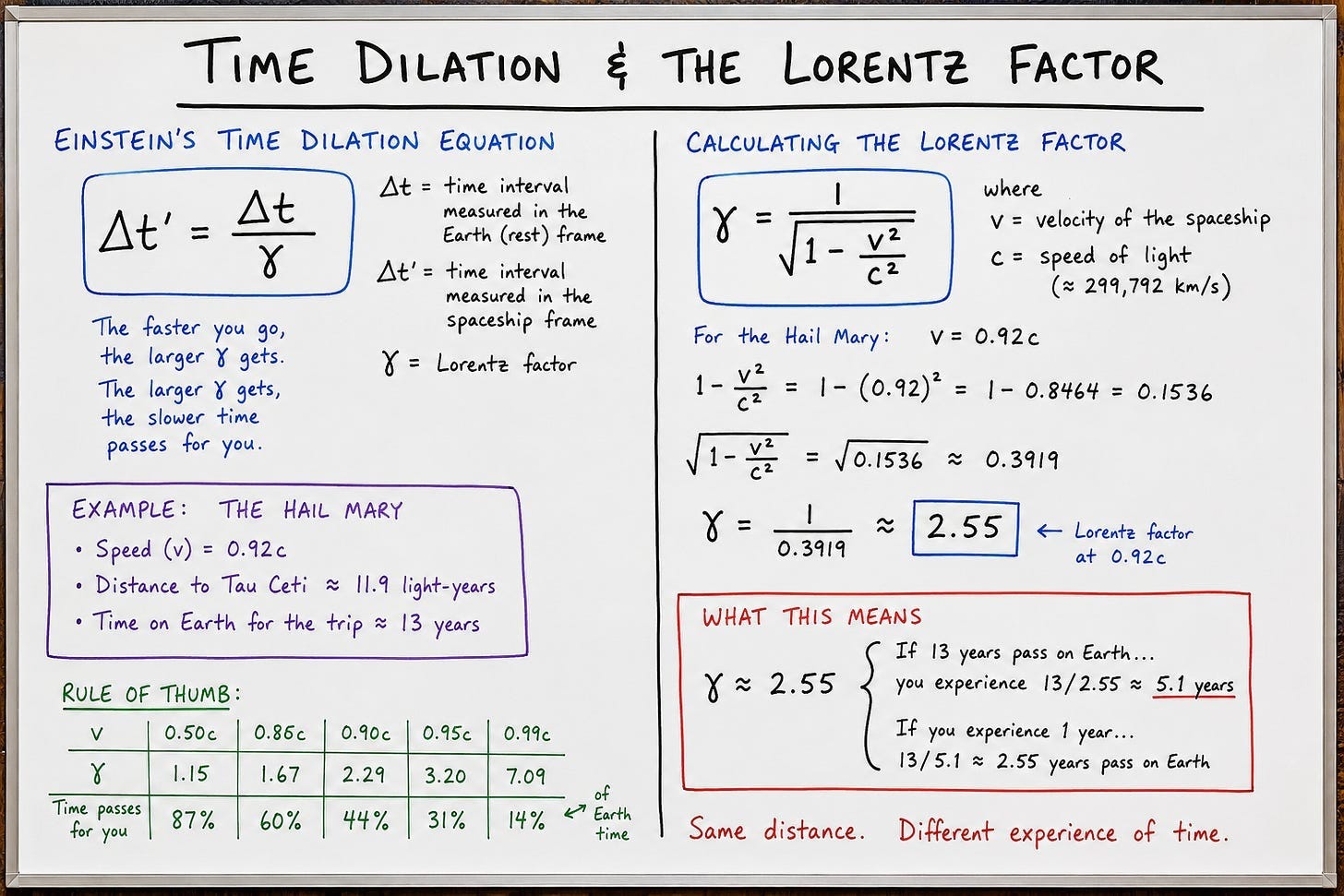
And to travel from Tau Ceti’s region ot space to Erid (picking up Rocky along the way), that’s 10ish light-years, which, at 92% the speed of light, would have taken them around 4.3 years, with another 10-11 years passing on Earth.
Time Zone Information
From Earth’s point of view, the mission takes about 13 years to reach Tau Ceti. Add in the return trip for the Beetles, and you’re looking at roughly a quarter-century between launch and solution.
As for Grace and Rocky, time is different. Everyone on earth is a quarter century older by the end of the story; Grace has aged more slowly. As he explains near the end of the novel, he’s given up trying to figure out how old he is; his best guess is that he’s biologically in his mid-50s, but chronologically, by an earth-based measure, he’s in his early 70s.
Time is not the same at any two points in the universe. It’s not a bug; it’s a feature.
The Neighborhood
At the beginning of this article, I described the Sun, Tau Ceti, and Erid as a galactic cul-de-sac.
That wasn’t entirely a joke.
On human scales, these systems are impossibly far apart. The nearest is nearly twelve light-years away. The farthest is more than sixteen. Even with Astrophage, the trip takes years. Without it, the journey becomes the sort of thing that civilizations attempt rather than that people do.
And yet, on the scale of the Milky Way, these three stars are practically neighbors.
One hosts the only known life-bearing world in the universe, one appears to be surrounded by far more planetary debris than our own Solar System, and one may remain stable for tens of billions of years after the Sun has finished its work.
Three nearby stars.
Three very different stories.
That’s one of the lessons hidden inside Project Hail Mary. The universe doesn’t need to be exotic to be interesting. Sometimes all you have to do is look closely at the neighborhood.
The next time you see Tau Ceti or 40 Eridani A mentioned in a science article, a science fiction novel, or a planetarium show, remember that they aren’t abstract dots on a star chart.
They’re places.
Real stars.
Real systems.
Real neighborhoods orbiting quietly around the same galaxy as our own.
And they’re close enough that, for a brief moment in one very good novel, a science teacher managed to visit them.
Your homework: using your favorite astronomy app, go out and spot Tau Ceti and 40 Eridani A. Both are visible to the naked eye.
Curiosity is what brought me here.
Teaching is what I do with it.
If you’d like to read more about education, classrooms, students, and the craft of teaching, you’ll find those stories in Teacher, Teacher.
https://shapeofcinema.substack.com/p/pigs-in-space?r=8dbojf&utm_medium=ios