
I Pushed the Button. The Math Says I’ll Be Fine. But...
What Richard Matheson, probability, and actuarial science reveal about one of the greatest moral dilemmas ever written.
Some ideas haunt you for a long time.
This is going to age me a little, but I remember watching “Button, Button” as a segment of the revived Twilight Zone series back in the day—that day being 1986. The segment was adapted from a 1970, 2000-ish word short story by Richard Matheson, first published in Playboy, and later adapted again (much more loosely) into the 2009 movie The Box.
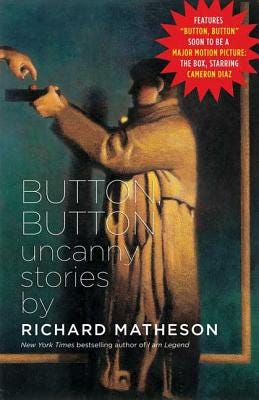
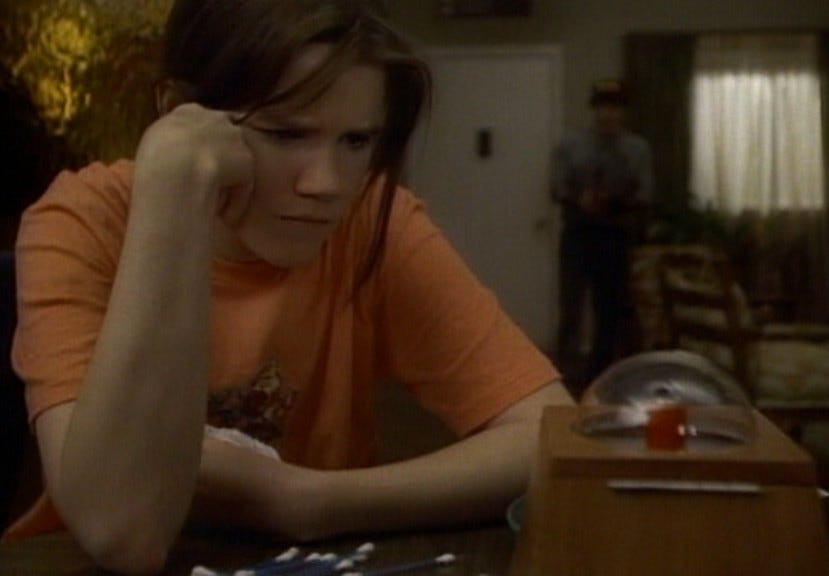
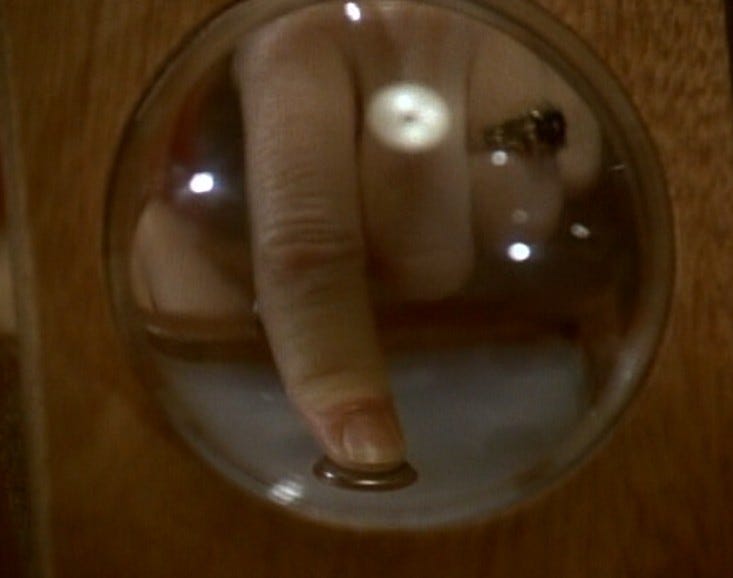
You’ve probably heard the premise by now: a woman receives a box from a stranger. The box itself is unremarkable except for a red button beneath a transparent dome. Push the button, and the stranger will return with $200,000. Oh, and somewhere in the world, someone you don’t know will die.
Simple.
Okay, before we go any further, I need to borrow a warning from John Mulaney. That is, this article won’t work in the “The Science Of…“ way…
Actually, this article will work in the usual The Science Of… way. The problem is that this time, the thing I’ll be treating as a discussion variable is death.
We’re about to walk across some ethically weird ground. I’m going to be completely objective about it and just examine the occurrence of death as a problem to solve.
Yeah, that doesn’t sound right either.
Look, for the next few sections, death is going to become a number. Nobody is being targeted, punished, or judged as more disposable than anyone else. Consider this a short ride aboard the Intrusive Thought Express. I’m your conductor and tour guide.
Oh, and there will be math.
(That wasn’t supposed to be more upsetting than the death stuff.)
Two Buttons, Two Endings
“Button, Button” was first published in the June 1970 issue of Playboy and has since appeared in collections of Matheson’s stories.
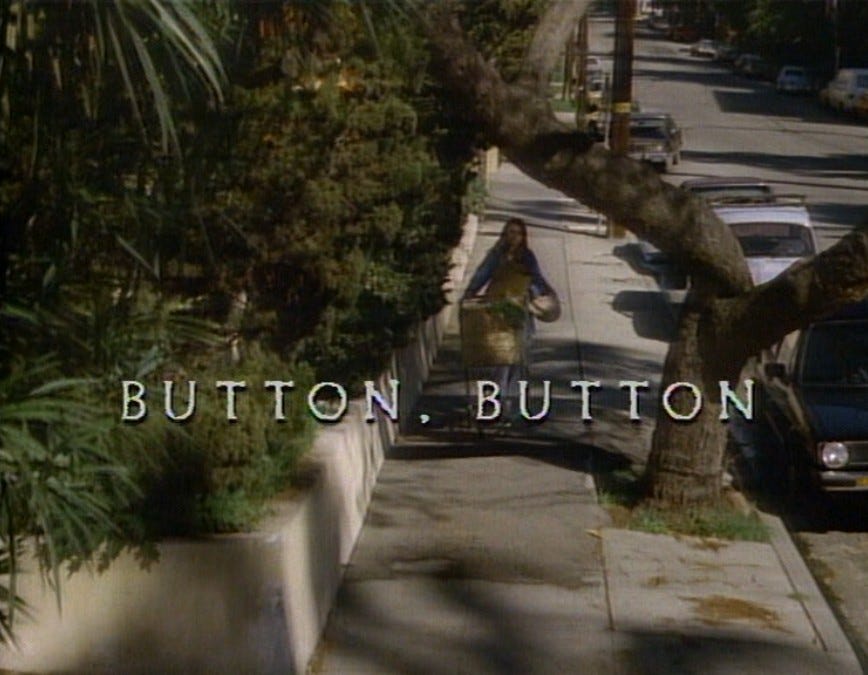
The broad strokes of the two versions are the same. In both versions, the married couple is Arthur and Norma Lewis, and a mysterious package containing the button unit is delivered to their apartment. A note says that a Mr. Steward will visit that evening to explain the device.
He does. Steward explains the terms: $50,000 in the story and $200,000 in the episode, and leaves the couple to decide. Push it: someone you don’t know dies, and they get the money. Arthur and Norma argue over the offer. In the story, Arthur returns the device to Steward, only for Norma to ask for it back. In the episode, Arthur throws it into the trash, and Norma retrieves it. Eventually, she pushes the button.
This is where the two versions split. In Matheson’s original story, Arthur is pushed in front of a subway train on his way home from work. His life insurance payout is exactly $50,000.
As the story goes, the phone rings. It’s Mr. Steward.
It wasn’t her voice shrieking so; it couldn’t be. “You said I wouldn’t know the one that died!”
“My dear lady,” Mr. Steward said, “do you really think you knew your husband?”
Oof. Gut punch.
The New Twilight Zone version ends differently. After Norma pushes the button and Steward delivers the money, he takes the device away and says it will be reprogrammed and offered to someone else. Oh, and Arthur’s fine, aside from a quick flash in his eye that maybe hints he really didn’t know his wife after all.
The “someone” who gets the box next, and Steward directs this to Norma, will be someone whom she does not know. The warning hangs there as the camera closes in on Norma’s horrified face.
Yeah. That lands differently, for so many reasons. My grossest one is that the organization Mr. Steward works for is (given the odds…coming up) basically paying people to kill strangers and get away with it.
Matheson, a veteran of the original Twilight Zone series’ writing staff, wrote the teleplay for the segment. But as television production can go, Matheson’s script was changed, and the different ending tacked on. Matheson disliked the altered ending so much that he had the episode credited to his pseudonym, Logan Swanson.
As I mentioned, I saw the episode a long time ago, and its moral question stuck with me: Would I kill someone I didn’t know, somewhere in the world, for enough money to change my life? I saw it as a teenager, which is prime time for discovering that a question can crawl into your head and live there for the next forty years.
That’s all a credit to the strength of Matheson’s original story, which rightfully belongs beside other creepy-weird stories like “The Monkey’s Paw,” “The Lottery,” “The Veldt,” and “An Occurrence at Owl Creek Bridge” that English teachers give unsuspecting students to read in the 10th grade.
And then smile inwardly as their discussions flare and continue for days.
But as the years went on, I realized something. The central question of “Button, Button” is ethical. There’s no getting around that. But the television ending accidentally creates another question:
What are the odds that a button push takes you out? They you’re the “someone” the person pushing the button does not know?
I mean, as I said up top, I’m treating this objectively and just as a mental experiment, not anything real or that could be real. This is all about probability. Set a few rules, draw a few boundaries, and the Twilight Zone ending starts looking suspiciously like a probability problem.
And…yeah. Matheson had a point. In his original story, “someone you don’t know” becomes a question about whether we ever fully know another person. In the television ending, it feels like a threat: someone else will push the button, and next time the stranger that dies could be you.
And once the threat becomes statistical, I can’t help asking how much of a threat it actually is.
Which makes for a weaker “scare,” to be honest (like when the monsters show up in Backrooms) - define the scary thing with information that can be processed, and it’s not as scary. This is a huge shout-out to learning about what you’re scared of, rather than just being scared of it.
Side note: All walking monsters have knees. Bugs me so much. Bipedal monsters need their knees to walk. As any athlete or person over 40 can tell you, knees are not, generally, the most well-protected or durable pieces of the skeletal system. Why are we wasting time with head shots? My god, just shoot Jason in the knees, then take your time to finish him off while he’s crawling. Problem solved. Knowledge, people. Knowledge. But I digress...
So, assuming nobody has pulled the emergency brake on the Intrusive Thought Express, let’s do the math.
Buttoning Up the Math
From here on, the version of the story I’m looking at is the “Logan Swanson” version that aired on The New Twilight Zone, not Matheson’s original short story. To turn that version’s final threat into a probability problem, we first need to answer one question:
How many people do you know?
For that, I’m going with Dunbar’s number.
Dunbar’s number is the idea that the human brain can keep only about 150 people fully populated in its social universe. Anthropologist Robin Dunbar arrived at that estimate by comparing primate brain size with group size and then applying the pattern to humans. Beyond that circle, people increasingly become acquaintances, strangers, crowds—and, eventually, numbers. People you “don’t know.”
I get it—you may have 10,000 followers on TikTok, but you do not have 10,000 stable relationships. Or, on the flip side, Dunbar did this work before social media let us connect with thousands of people without necessarily knowing many of them well, so 150, while theoretical, may be a little higher than the actual number of stable relationships people have in 2026. Maybe a lot higher.
I’m sticking with 150. Try another number if you like; as you’ll see, it barely matters.
Let’s assume that the box can appear anywhere in the world. We’ll also round the 2026 world population to 8.3 billion.
We’ll call that population N.
Let’s say that Norma2026 is itching to push the button. Norma knows 150 people, and her push kills one randomly selected person outside that circle. If “knows” = 150 people, then the number of Norma2026’s eligible victims is about
N - 151 people.
Why subtract 151 rather than 150? I didn’t check with Mr. Steward, but I’m assuming Norma2026 cannot kill herself by pressing her own button.
Assuming Norma2026 does not know you, your chance of dying from her push is:
1 / (N - 151)
With our rounded population, that is approximately:
1 / 8.3 billion
In other words, if the button-pusher does not know you, your chance of dying from that one push is about 1 in 8.3 billion. As a percentage, that’s
1/8,300,000,000 x 100% = 0.00000000012%
There is one wrinkle to consider. If the next recipient is chosen randomly, that person might know you. If they do, you are not in their pool of possible victims. So your overall probability (P) of dying on a randomly assigned push is:
P(pusher doesn’t know you) x P(you are selected | pusher doesn’t know you)
(N-151/N) × (1/N - 151) = 1/N
(the N-151 terms cancel)
So, if Mr. Steward is telling the truth and both the recipient and victim are selected randomly, the cleanest answer is:
1/N
Your BFF getting the box would make you perfectly safe from that push. But averaged across every possible recipient, it doesn’t change the overall odds. Dunbar’s number helps us define “someone you don’t know,” but ultimately it cancels out of the equation.
Keep selecting randomly and pushing the button indefinitely, and the probability that it eventually kills you approaches 100%. The expected wait is 8.3 billion pushes. That does not mean the box is guaranteed to kill you by push 8.3 billion. At that point, your chance of having died is about 63%.
After about 5.75 billion pushes, the box is more likely than not to have killed you. After 8.3 billion, the probability is about 63%. But there is no deadline. Probability does not make appointments.
That assumes the population stays fixed at 8.3 billion, which it won’t.
The United Nations projects the population to peak around 10.3 billion in the mid-2080s before declining slightly by 2100. Okay, that’s not exactly a smidge, but close enough that our conclusion survives.
Give It to Me Straight: How Long Until the Box Gets Me?
Let’s turn pushes into time. If the box is pushed once per day. The expected waiting time would be:
8.3 billion days ÷ 365 ≈ 22.7 million years
The point at which the box has a 50% chance of having killed you comes earlier, at about 5.75 billion pushes:
5.75 billion days ÷ 365 ≈ 15.8 million years
Those are not contradictory answers. At 15.8 million years, your cumulative risk reaches 50%. The 22.7-million-year figure is the average wait across an enormous number of hypothetical runs.
Let’s put some hustle on Mr. Steward. What if the button is pushed once per hour?
8.3 billion hours ÷ 24 ÷ 365 ≈ 947,000 years
What if someone pushes it once per minute?
8.3 billion minutes ÷ 60 ÷ 24 ÷ 365 ≈ 15,800 years
So, if the box moves at anything resembling a human pace, you take the money and spend the rest of your life facing a real (but extremely small) risk.
And Dunbar’s number still barely matters. Excluding 150 people from a pool of 8.3 billion is almost nothing—and when the recipient is also chosen randomly, the Dunbar term cancels out altogether. The horror isn’t that the odds are high. The horror is that the box turns everyone outside your circle into statistical fog.
Matheson’s original trap is moral. The television version makes it look actuarial.
What Are My Odds During a Normal Lifetime?
The huge numbers above are average waiting times, not how long you will live.
So let’s make it personal. Suppose you have 50 years left, and the box keeps moving.
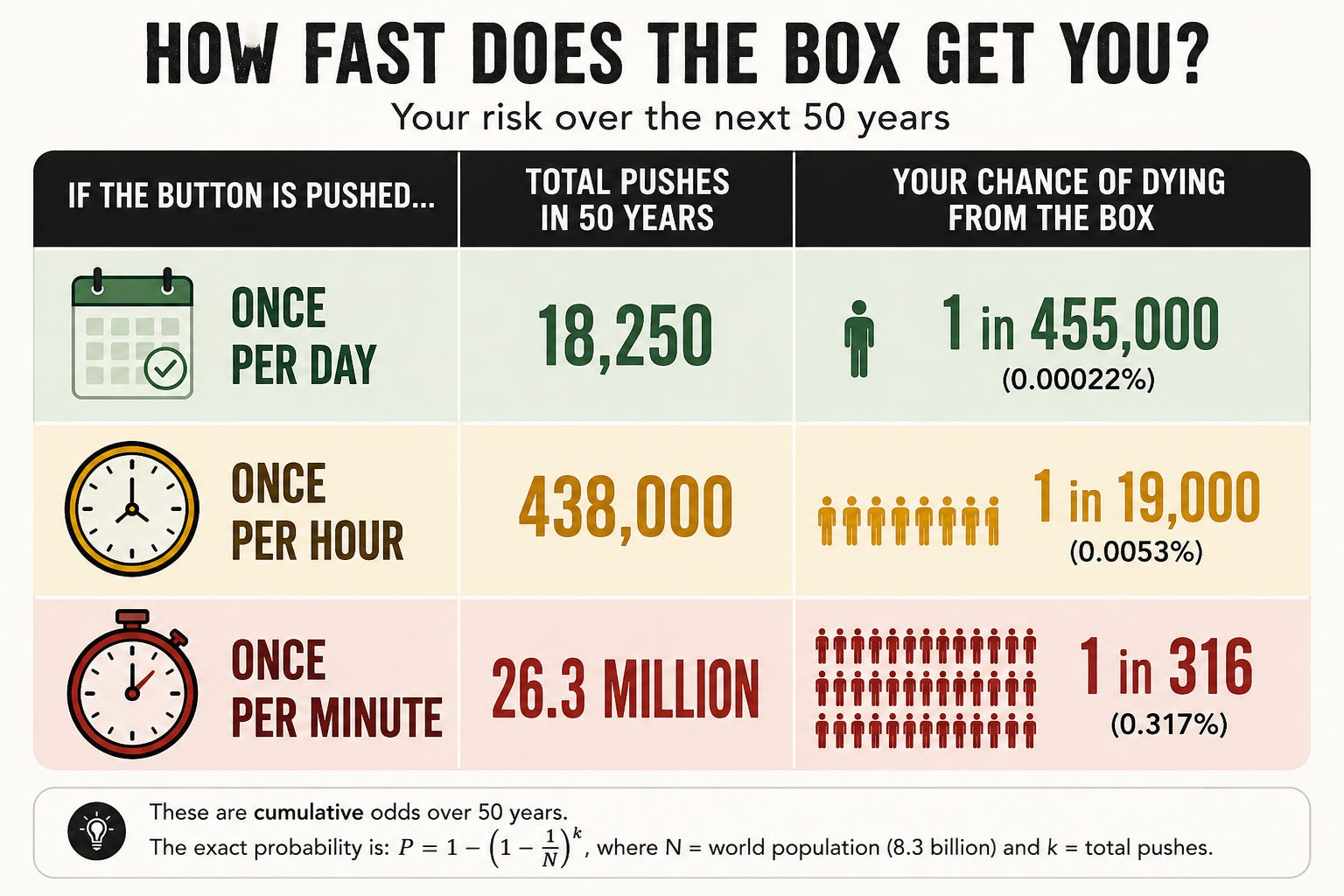
Frequency matters.
One in 8.3 billion? That’s impossible. Sure...but what if you repeat the experiment 26 million times?
Fortunately for us, Mr. Steward probably can’t explain, deliver, collect, and redistribute the box 1,440 times every day for fifty straight years.
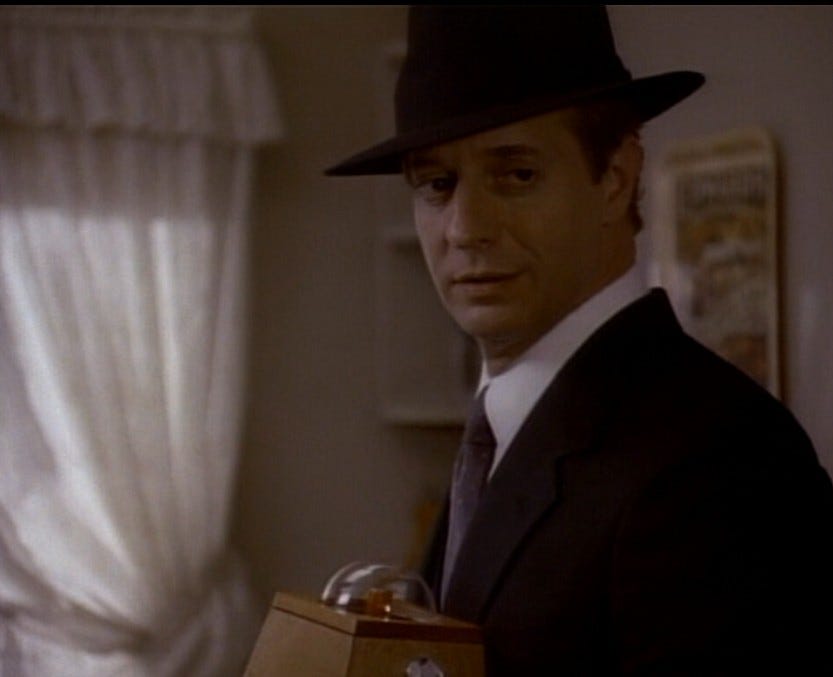
Or can he?
Yeah, But Compared To…?
The numbers are interesting, and I think the last of the ghosts in my head have finally been satisfied.
But, after all of this, it settled in on me that the numbers aren’t really the point.
Assuming the box changes hands once per day, your chance of dying from it over the next 50 years is roughly 1 in 455,000.
That’s tiny. You take bigger risks before lunch. Seriously.
Your lifetime odds of dying in a motor vehicle crash are around 1 in 100. Your odds of dying in a fall are about 1 in 250. Even being struck by lightning at some point in your life is more likely than being killed by the box (1 in 15,000).
Putting real numbers on the television ending does something unexpected: it almost completely defangs the curse. If you push the button, and the box moves on, statistics say you should probably spend zero hours and zero minutes worrying about dying from “someone you don’t know” pushing the button.
Mr. Steward’s final warning isn’t nearly as terrifying once you see the odds. Compared with the risks we live with every day, the box barely registers. Which leaves us with a very uncomfortable answer:
Statistically, you should push the button.
If your only goal is maximizing your own outcome, it’s an incredible deal. You get the money, and the odds that you’ll ever pay the price yourself are vanishingly small.
So why does it still feel wrong?
Because the button changes something more important than the odds, it changes who makes the choice, and who lives with the consequences.
Most of the risks we take in life primarily expose us. We drive. We board airplanes. We take medications with known side effects. We travel over bridges knowing that no bridge design is perfectly risk-free. Doctors recommend surgeries whose benefits must be weighed against possible harm. Modern life depends on countless decisions that carry small statistical risks because a world with zero risk does not exist.
Sometimes we accept those risks for ourselves. Sometimes our choices broadcast a little risk outward—to neighbors, workers, passengers, customers, or strangers on the other side of the world.
Most of the time, we experience the benefits while the risks are spread thinly across thousands or millions of strangers. Those risks are real, but they are distant. Usually invisible. We need electricity for modern life. No way of producing it comes with clean hands and zero risk. The same is true of mining the materials used in our phones, computers, batteries, and other devices, as well as countless other industries that enable us to live a modern lifestyle in a wealthy country.
The button refuses to let the stranger stay invisible. It doesn’t merely tell you that harm is possible. It tells you that someone will die, and that your decision caused it. That’s why the ending lingers.
The math says you will almost certainly never pay the price yourself. The story asks whether you can live with knowing someone else did.
Statistics are very good at telling us how often something happens.
They are completely silent about whether it should.
Curiosity is what brought me here.
Teaching is what I do with it.
If you’d like to read more about education, classrooms, students, and the craft of teaching, you’ll find those stories in Teacher, Teacher.