
Why Green Stars Don't Exist (And Why Supergirl Keeps Finding Them)
The real astrophysics behind Supergirl's green sun, binary star systems, and why the universe refuses to make green stars.
Super-slight spoilers for Supergirl (2026) and Supergirl: Woman of Tomorrow (2021) ahead — but they’re about astrophysics and stellar evolution, not the story. I mean, it’s really small. It’s basically... in the title.
First and foremost—and this is the rule for every piece on The Science Of...—this isn’t about criticizing the source material. Opinions about Supergirl (or any film, comic, or television show) are what they are. We’re interested in the science and the questions the story raises.
Cool?
This time, the science starts with a green star.
And those don’t exist.
Which raises a wonderfully nerdy question: if green stars don’t exist... why do DC heroes keep running into them?
First up, a little history…
TWINKLE, TWINKLE LITTLE GREEN STAR
In Supergirl, Kara and Ruthye find themselves on the planet Barenton. The film places the planet in a binary star system, orbiting two suns: one yellow and one green. We’ll get to the green one in a minute, but first, just to be clear, this isn’t the first green star in DC history.
The first green star to harm a Kryptonian appeared in 1962’s Superman #155, “Superman Under a Green Sun.” The star was originally blue until the villain Drago changed it to green using a satellite (Apparently by adding a yellow filter? Silver Age comics were wonderful). The green light robbed Superman of his powers.

Four years later in Action Comics #337, “The Green Sun Supergirl!” - Kara found herself on a planet orbiting a green sun, which also robbed her of her powers. And in 1967’s Justice League of America #53, Superman casually name-checked green stars as something that can rob him of his powers.
After that, green stars went quiet and didn’t play a role in any Super-stories for decades. They still existed in the DC Universe’s cosmology, as N’Gon did the whole villain origin story recap to Green Lantern in DC Comics Presents #26, “Between Friend and Foe.”
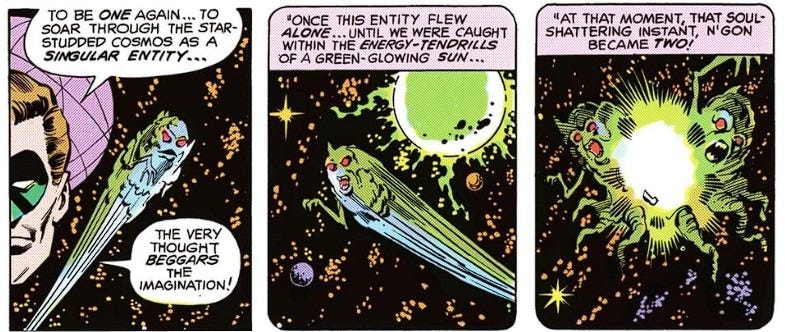
Even though the series was the Superman team-up book, Superman didn’t encounter the green sun.
Green stars then took a very long nap until Tom King and Biliquis Evely’s Supergirl: Woman of Tomorrow #5 in 2021.
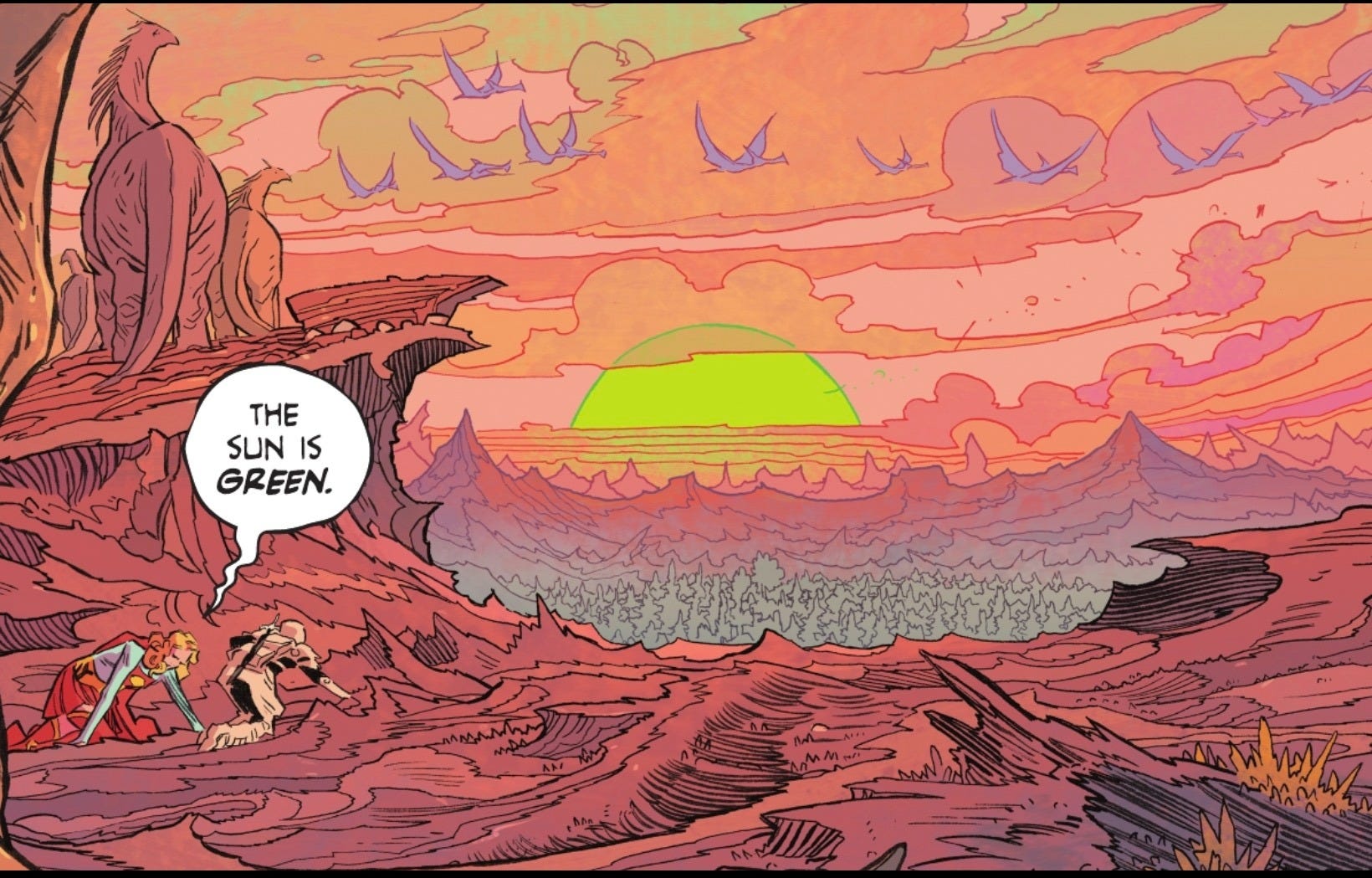
In the issue, the planet (and its sun) are known to Kara — and her cousin, Kel-El:

Tom King updates the idea a bit. Light from a green sun now acts much like Kryptonite. As the movie showed, and the comic makes clear, it’s a very painful way to die. A stellar-scale dose of Kryptonite. Literally killer sunburn. Kara needed to find shelter, and fast.
Although she did take a moment to get a couple of good shots in first:

Anyway, I don’t want to spoil any more of the comic. You should absolutely read it. Not making any sweeping judgments here, but in about 99% of cases, the book is better than the movie. This is one of those cases. Plus, it has a super-horse.
Now... let’s talk about the science.
STAR STORIES
Before we get into colors, making the planet part of a binary system with a yellow sun was an odd (clearly she was going to get her powers back), but nice touch — it’s estimated that around half of all Sun-like stars in the Milky Way are part of a system with two or more stars. A planet with two suns isn’t the weird part. In fact, astronomers have discovered planets orbiting binary stars. Nature builds those all the time.
But—making one green and one yellow? That’s the weird stuff.
Aside from the whole “green stars don’t exist” thing (coming up, I promise), that’s also not how binary systems usually work. Stars form from massive clouds of interstellar gas and dust. In a binary system, both stars would form from the same original cloud.
Think of them as siblings. They start with the same raw materials, they’re roughly the same age, and they generally follow the same evolutionary path. Yes, there’s a slight chance that a single star could capture a rogue star that’s wandering through the galaxy, but it’s highly improbable due to the masses and velocities involved. And yes, someone could have built a second star and engineered both stellar and planetary orbits, but that’s less astrophysics and cosmology and more wizardry.
So, as a rule, stars in binary systems are roughly the same age and made from the same material. Exceptions do exist, but on average, siblings, not strangers.
WHY THERE AREN’T GREEN STARS
Disclaimer: Nothing in this article is meant to deny that the color green exists. Grass is green. Kermit the Frog is green. Kryptonite is green. Objects look green because they reflect green light while absorbing much of the rest.
Given the vastness of the universe and all the strange things we’ve discovered, saying there are no green stars sounds... yeah, I know how it sounds.
But there aren’t.
Let’s not talk about stars for a minute. You’re reading this on a screen, right? You’re probably looking at black text on a white background. Here’s the weird part: your screen doesn’t have any white pixels. If you looked at your screen through a microscope, you’d see millions of tiny red, green, and blue lights. Every white page you’ve ever read was really those three colors working together.
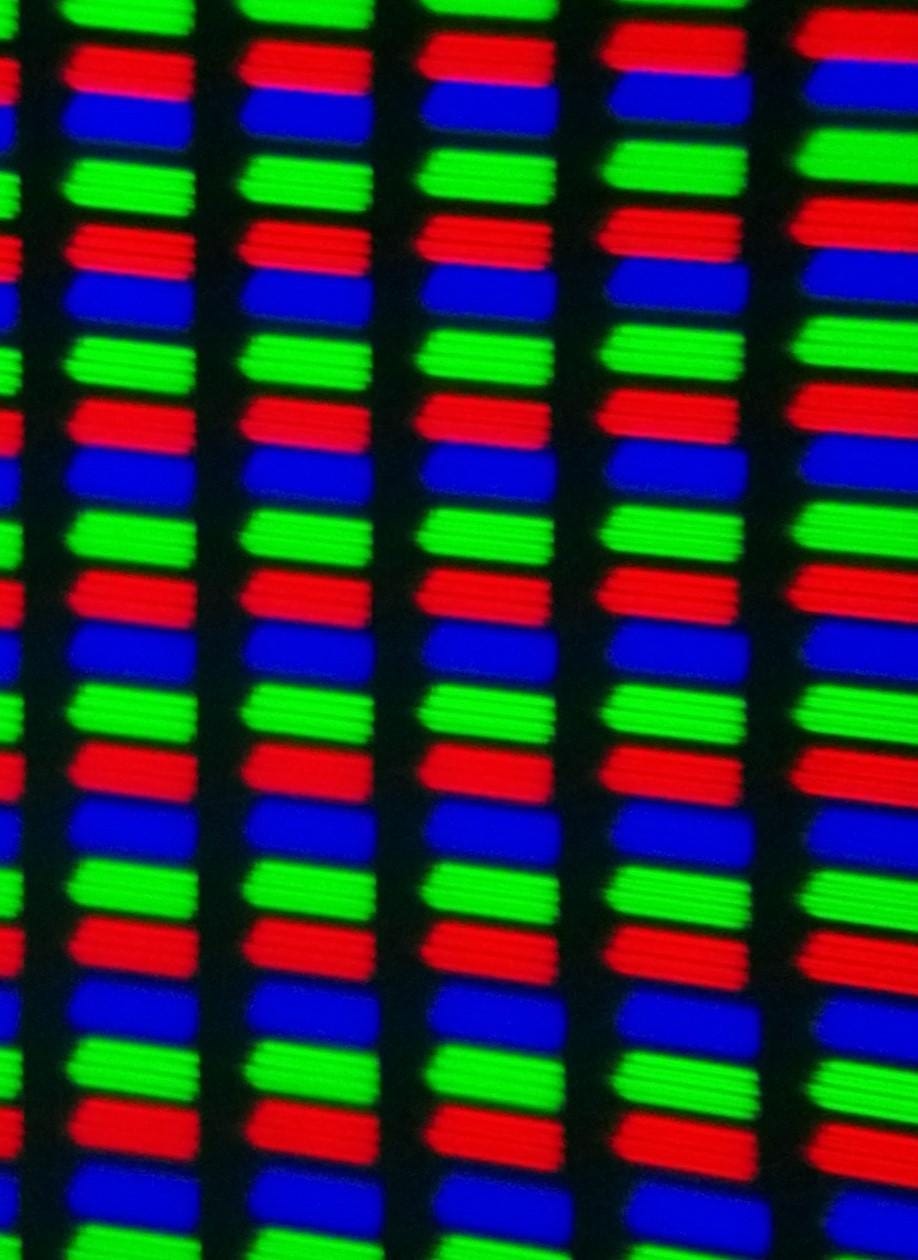
Seriously.
Every bit of whiteness on your screen is made up of three tiny red, green, and blue subpixels so close together that your eyes and brain can’t distinguish them individually. Turn all three on together, and your brain says, “Yep. That’s white.”
Your screen is fooling you millions of times per second.
Side note: This is one of those “the universe is ridiculous” facts. A single colored subpixel in a modern phone is only about 10–20 micrometers across—just a bit bigger than a red blood cell. Your phone’s display contains millions of pixels, which means it’s coordinating nearly ten million microscopic colored light sources to convince your brain you’re looking at a plain white page.
Let’s bring this in super close — like eyeball close — to explain what we’re talking about. Your eyes have three types of color-sensitive cone cells—one that responds mostly to red light, one to green, and one to blue. When all three are getting a strong signal at the same time, say, from a star, your brain doesn’t conclude “That’s green.”
It decides: “That’s white.”
It’s the same reason your tablet doesn’t need white LEDs to show a white page. Your visual system isn’t looking for a “white wavelength.” It’s looking at how strongly its three color sensors are responding.
Stars work in much the same way. A star isn’t like a green laser pointer. The light from a star is like the music produced by an orchestra rather than by a solo violin. Some colors are “louder” than others, but all of them are in there.
To keep going with the orchestra idea, cool stars play mostly “red.” Hotter stars play “blue,” and stars like our Sun hit a balance across the entire spectrum to produce a whitish light.
Side note: But Superman and Supergirl get their powers from Earth’s “yellow sun.” Technically, our Sun is white; if sunlight weren’t basically white, a white sheet of paper wouldn’t look white outdoors, but it’s classified as a yellow dwarf star. From space, it’s white, but from Earth’s surface (as seen through our atmosphere), blue and violet light are scattered much more strongly than the longer wavelengths, giving the Sun a slightly warmer, yellowish appearance.
So, what about stars that might produce more green light than any other wavelength? Shouldn’t they look green?
Nope. Because that star would also be producing lots of red and blue light along with its green, and we’re back to where we started: white.
That isn’t an accident. It’s a consequence of the way hot objects emit light, known as blackbody radiation. Something can be red-hot when it is hot enough that some of the energy being released appears as red visible light.
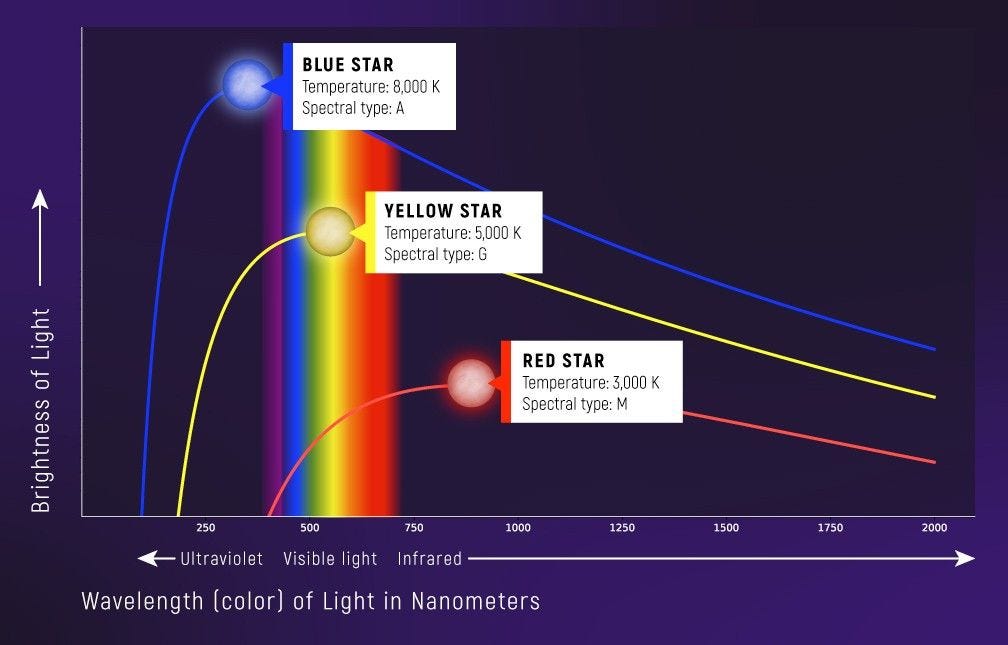
Heat things more, and you can reach orange-hot or white-hot, but you can’t stop at green. Heat things more, and they don’t suddenly switch from red to green light. Instead, they keep producing red while adding more orange, yellow, green, blue, and beyond. The hotter the object gets, the whole spectrum shifts, but it never narrows down to a single color. And in stars, there’s overreach, so stopping on green means you’re also hitting the temperature that produces blue as well.
Red-hot? Absolutely. White-hot? Definitely. Green-hot? Nature doesn’t really do that.
All of this means that a star can absolutely emit a tremendous amount of green light.
Ours does.
Here’s the twist: our own Sun actually produces more light in the green part of the visible spectrum than in any other single color.
It still doesn’t look green.
I know. That feels like I buried the lede.
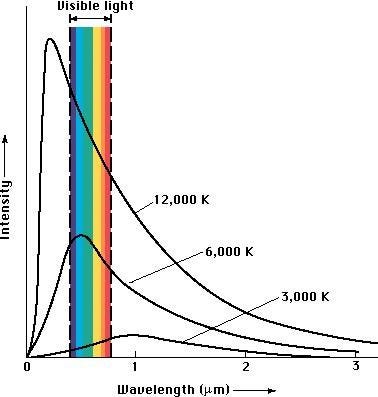
But stars can’t emit only green light. There’s no pathway for that to happen.
Stars are giant balls of hot gas, and hot objects naturally emit a broad spread of wavelengths, not a single narrow slice of color. There isn’t a temperature at which a star emits only green light.
Side note: “But I’ve seen green light in fire…” Sure have. That’s a completely different process. Stars shine because they’re incredibly hot, producing a broad spectrum of light across many wavelengths (that’s the blackbody radiation we just talked about). Green flames come from excited atoms. Heat an element enough, and some of its electrons jump to higher energy levels.
When those electrons fall back down, they release photons with very specific energies—and therefore very specific colors. For example, sodium vapor produces a sickly yellow-orange light familiar from older streetlights, and copper, when heated, can produce green light. Those colors come from the atoms themselves, not from the overall temperature of the fire.
A star isn’t a giant copper flame - it’s a giant ball of hot gas radiating across the entire visible spectrum.
To make a star look green, you’d have to remove most of its red and blue light before it reached your eyes.
At that point, the star isn’t actually green.
Something else is making it look that way.
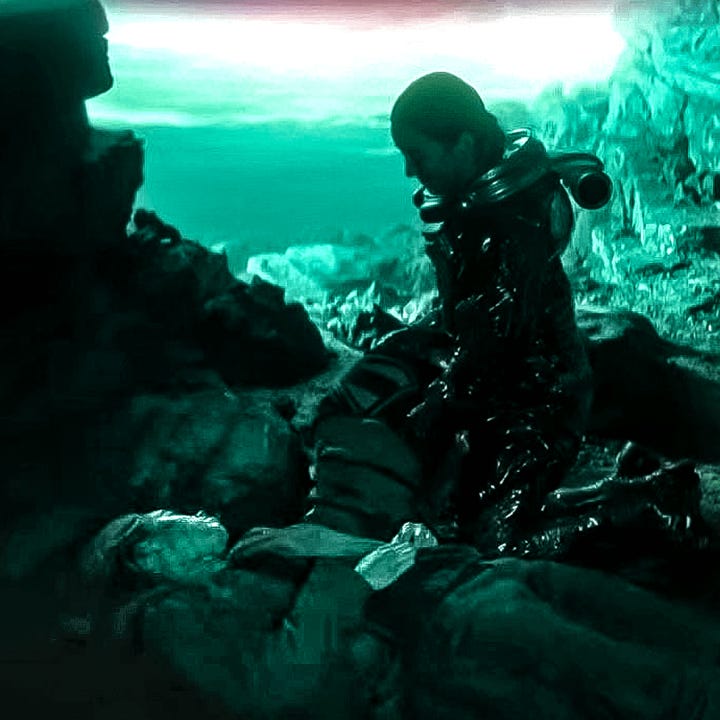
COULD A STAR ACTUALLY LOOK GREEN?
Yes. Sort of.
But only under very specific circumstances. Let’s look at three: one that’s real, one that’s probably not, and one that borders on wizardry.
When viewed through specific atmospheric conditions. The Sun sends a tremendous amount of energy toward Earth, but our atmosphere acts like a bouncer at a club. Some wavelengths are absorbed before they ever reach the ground; others are scattered in different directions, while visible light mostly makes it through.
It’s why the Sun can look different depending on where you’re looking at it from. In space, it’s white. At noon, it looks bright yellow-white because there’s not a lot of atmosphere between you and it. Compare that to mornings or evenings, when you’re seeing the sunrise or sunset, and the amount of atmosphere you’re looking through to see the Sun is considerably thicker. The more atmosphere sunlight has to travel through, the more opportunities there are for that light to be scattered, absorbed, or bent.
Could a planet have a weird atmosphere that could remove incoming red and blue light from a white star, leaving mostly green? Sure. It’s a big universe. But - if the Sun looks green, everything illuminated by it would probably look strange, too. Anything green would look green. White objects would look green; red things would look dark or black (with no red light to reflect), while yellow things would look green. It would be a very strange world.
Side note: “Wait... what about the green flash?” That’s real, too. Under just the right conditions at sunrise or sunset, the upper edge of the Sun can briefly flash green for a second or two. It’s caused by Earth’s atmosphere bending (refracting) different colors of light by slightly different amounts, while also scattering blue light more strongly than the others. For a brief moment, the green portion of the Sun’s light reaches your eyes just before the rest of the Sun disappears below the horizon. The Sun hasn’t suddenly turned green—our atmosphere has briefly played a neat optical trick on us. It’s one more example of an ordinary star appearing green without actually being green.Better eyes? Mantis shrimp have up to 16 kinds of photoreceptors compared to our three, giving them a visual system very different from ours. What if we’re saying “there are no green stars” because our eyes don’t see green stars as they really are?
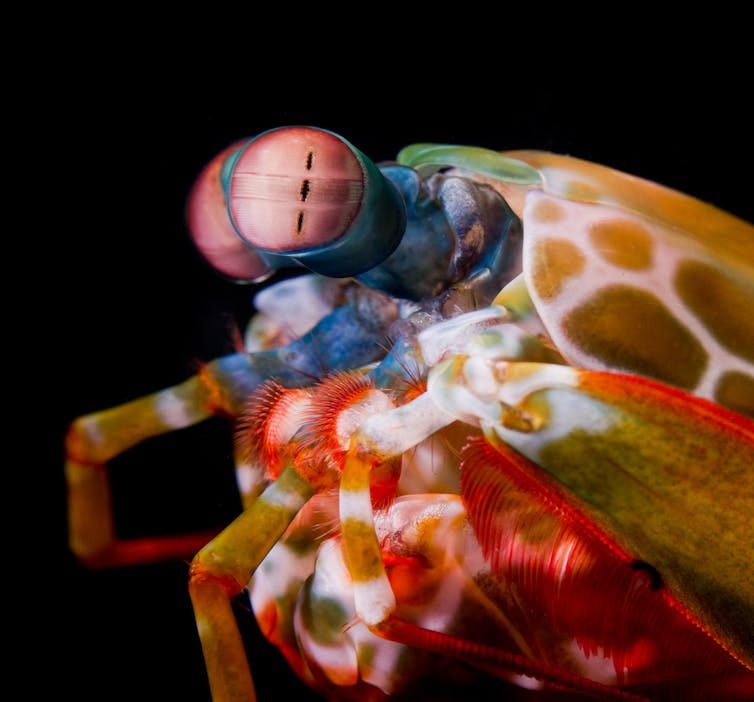
The black regions of the eye are the parts looking at the camera. (Image, Michael Bok) Let’s take our space-faring mantis shrimp. Hold it up, show it to the sun, and ask what color it is; it would not say it was green, green-white, or greenish, despite the Sun emitting more green light than any other color. The mantis shrimp would almost certainly distinguish subtler differences between stars than we can, but a Sun-like spectrum is still a broad spectrum. Better eyes don’t change the physics of what the star is emitting.
And also, sixteen photoreceptors sounds like mantis shrimp would have super color vision. Weirdly... they probably don’t. Probably just different, not better.A giant filter. Your best bet, but highly unlikely, is to put something between the observer and the star that would make it appear green. You wouldn’t build a green star—you’d build a green view of an ordinary star. If your star is white, put a giant green filter in front of it, something like a green Dyson sphere. An enormous cloud of nanoparticles. A bespoke planetary atmosphere designed to absorb red and blue. You know, easy stuff.
But at that point, you haven’t made a green star at all. You’ve made a perfectly ordinary star wearing green sunglasses.
Which brings us right back where we started. Green stars don’t exist. But under the right conditions, perfectly ordinary stars can do a very convincing impression of one.
Oh, and to give that final answer, why does Supergirl keep finding them? I can only imagine the storytelling, the mythology. She and Superman are god-like, but there are planets out there where they can die just because the sun shines on them. And Kara’s reveal from Woman of Tomorrow? That someone made a green star as a trap for Superman? Nice - it speaks to the efforts and resources going into stopping Superman (and Supergirl) and all that they stand for. I like the idea a lot. All of this? Explaining that green stars can’t exist? Didn’t take away any of my enjoyment of the graphic novel or the movie. If you ever find yourself in a place like this, remember, you never yuck someone else’s yum.
Curiosity is what brought me here.
Teaching is what I do with it.
If you’d like to read more about education, classrooms, students, and the craft of teaching, you’ll find those stories in Teacher, Teacher.
First, great article, fun read, lots of great info.
Second, this is why I dislike all the multiverse shenanigans in comics. There are no, and can be no green stars in Prime-Earth (sometimes also/alternatively called Earth-33). However, because gobbledegook, there can be and are in Earth-1 aka Earth-0 aka Earth-Prime and presumably others.
Although I reserve the right to change my mind once we (if we) learn more about the physics of parallel worlds. Until then the whole "so-and-so is dead, haha just kidding alternate reality" nonsense just frustrates me by removing all the tension and drama from everything, because nothing matters.