
There will be spoilers for DC’s The Flash #34 by Ryan North and Gavin Guidry ahead. Just sayin’.
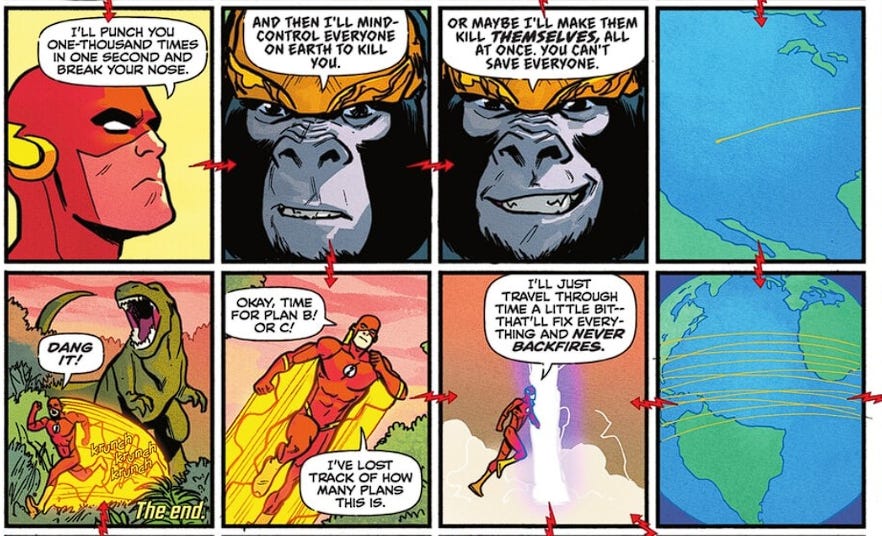
Okay—so in The Flash #34…well, a bunch of stuff goes on. The “battle” between Flash and Gorilla Grodd and his army is set up as a flowchart through time, and it’s one of the more innovative uses of the medium I’ve seen in a while.
But…
Toward the end of the issue, Flash discovers that Central City is covered in what he initially thinks is fog. Then he realizes it’s steam.
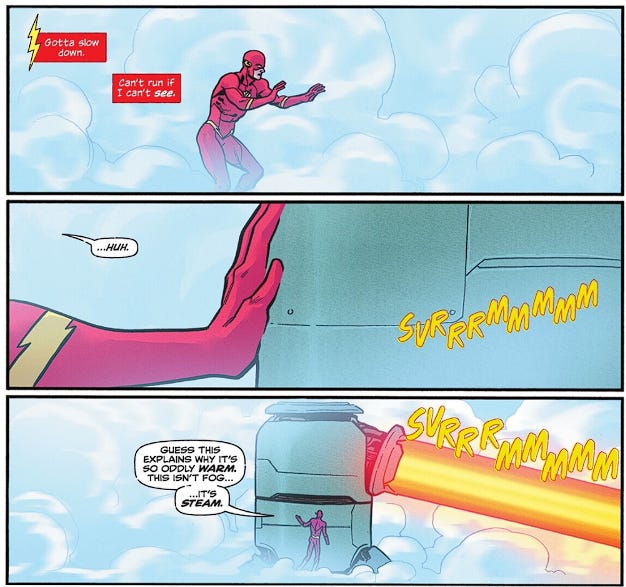
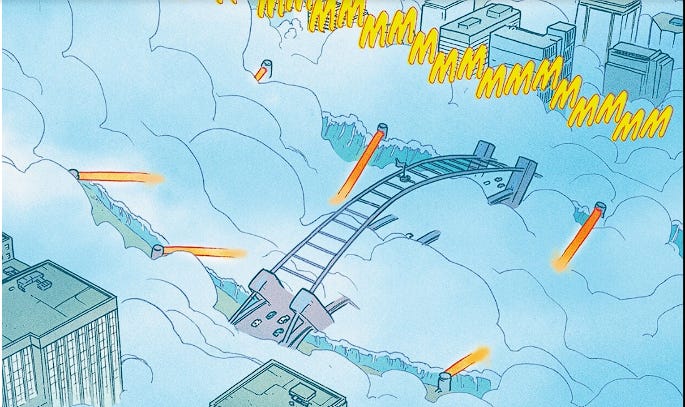
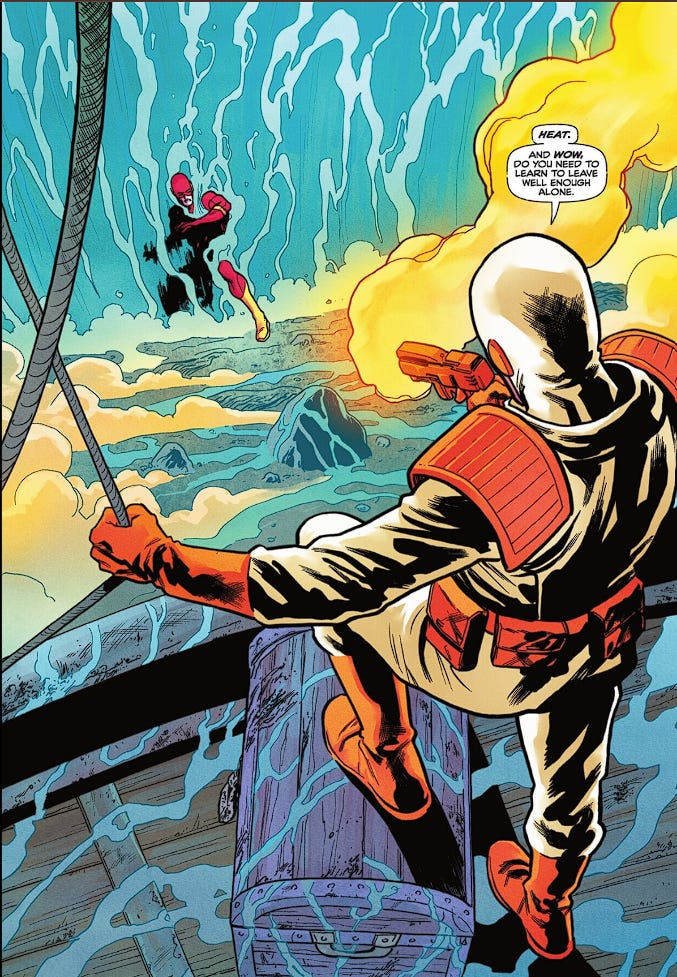
Said steam was generated when one of the Flash’s Rogues, Heat Wave, used six giant heat generators to vaporize a chunk of the river. Apparently, he does this to expose a shipwreck with treasure on it? I’m looking forward to reading issue #35, which shows the creative team is doing its job.
Depending on which map of the DC Universe you’re looking at, Central City is in Missouri, across the Missouri River from Keystone City. Look, there are reasons and explanations for all of this, including why in the world there are two fairly large cities right next to each other in the DC Universe, and I could tell you all about it. Seriously. I could bore you (and me) to tears.
But I’d rather not.
What I want to talk about is what Heat Wave is doing, because it resembles a problem I give my students during our thermochemistry unit in chemistry—and again when physics students hit thermodynamics and heat transfer.
In short…
That’s a really cool scene there with Heath Wave vaporizing the river you got there.
It would be a shame if someone did some real-world science to it…
Okay, okay—DISCLAIMER—we’re not doing this to yuck anyone’s yum or rain on any parades. The DC Universe is fictional. Our rules don’t apply, or there are workarounds. (See: the Speed Force.) My curiosity kicked in when I saw the scene and started wondering what it would look like in our world, with our physics.
And my electric bill.
You wanna do some physics?
Come on. I’ll make it easy.
(Oh, and in case you’re curious, I’d give about an hour of class time for this in a course…)
Step One: How Much Water is That?
This is the only step where we need to make some approximations. We need to determine the volume of water Heat Wave has already vaporized, based on what we see in the panel. Let’s use the bridge as our ruler and call the river about 150 meters wide. The affected stretch looks roughly 800 meters long (about half a mile), and based on the buildings, bridge, cars, streets, and everything else we can use for scale, let’s call the river about 8 meters deep.
All numbers are open to interpretation. If you don’t agree with them, put your own numbers in and join us for Step Two.
As pictured, Heat Wave has vaporized a shoebox-shaped volume of water. The formula for volume has been the same since you were in school:
Volume = width × length × height
Volume = (150 m)(800 m)(8 m)
Volume = 960,000 m3 of water.
To make the calculations easier, let’s nudge that up to 1 million cubic meters of water. What’s the mass of that much water? Well, the mass of 1 m3 of water is 1,000 kg, so:
1 x 10⁶ m3 × 1000 kg/m3 = 1 × 10⁹ kg
That’s 1 billion kg of water.
That’s a lot of water.
Step Two: Vaporize!
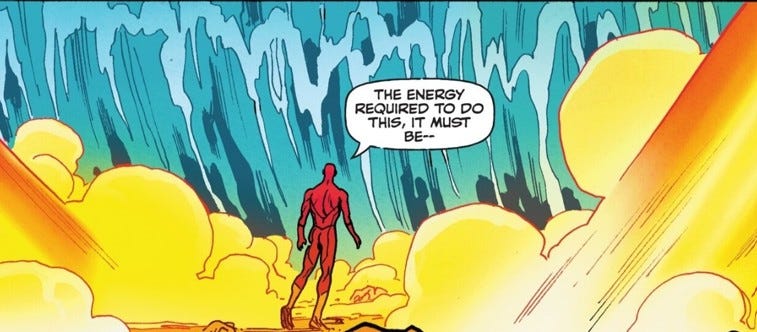
Cool your jets for a second. We can’t vaporize water in one step. To turn water into water vapor, you have to go through two steps. First, the water temperature must be raised to its boiling point, 100 °C at normal atmospheric pressure. Then it can be vaporized. Each step requires dumping energy into the water, hence Heat Wave’s six giant heat blasters on the shore.
Why do things work this way?
Heating transfers energy into the water, making its molecules move faster (and taking up more space). As the water’s temperature increases, its molecules move faster and faster until the water reaches 100 °C. Once there, the water still needs more energy, this time to overcome the attractions between water molecules and escape as a gas.
Figuring out how much energy Heat Wave needs requires two calculations, so we need two formulas.
The first looks like this: Q = mcΔT
That means the energy needed (Q) to raise the temperature of a certain mass of water equals the water’s mass (m), multiplied by its specific heat (4,186 J/kg·°C), multiplied by the change in temperature (ΔT).
That specific heat means it takes 4,186 joules of energy to raise the temperature of one kilogram of water by 1 °C. And ΔT is just the final temperature minus the initial temperature.
Let’s assume that the water in the river is 20 oC (about 68 oF). We need to raise that water to its boiling point of 100 °C, so ΔT is 100 − 20 = 80 °C. The rest of our math looks like this:
Q = (1 x 10⁹ kg)(4186 J/kgoC)(80)
Q = 3.35 x 10¹⁴ joules
As I remind my students, that’s just to heat the water to the boiling point. Now, we’ve got to vaporize it. New formula:
Q = Hvm
(Note - Hv is sometimes called the “latent heat of vaporization and abbreviated as Lv)
This means the energy (Q) required to vaporize a given mass of water (m) equals the heat of vaporization of water (2.26 × 10⁶ J/kg) multiplied by the mass of the water.
Why is the heat of vaporization number so much bigger than the specific heat of water?
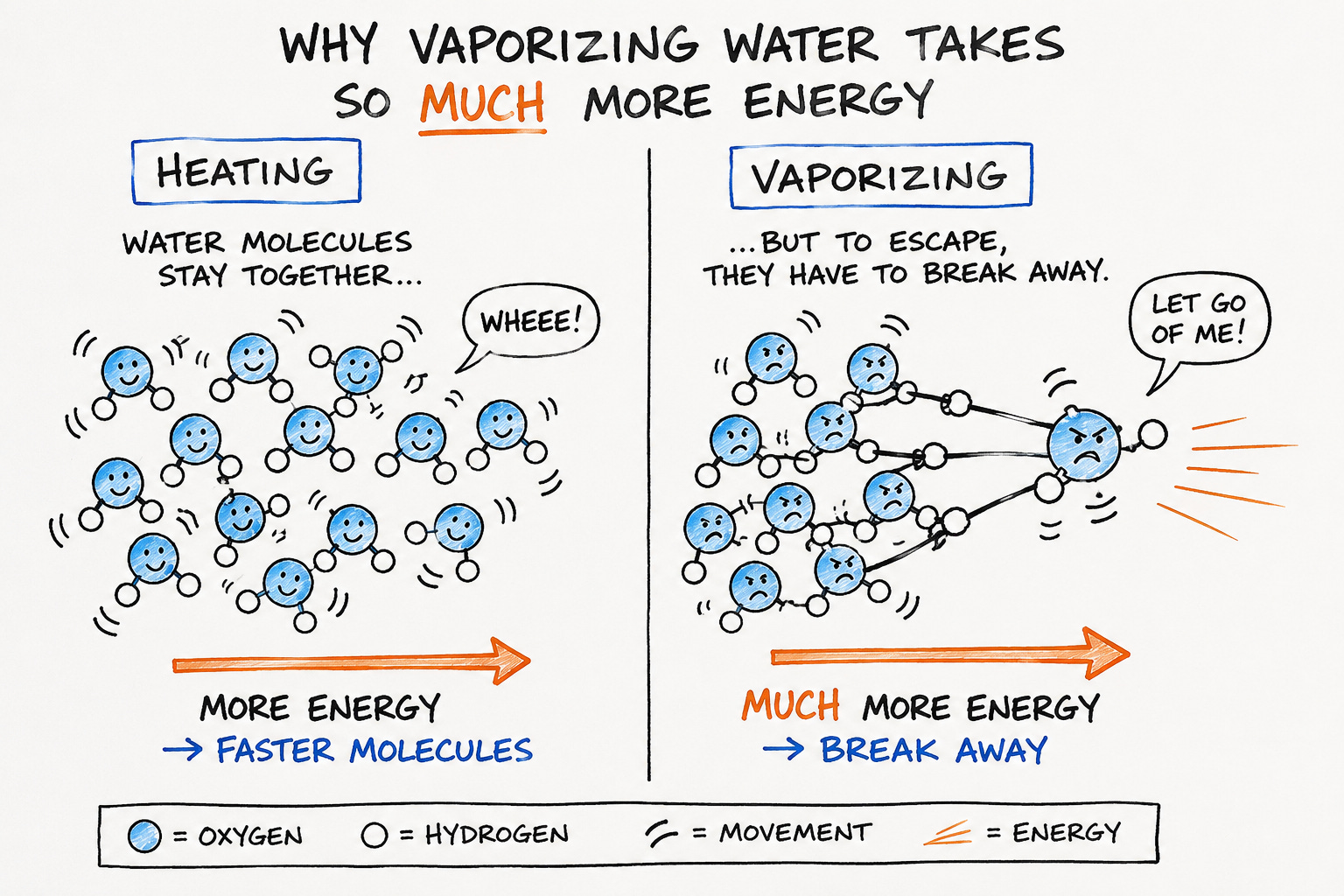
Think about what you need the water molecules to do. Before, you were adding energy to make them move faster. Now, you’re asking them to break away from their pals and fly off into the atmosphere, overcoming the attractions between them and pushing back the surrounding atmosphere.
That’s a much bigger ask. In Heat Wave’s case:
Q = (2.26 × 10⁶ J/kg)(1 × 109 kg)
Q = 2.26 × 10¹⁵ joules
Side note: There’s no value for temperature in this equation because there’s no temperature change. While a substance is vaporizing, the energy being dumped into it is used to overcome the attractions between its particles and separate them from one another. Heat’s still going in, but the temperature isn’t changing. It’s one of the things my students struggle with, too.
So how much energy does Heat Wave need in total to heat up and vaporize 1 billion kg of water? We add the two numbers together.
Qtotal = 3.35 × 10¹⁴ + 2.26 × 1015 = 2.6 × 10¹⁵ Joules
Or 2.6 petajoules.
That’s a lot of energy, but I know. That number means absolutely nothing to you.
Step Three: TNT!
When talking about energy, joules aren’t that helpful. We don’t run into them often. We could convert everything to calories and get another interesting number, but it still wouldn’t mean much. So let’s use something we’re all much better at understanding: explosions. Specifically, trinitrotoluene, better known as TNT.
1 kiloton (1,000 tons) of TNT releases the energy equivalent of 4.184 × 10¹² J when it explodes.
So, for our vaporized river…
(2.6 × 10¹⁵ J) ÷ (4.184 × 10¹² J/kiloton) = 620 kilotons of TNT
Just for comparison…
Hiroshima atomic bomb: about 15 kilotons of TNT
Nagasaki: 21 kilotons
Essentially, to vaporize 1 billion kg of water, Heat Wave has to dump the energy equivalent of about 40 Hiroshima bombs into the river.
Step Four: Electricity!
A simple idea as we go through this: energy is energy. It can take different forms, but it’s always energy.
It can’t be created or destroyed, only changed from one form into another. Some of that energy usually becomes less useful to us, often because it ends up dispersed as heat, but that’s another law of thermodynamics and not quite what we’re on about here. At least not yet.
I won’t go into the full conversion here, but joules can be converted to kilowatt-hours, the unit of energy we pay for on our electric bills each month.
It goes like this:
1 kWh = 3.6 × 10⁶ joules
So let’s convert the energy Heat Wave needs into kilowatt-hours.
2.6 × 10¹⁵ joules ÷ 3.6 × 10⁶ joules/kWh = 720 million kWh
or
720 gigawatt-hours.
That’s still a ridiculous number, but this one comes with a price tag.
Let’s say Heat Wave’s heat generators are plugged into the power grid. Not a great idea, but go with me here. As I mentioned earlier, kilowatt-hours are the unit we use to measure the electrical energy we buy from the power company. Think of them like gallons of gasoline. You pay for gas per gallon; you pay for electricity per kilowatt-hour used.
Heat Wave uses 720 million kilowatt-hours of electricity to vaporize a billion kilograms of river water.
Okay…
Let’s try this with a nice, round industrial electricity rate of $0.10 per kilowatt-hour. Hey, maybe Heat Wave knows someone at the power company and can get a good deal…
720,000,000 kilowatt-hours × $0.10/kWh = $72 million.
Okay, maybe he just plugged his heat rays into some nearby houses with extension cords. Residential electric rates are a little higher than industrial rates, because of course they are, so let’s say $0.18/kWh.
720,000,000 kilowatt-hours × $0.18/kWh = $130 million.
This assumes the heat rays are 100% efficient, that is, every joule of electricity is converted into heat in the river.
That’s not happening.
Some of that energy will heat the generators, the air, the riverbed, and pretty much everything else nearby, so the prices above are lowballing it. If Heat Wave is paying for electricity, his actual bill could easily run into the hundreds of millions of dollars.
In the final panel of the issue, Heat Wave is standing on the deck of what looks like a recovered ship, his foot resting on a chest full of—I guess?—treasure. It’s going to take a lot of treasure to achieve any reasonable ROI.
Okay, okay — he’s most likely not plugging the heat rays into the city’s power grid. Presumably, they have their own power source. Nuclear power is at the top of that list. Yeah, if we go down this road, Heat Wave brought six extremely unlicensed nuclear power systems into Central City and turned the dials to 11.
But wait — there’s more! How fast did Heat Wave do this?
Step Five: Power!
Power is the rate of change of energy per unit time. Energy tells us how much. Power tells us how fast.
The formula for power looks like this:
Power = energy ÷ time
When energy is measured in joules and time in seconds, the answer comes out in watts.
I know we were talking about kilowatt-hours above, but now we’re asking a different question. Before, we wanted to know how much energy Heat Wave needed. Now we want to know how quickly he delivered it. The same amount of energy delivered over an hour and delivered in 30 seconds is still the same amount of energy. But the second one requires vastly more power.
Let’s say it took Heat Wave 30 seconds to vaporize one billion kilograms of river water. I’m guessing here, but the comic certainly doesn’t make it look like he spent the afternoon doing this.
That would look like this:
Power = 2.6 × 10¹⁵ joules ÷ 30 seconds
Power = 8.7 × 10¹³ watts
or
87 terawatts.
I know. We’ve got another ridiculous number that means almost nothing on its own. Let’s put it into context. In 2025, the entire world used 31,779 terawatt-hours of electricity. Spread across the year, that means the entire world was using electricity at an average rate of about 3.63 terawatts at any given moment.
Heat Wave’s generators would need to produce 87 terawatts—about 24 times the average electrical power being used by the entire world.
For 30 seconds.
And that’s just to clear the river once. Even in comics, rivers keep flowing.
That treasure really better be worth it.
Step Six: Rivers Are Gonna…River?
The first billion kilograms of water was just the cover charge.
Once the riverbed is exposed, Heat Wave has to keep paying. He has to keep vaporizing water.
I’m going to try and keep this short, but Heat Wave needs to do three things:
Vaporize ‘a section’ of the river — which has already required a lot of energy.
Hold back vertical walls of water without a dam. And I don’t see Moses.
Continuously vaporize new water flowing in from upstream
We’ve handled #1; let’s skip #2 for a second and deal with #3.
I’m not budging on this one — he has to be continuously vaporizing the water; otherwise, it would pile up and flood the downtown (and flow around the wall, filling the exposed area again).
So while we’re working out an energy budget, let’s add what it would take to keep vaporizing water as it flows into the exposed riverbed.
A ballpark flow rate for a large river — let’s go with about 1,000 m³ of water per second.
Each cubic meter of water has a mass of 1,000 kg, so:
1000 m3/second × 1,000 kg/m3 = 1,000,000 kg/s
That’s one million kilograms of water per second that needs to be vaporized to keep the exposed area water-free.
To vaporize incoming water continuously, Heat Wave would need:
1,000,000 kg/s × 2.6 × 10⁶ J/kg = 2.6 × 10¹² joules/second
Since J/s = watts, that’s 2.6 terawatts.
So even after the initial blast, Heat Wave needs roughly 2.6 TW of continuous power to keep the river from refilling. That’s about 70% of the entire world’s average electrical power consumption in 2025.
And again, that still doesn’t explain #2 — the water walls.
Maybe he’s vaporizing the water right where it flows into the exposed area, creating the appearance of a vertical wall of water? But that surface would look like the top of a violently boiling pot, not a clean wall of water.
In the panel, the river appears to stop at the edges of the exposed riverbed, standing there like it got a polite note from management.
That is not how liquids behave.
But given that this is how the water is behaving—and given that Flash is standing inside the water wall (above) without being boiled alive—I’m willing to budge on #2 and let the wall go. It’s some kind of force-field magic.
But the other stuff? Where there’s steam, there’s heat. Heat Wave says it’s heat. So the missing billion kilograms of water? That was vaporized.
And somehow the upstream flow of the river is being stopped, so continuous vaporization isn’t off the table entirely.
A Quick Weather Forecast…
So far, this has all been about energy. The thing is, energy—and water—in the atmosphere are what drive weather.
You can probably see where this is going.
Again, with the caveat: “If this took place in our universe…”
Let’s run the meteorological numbers:
One billion kilograms of water is on the order of the amount of water contained in a large thunderstorm. Heat Wave effectively put an entire thunderstorm’s worth of water into the atmosphere over Central City instantly.
The air around the river would become extremely warm and saturated with water vapor. That heat and humidity are extremely dangerous to anyone exposed to them (see my pal Joe Hanson explain it over here), but let’s worry about the weather. As shown in the art, dense clouds will form almost immediately.
(Technically, the white stuff we can see isn’t water vapor. Water vapor is invisible. Those clouds are tiny liquid water droplets that have already condensed.)
But that enormous mass of hot, moist air isn’t going to politely hug the ground and turn Central City into Jack the Ripper’s foggy London.Turning liquid water into vapor takes in heat, but turning vapor back into liquid water releases heat. How much heat? Well, it took 2.26 petajoules to change that boiling water into vapor, so up to 2.26 petajoules of latent heat can be released as that vapor condenses.
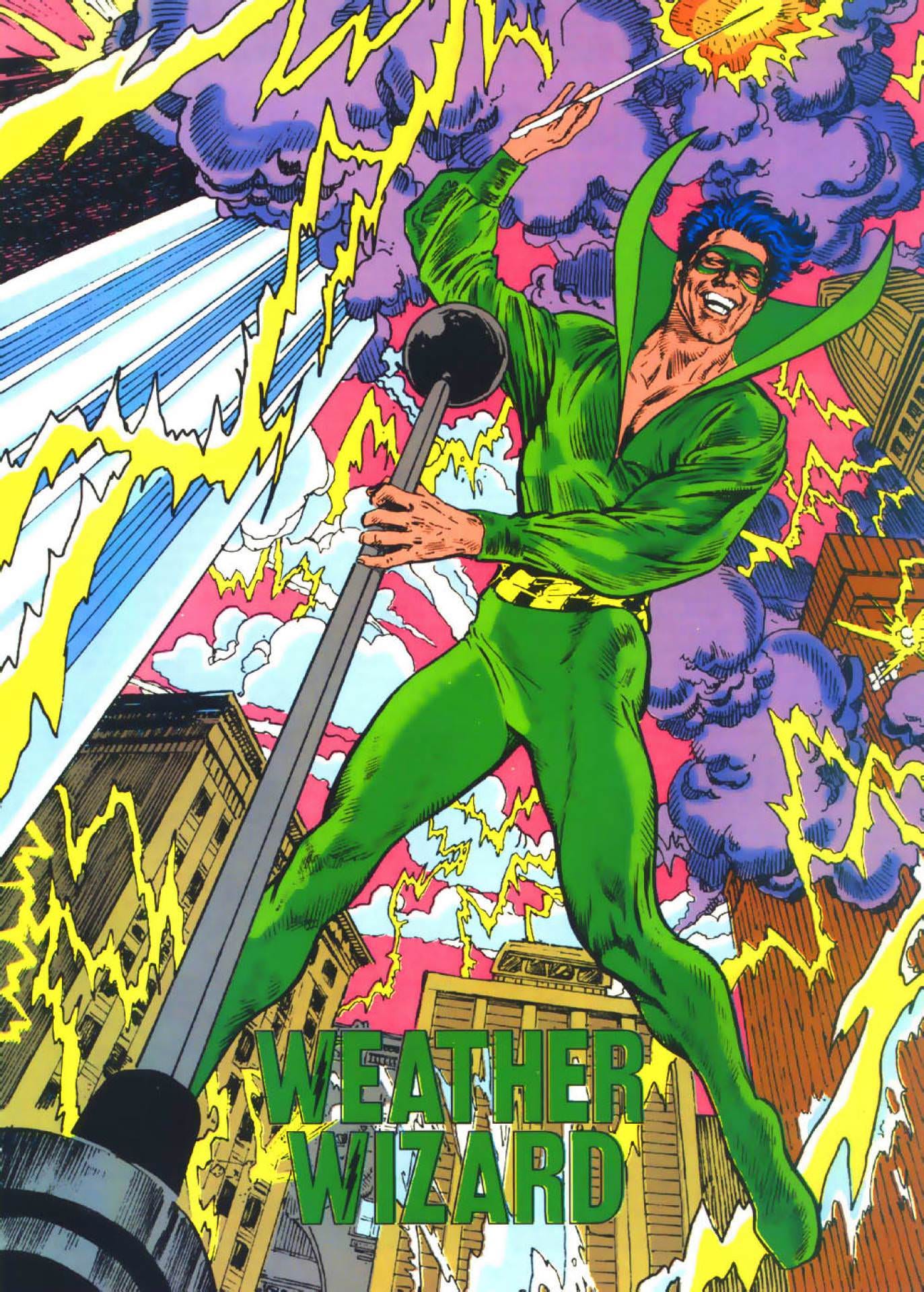
That is an enormous amount of energy being released into the atmosphere, and it would drive powerful convection. So yeah—given a reasonably unstable atmosphere, Heat Wave may have just whipped up a massive thunderstorm from scratch, which means he’s stomping all over the territory of this fellow Rogue:
But we’re not done with this just yet.
The enormous mass of hot, moist air would be highly buoyant and rise rapidly. In weather-ese, those are called updrafts. Any planes trying to fly through that rapidly developing convection would have a very bad day. How high would it go? That depends on the atmosphere over Central City that day. But a powerful thunderstorm can reach the upper troposphere and, in extreme cases, push against or even briefly overshoot the tropopause.
Yeah. We’re cooking up some sweet weather now.As the rising air cools and water vapor condenses, clouds form, and precipitation begins. Given the sheer amount of water available, the rainfall could be easily described as torrential. If the storm develops strong enough updrafts to carry water above the freezing level and keep hailstones aloft, hail becomes possible, too.
Heat Wave put a chunk of the river’s water into the atmosphere. Now some of it is coming back down on Central City.And then, quite possibly, the lightning. Oh, there could be a lot of lightning.
And shockwaves. All of that newly heated water vapor and hot air has to go somewhere, and initially, it would push the surrounding atmosphere out of its way. As that enormous mass of hot, moist air rises, surrounding air would flow in underneath it to replace it. Later, rain-cooled air could come crashing back down as powerful downdrafts, spreading outward when it hits the ground as a gust front. So now we’ve potentially got torrential rain, strong winds, lightning, and maybe hail.
Heat Wave wanted to empty a river. He made weather.
But…In the End…
Of course, we don’t see any of this happen.
We don’t see the massive thunderstorm. We don’t see the river immediately trying to refill itself. We don’t see Central City dealing with 2.6 petajoules of heat dumped into a billion kilograms of water.
And Flash is standing inside a vertical wall of water that should be boiling, so clearly, something else is going on here.
Which is fine.
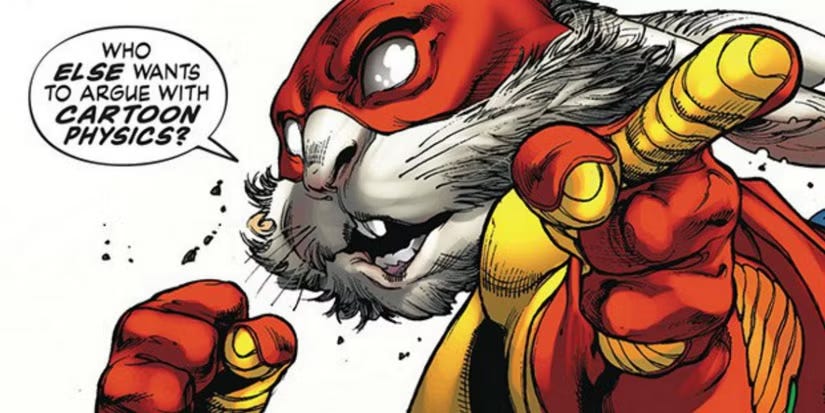
The Flash operates under a different set of physics. We’ve known that for a long time. There’s the Speed Force, after all. Maybe Heat Wave has found the Heat Force (Heat Force, © Matt Brady, 2026, in case he hasn’t). I don’t know. I don’t make the rules.
And really, I think our boy Captain Carrot said it best:
One final disclaimer: Since the relaunch of The Science Of… here on Substack, I’ve written a lot about Ryan North’s comics. I would like to take this opportunity to state for the record that I am not stalking Ryan North (that he knows about), nor am I Ryan’s secret child (I’m older than him), nor is he my son (he’s Canadian—not that there’s anything wrong with that - little jelly about that these days, actually).
I love the big science ideas or tidbits Ryan always puts in his stories.
They make me feel like a kid reading comics again—I’m excited, curious, and wondering about the story and ideas. It’s a good thing.
Ryan, this should make your lawyers happy, right?
Curiosity is what brought me here.
Teaching is what I do with it.
If you’d like to read more about education, classrooms, students, and the craft of teaching, you’ll find those stories in Teacher, Teacher.